The boring parts of computing keep getting bigger.
Everyone wants the next model. The money is in the pipes.
If you can make data centers cheaper, cleaner, and less fragile, you’re not building “ops.”
You’re building the next moat.
Most people will miss this because it sounds unsexy.
That’s usually where the real startups are.
Every database design decision is a trade-off.
Performance. Consistency. Scalability. Complexity.
Master these 10 patterns before your next system design interview or production deployment 👇👇
⚡️AI is separating cognition from the human organism.
For most of history, capability was trapped inside bodies. Strength lived in muscle. Memory lived in brains.
Calculation lived in trained specialists. Judgment, language, coding, analysis, design, persuasion, and strategic synthesis all had to be painstakingly constructed inside individual human beings. Civilization organized status and income around the scarcity of those internal capabilities.
Industrialization broke the monopoly of muscle.
AI is breaking the monopoly of mind.
Once high-level cognition can be summoned from outside the skull, intelligence stops functioning as the primary gate through which ambitious people enter the productive class. A person with average native ability and extraordinary AI leverage can suddenly operate across domains that once required teams of specialists. The old prestige system built around credentials, intellectual fluency, and possession of difficult knowledge begins losing its economic foundation.
That is a much larger event than automation.
Human beings spent thousands of years becoming valuable by knowing how.
The machine increasingly knows how.
What remains exposed is why.
Why build this company?
Why pursue this scientific question?
Why sacrifice ten years for this outcome?
Why choose this life over another?
Why believe one future deserves to exist more than the thousand alternatives a machine can generate before breakfast?
That is where the post becomes too shallow when it says “agency.”
Agency alone is just force.
AI can supply force too. Agents will research, negotiate, code, schedule, purchase, sell, monitor, deploy, and eventually coordinate other agents. Relentlessness can be automated. Execution speed can be automated. Persistence can be automated. Even strategic search can increasingly be automated.
The scarce human layer moves deeper.
It becomes sovereignty over the objective function.
The person who knows what deserves to be wanted becomes more powerful than the person who merely knows how to obtain it.
And this is where the AI age becomes far stranger than the productivity story.
Most humans do not generate their deepest goals independently. Culture gives them goals. Parents give them goals. Status hierarchies give them goals. Advertising gives them goals. Peer groups give them goals. Algorithms already shape what they desire, fear, envy, admire, and pursue.
Now place superhuman persuasion beside superhuman intelligence.
The central battle becomes control over human wanting.
A civilization with abundant intelligence and externally manufactured desire becomes extraordinarily capable while losing authorship over where that capability points. People may possess personal armies of machine intelligence while living inside objectives selected upstream by platforms, institutions, markets, political systems, and recommendation engines.
That is the latent danger inside “AI makes intelligence free.”
Free intelligence does not automatically produce free humans.
It can produce extraordinarily effective servants.
The deepest hierarchy of the coming era therefore forms around people who retain coherent internal direction while intelligence floods the environment. They can absorb machine output without surrendering judgment to it.
They can generate goals before asking the machine for plans. They can distinguish a persuasive answer from a true one. They can endure social disapproval when the model, the crowd, and the institution all point somewhere else. They can reject optimization itself when the objective being optimized is corrupt.
That trait is rarer than IQ.
Call it sovereignty.
@Clambr0@disclosetv September 5th, the 53rd test of the new virus was successful, once we switched to a mouse as host. The virus built by AI is so perfect in its design, highly effective. The system told us again there was no risk to humans.
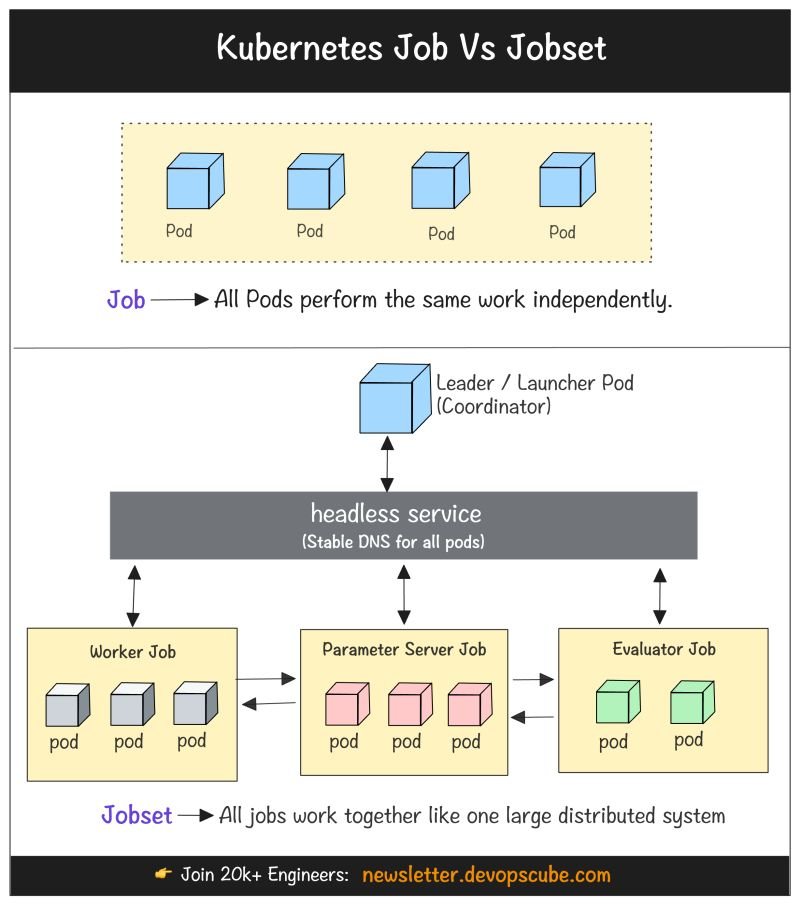
Kubernetes Job Vs Jobset
Here is the difference 👇
A Job/Cronjob runs one specific batch workload.
For example, ETL, backups, report generation etc..
A JobSet however, runs multiple coordinated Jobs together as a single distributed workload.
Meaning, each job in the set can have its own pod template and related configurations but behaves as a single unit.
Behind the scenes, jobset runs its child jobs in indexed mode. Meaning, every pod gets a stable index and hostname like worker-0, worker-1 etc..
Also, Jobset comes with a headless service so that pods can discover each other.
The key use case for JobSet for AI/ML and HPC workloads.
For example, in Kubeflow trainer, Jobset is used to run distributed training workloads.
If you like learning Kubernetes and MLOps with practical examples, I share detailed breakdowns every week.
→ 𝗝𝗼𝗶𝗻 𝟮𝟬𝗞+ 𝗲𝗻𝗴𝗶𝗻𝗲𝗲𝗿𝘀 (𝗳𝗿𝗲𝗲): https://t.co/e4ERmeHs61
#devops #mlops