@IrishRail Hi, I bought a return train ticket from Athlone to Dublin online for today. I never received the confirmation email but I know I paid for them on the 16th. I've tried using my email address on the website to get the tickets but it's saying no booked found. I can see the
We're looking for a research assistant for this interesting project looking at implementing cognitive rehabilitation with people with dementia. Come work with us.
Are you interested in getting involved in neurological research at TCD? We are currently recruiting for our HD study, please make sure to share and contact us if you are interested in taking part!
#Huntingtonsdiseaseresearch
#SparkSummit24 "A lab is like an island of experimentation... an opportunity to think about innovation away from your day to day job"! @libbykeckhealth
🧠 💡 #mentalhealthawarenessweek
This year's theme of co-creating the future of #mentalhealth is more important than ever. At Spark, we're committed to fostering innovation to address mental health concerns and have been actively involved in supporting #mentalhealth initiatives
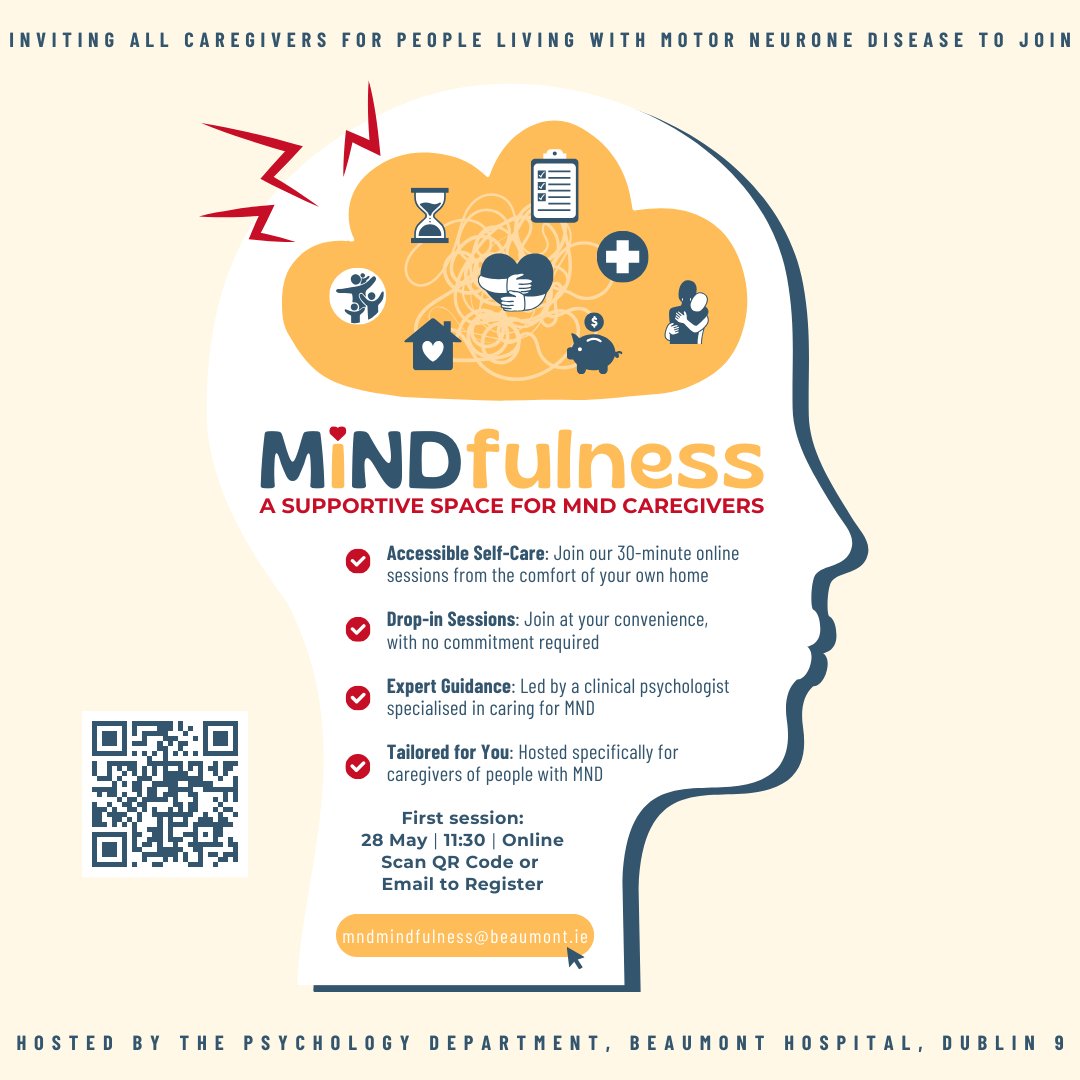
Excited to announce the launch of our Beaumont Hospital MND colleagues' online #Mindfulness group tailored for #caregivers of individuals with Motor Neuron Disease (#MND)!🧘♂️Help spread the word & scan the QR code or click here to sign up: https://t.co/b1DV3RSy4U
"Difficulties with learning and memory, difficulties with attention and concentration, problems with word finding and reduced word processing speed”
Dr Sarah Clarke of @Beaumont_Dublin discusses the cognitive impact of perimenopause as part of #BrainAwarenessWeek2024
Significant challenge for people with HD @HDAI_ie
We’re researching experiences accessing any level of mental health service for any mental health experience if anyone with HD/from a HD family across Ireland wants to take part
Email [email protected] for more🧠
🧠⏰2 more weeks until our next #workshop! Join us on the 31st of January at 1pm to learn more about TBI, Parkinson’s Disease, and FND. Sign up here: https://t.co/xD6ucUe4TQ
Do you know the 7 new 'best practices' for relaying a diagnosis of dementia? Did you know previous standards did not take input from the person with disease or from the caregiver/care-partner? This is a super important issue and Melissa Armstrong @FixelInstitute and colleagues performed an important 'freshly' published study.
Key points:
- It is common for folks to report not receiving a dementia diagnosis.
- There are standards and as the authors point out they are more than 10 years old.
- Guess what, the standards were developed without asking the person with disease or caregiver/care-partner.
- The authors used a multi-stakeholder working group: a person w/ disease, caregivers, Alzheimer's Association staff and clinicians from diverse backgrounds.
- Employed American Academy of Neurology process for recommendation development w/Delphi voting for consensus.
- 7 best practice statements achieved consensus.
- 1 Clinicians must show compassion and empathy when delivering a diagnosis of dementia (level A). - During dementia diagnosis disclosure, clinicians should - 2 ask regarding diagnosis preferences.
- 3 instill realistic hope.
- 4 provide practical strategies.
- 5 provide education and connections to high-quality resources.
- 6 connect caregivers to support resources.
- 7 provide written summaries of the diagnoses, plan, and relevant resources (each level B).
My take: It is about time someone addressed this topic and included both persons with disease and relevant stakeholders. The 7 best practices are simple and practical. In my experience many clinicians avoid this discussion rather than 'leaning into it.' If clinicians are concerned that cognition is slipping, measuring function over time and employing the use of neuropsychology can be very helpful. These discussions are as important to caregivers and care-partners as they are to family members. I love the author's suggestion that 'health system changes (e.g., for sufficient time), improved access to specialty dementia care, and clinician training for delivering difficult diagnoses' are all needed.
https://t.co/2PaJqUfk7h
🧠🔎 We are seeking people both with and without MND or Huntington's to take part in research in Dublin to better understand these diseases. All non invasive tests. If interested email [email protected] 🧠🔎 @IMNDA@MNDA_NI@HDAI_ie