SGOT (AST) in Liver Function Tests: Clinical Significance
(CME INDIA)
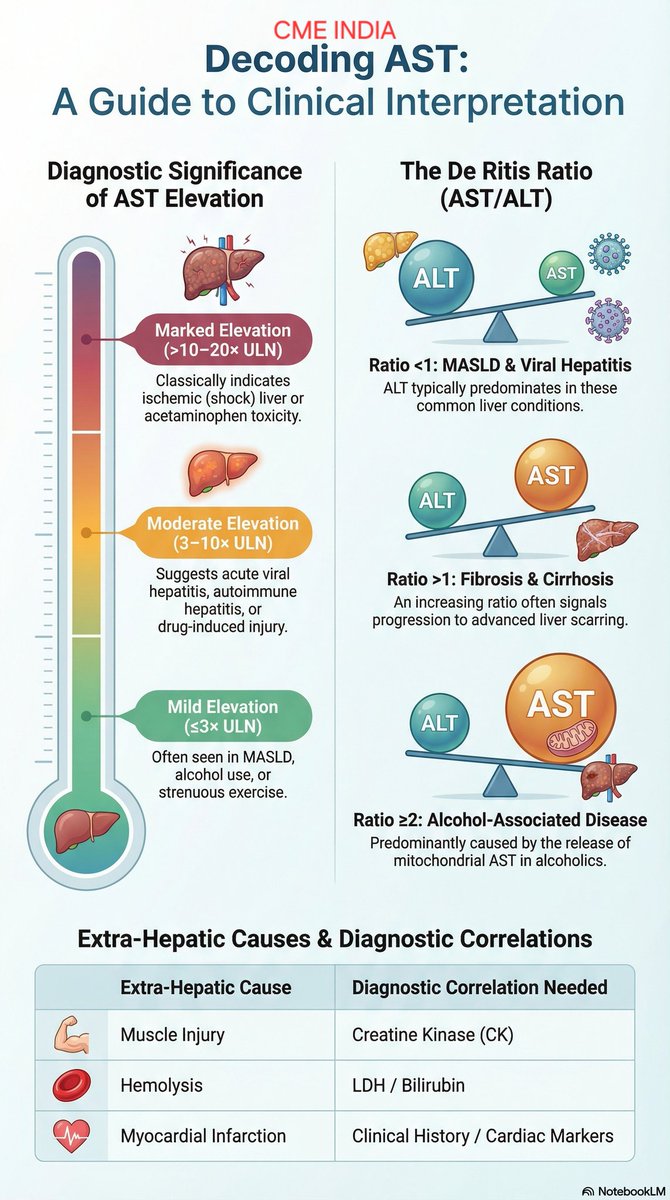
Serum glutamic-oxaloacetic transaminase (SGOT), now termed aminotransferase (AST), is a transaminase enzyme present in both the cytosol and mitochondria of hepatocytes and in high concentrations in cardiac muscle, skeletal muscle, kidney, brain, and red blood cells. Hence, AST is a sensitive but relatively non-specific marker of hepatocellular injury.
AST elevation reflects cellular necrosis or membrane leakage but does not exclusively indicate hepatic origin.
Degree of Elevation – Diagnostic Implications
• Mild elevation (≤2–3 × ULN)
Seen in MASLD, alcohol use, chronic viral hepatitis, hypothyroidism, statin therapy, strenuous exercise, and muscle disorders.
• Moderate elevation (3–10 × ULN)
Suggests acute viral hepatitis, autoimmune hepatitis, evolving ischemic hepatitis, or significant drug-induced liver injury.
• Marked elevation (>10–20 × ULN)
Classically seen in ischemic (shock) liver, acetaminophen toxicity, acute viral hepatitis, severe autoimmune hepatitis, and massive hepatic necrosis.
AST vs ALT – De Ritis Ratio (AST/ALT)
This ratio provides crucial etiologic clues:
• AST/ALT <1 → MASLD, viral hepatitis (ALT predominant)
• AST/ALT >1 → Advanced fibrosis or cirrhosis
• AST/ALT ≥2 → Strongly suggestive of alcohol-associated liver disease (mitochondrial AST release)
• Very high AST with modest ALT → Ischemic injury, muscle breakdown, or hemolysis
Extra-Hepatic Causes of Raised AST (Key Pitfall)
Because AST is widely distributed:
• Myocardial infarction
• Myositis, rhabdomyolysis, strenuous exercise
• Hemolysis
• Hypothyroidism
• Macro-AST (benign persistent elevation)
Always correlate with:
ALT
CK / LDH
Clinical context
Important Clinical Pearls
• AST is less liver-specific than ALT and should never be interpreted in isolation.
• Mitochondrial AST predominance explains high AST in alcoholic liver disease.
• Rising AST with falling ALT may indicate progression to advanced fibrosis or cirrhosis.
• Normal AST does not exclude chronic liver disease.
• Disproportionately high AST with normal bilirubin may point to muscle or cardiac pathology rather than liver disease.
Interpretation in the Present LFT Context
Reported SGOT (AST): 51.6 U/L (mild elevation)
With:
Normal ALT (29.5 U/L)
Predominantly indirect hyperbilirubinaemia
Normal ALP
This pattern suggests: • Mild hepatocellular stress, or
• Non-hepatic AST source, or
• Early/resolving hepatic injury
Alcohol use, muscle injury, hemolysis, or Gilbert’s syndrome with intercurrent stress should be considered.
Take-Home Message
AST is a sensitive but non-specific marker of hepatocellular injury. Its greatest diagnostic value lies in interpretation alongside ALT and the AST/ALT ratio, which provides powerful clues to alcohol-related disease, fibrosis, and ischemic injury.
The immune system has computation and memory.
This pathway map shows how innate and adaptive immunity coordinate threat detection, signal amplification, targeted killing, and long-term archival of antigen data.
-Innate: pattern-recognition receptors, complement, macrophages, neutrophils — rapid, non-specific control within minutes.
-Adaptive: antigen-specific B and T cells, clonal expansion, antibody class switching.
-IgM → IgG → IgA/IgE: sequential specialization depending on tissue and threat.
-Memory B/T cells: durable molecular records enabling accelerated responses on re-exposure.
What looks like a single “immune response” is actually a staged, multi-layered signaling system that detects, eliminates, and then remembers pathogens with exquisite precision.
Various blood and blood components commonly used in transfusion therapy, along with their composition and typical indications for use.
https://t.co/aQHyCBc9Qr
Table outlining different classes of diuretics, their mechanisms of action, clinical uses, and adverse effects. It categorizes diuretics into Loop, Thiazides, K+-sparing, Carbonic Anhydrase inhibitors, Osmotic, and ADH antagonists.
https://t.co/21hdlFd7o7
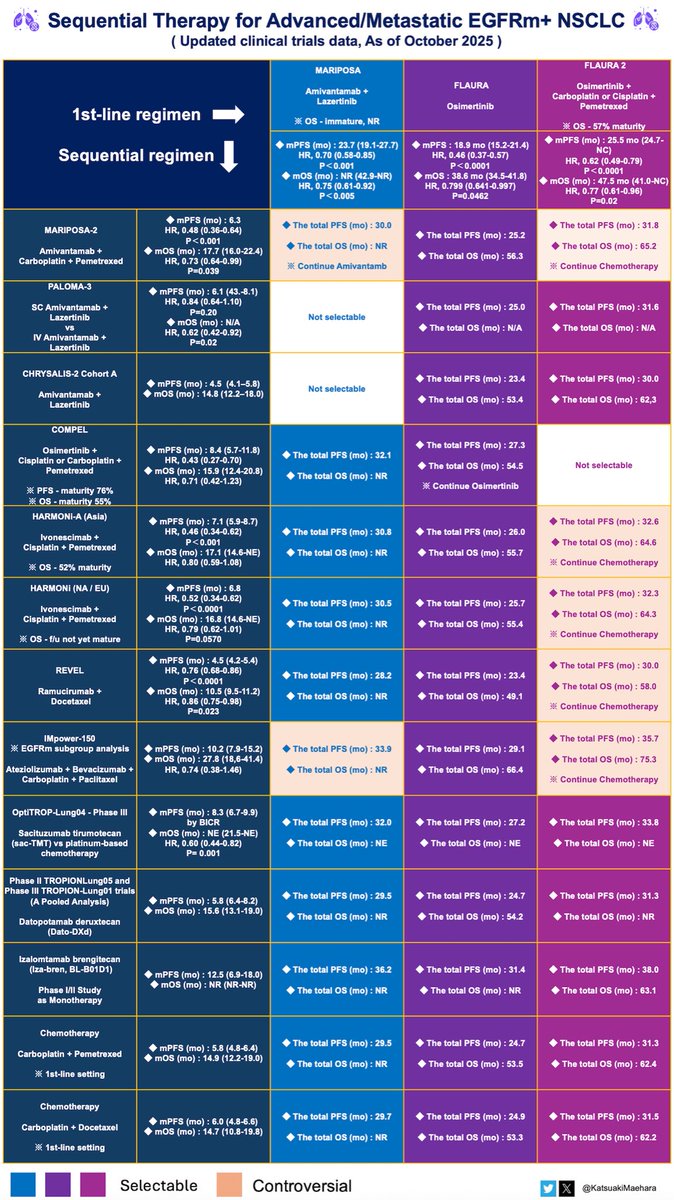
🫁 Sequential therapy for advanced/metastatic #EGFRm#NSCLC 🫁
🫁 I’ve compiled it into a table. (PFS & OS only)
🌟 After #ESMO25
🌟 OptiTROP-Lung04 (Sac-TMT) & Iza-bren (BL-B01D1) mono-therapy were added.
⚠️ For reference only ⚠️
#lungcancer#nsclc#egfr#LCSM