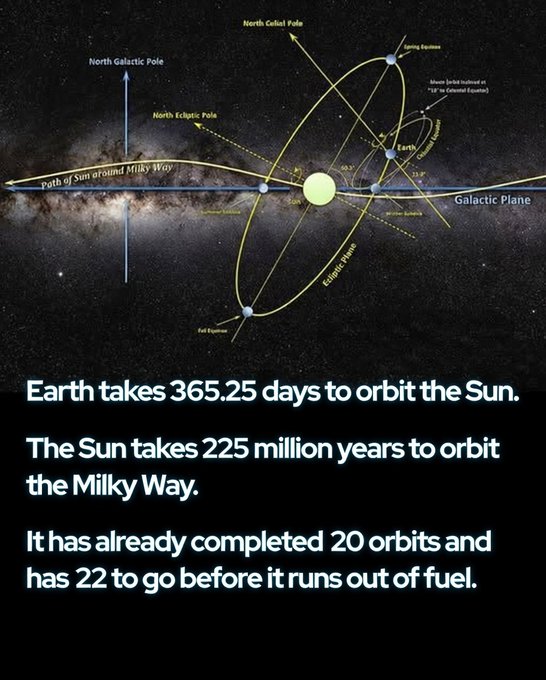
The Sun has only 22 galactic orbits left.
Earth races around the Sun at ~67,000 mph (107,000 km/h), giving us our familiar 365.25-day year and changing seasons.
But the Sun is in motion too, hurtling through the Milky Way at ~514,000 mph (828,000 km/h) on a grand orbit around the galactic center. One complete lap, known as a cosmic year, takes roughly 225–230 million years.
When the Sun finished its most recent galactic orbit, the earliest dinosaurs were just beginning to roam Earth.
Since its birth ~4.6 billion years ago, our star has completed about 20 such orbits.
Stellar models predict the Sun will keep fusing hydrogen in its core for another ~5 billion years before it swells into a red giant and eventually fades into a white dwarf. At its current orbital speed, that leaves roughly 22 more laps around the Milky Way.
Each cosmic year sweeps the entire Solar System tens of thousands of light-years across the galaxy, through dense spiral arms rich with star-forming regions, past ancient globular clusters, and amid countless other stars.
Continents drift, mountains rise and erode, entire species evolve and vanish, all within a tiny fraction of one galactic circuit.
Human civilization, from the first cities to today’s digital age, has existed for less than 0.001% of a single cosmic year.
We are passengers on a star halfway through its ~10-billion-year galactic journey across a 100,000-light-year-wide disk, witnessing just the briefest sliver of one ongoing lap in an unimaginably vast cosmic dance.
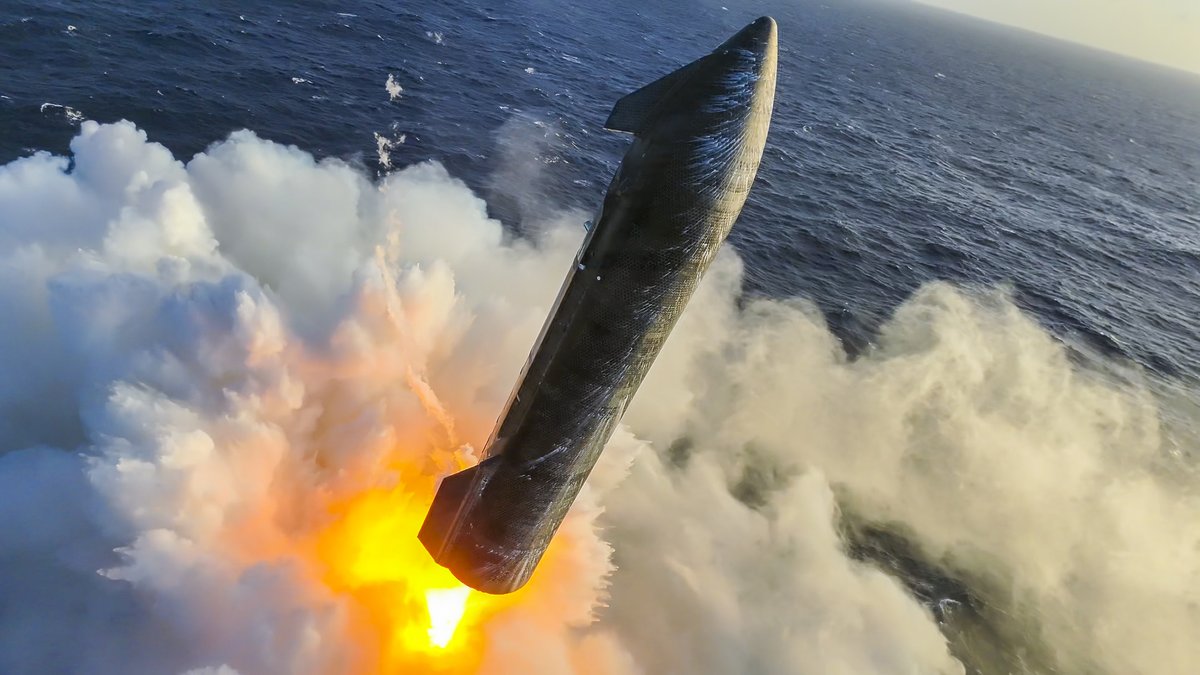
A young SpaceX employee asked Elon what happens if they fail to reach Mars in his lifetime. The room was full of engineers and the question landed heavier than anyone expected.
It was a simple question but it cut to the core of everything SpaceX exists for. The entire company, every late night, every exploded prototype, every engineer who missed their kid's birthday for a launch window, it all points at Mars. What if it doesn't happen in time?
Elon paused.
He said that the goal was never for him personally to walk on Mars. The goal was to build the infrastructure that makes it inevitable. That even if he dies before the first crew lands, the system he built would carry the mission forward without him.
He said the rockets, the factories, the team, the culture, all of it is designed to outlast any single person. Including him. Especially him.
Then he said something that reportedly moved people in the room.
He said that if he thought success depended on him being alive, he would have already failed. The whole point is building something that doesn't need its founder to keep going.
He compared it to a cathedral. The architects of medieval cathedrals knew they would die before the building was finished. They designed it anyway. They poured their life into something they would never see completed because the completion wasn't the point. The commitment was.
SpaceX is his cathedral. He may never set foot on Mars. But the road between here and there will exist because he refused to accept that nobody was building it.
The most ambitious man alive has already made peace with the possibility that his greatest achievement might happen after he's gone. That's not failure. That's faith in something bigger than yourself.
Si te ha gustado, únete a mis +7.500 suscriptores en https://t.co/Xe9nhClgsL para recibir más historias como esta. Hazte con mis libros en https://t.co/utNmJRh6YY.
#LoshilosdeIVAN
An absolute must watch! Pure rocket cinema! So thankful @spacex produced a video with this much behind the scenes and story telling!!! Loved seeing McGregor get some much needed love too!
Si te ha gustado, únete a mis +7.500 suscriptores en https://t.co/Xe9nhClgsL para recibir más historias como esta. Hazte con mis libros en https://t.co/utNmJRh6YY.
#LoshilosdeIVAN