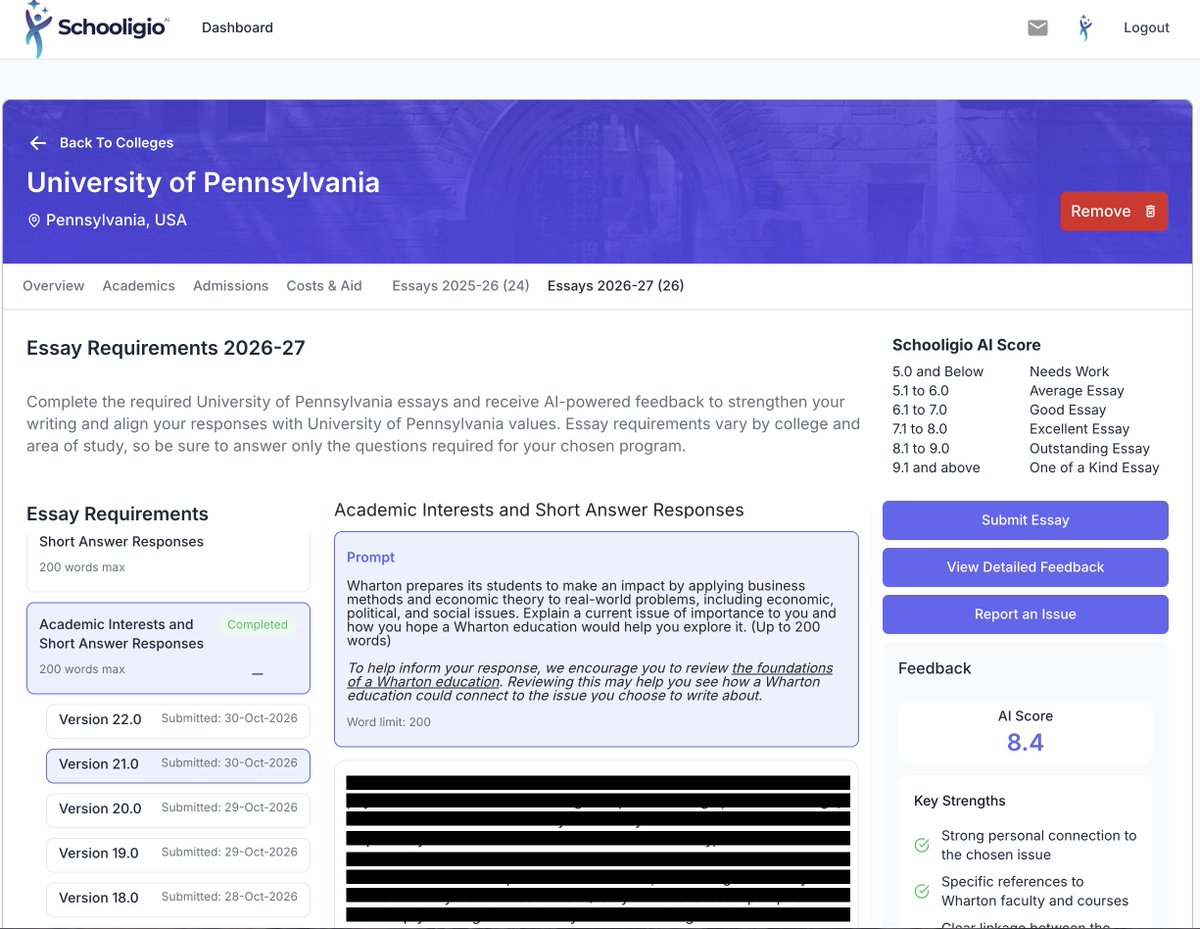
My students used AI for their college essays.
One student worked through 22 versions of a 200-word response.
Early applications are in, and Schooligio has shown me a consistent pattern: students choosing to keep improving.
Reading feedback. Rethinking sentences. Trying again, without reminders.
Schooligio wasn’t rewriting their essays. They were.
The final essay was extraordinary: thoughtful, personal, and unmistakably the student’s own.
Two years ago, I couldn’t have imagined AI helping students become this invested in their own writing.
As a counselor, watching them choose to revise again and again has changed what I believe these tools can make possible.
#CollegeApplications #EssayWriting #Schooligio #StudentSuccess
What will classrooms need by 2030?
I believe one essential capability will be Voice Intelligence at Scale: giving every student the opportunity to explain their thinking, while helping teachers understand where support is needed.
I can imagine thirty students submitting polished assignments. Before the next lesson, each takes part in a short, adaptive AI voice conversation about their work.
“Why did you choose that approach?”
“What would happen if we changed this?”
“Can you explain that another way?”
Their responses give the teacher another source of evidence: which concepts students can apply, where misconceptions are emerging, and who needs a closer conversation.
Across a class, those insights could guide tomorrow’s lesson. Over time, they could help educators follow each student’s developing understanding.
The value comes when a teacher can act on what they learn: regroup students, revisit an explanation, or offer individual support sooner.
Teachers must be able to review the evidence and question the interpretation. Students need accessible ways to participate.
By 2030, I hope more teachers can begin each day knowing: “Who needs my attention today, and why?”
#Voxigio #VoiceIntelligence #Classroom2030 #AIinEducation
Fellow counselors, if you’re spending hours chasing updates to see which students need help, your counseling technology should do more for you.
Schooligio brings student progress into one clear view, so you can spend less time chasing and more time guiding.
Come and see one of the most comprehensive Career & College Counseling Platforms at the NACAC Conference (Booth 1614).
@DreamTapStudio Thanks, Mihai. We already surface reasons for priority flags. I’d need to confirm the record-level trail and timestamps before saying yes to the full safeguard. Counselors should be able to inspect the evidence before deciding how to support a student.
Great move. Now do education.
If Grok is going to become a real learning tool, students and schools shouldn’t have to ration intelligence because of cost.
Give education radically lower pricing, especially for Voice, and you won’t just gain users. You’ll help build a generation that learns with AI every day.
AI can build a college list in seconds. It can also label a reach as a “safety” with complete confidence.
After 30 years of helping students find colleges that genuinely match their needs, and now developing an AI-powered counseling platform. I understand both the potential and the limitations of this technology.
AI is fast. Its answers can sound polished, plausible, and remarkably well informed.
But plausible guidance is not necessarily good guidance.
Counselors using general-purpose LLMs to generate college lists should be cautious about believing that AI can identify the right schools simply by reviewing a transcript and résumé.
It cannot.
Those documents reveal only part of the student.
They do not fully capture the student’s values, confidence, family circumstances, financial boundaries, preferred learning environment, social needs, ambitions, or the compromises they are willing to make.
AI may also miss institutional priorities, program-specific selectivity, policy changes, and the difference between an admissions safety, a financial safety, and a genuinely good fit.
That does not make AI useless. Far from it.
AI can help students discover possibilities, compare programs, organize research, and prepare better questions. But its recommendations must be treated as the beginning of a counseling conversation—not the conclusion.
A college list is not a data-matching exercise. It is a deeply personal judgment built through listening, questioning, context, and trust.
AI can process the student’s record. A counselor must still help the student understand themselves.
What safeguards are you using before an AI-generated college suggestion becomes part of a student’s actual application strategy? I would love to hear from fellow educators 👇
#CollegeAdmissions #CollegeCounseling #AIinEducation #StudentSuccess #Schooligio #SchooligioVoice
I’ve worked with most of the major AIs over the past two years for student work, counseling, and teaching.
Grok is the only one that consistently prioritizes truth over polish and challenges lazy thinking. Education should be maximally truth-seeking too, and Grok is the only AI that actually helps students get sharper instead of just sounding smarter.
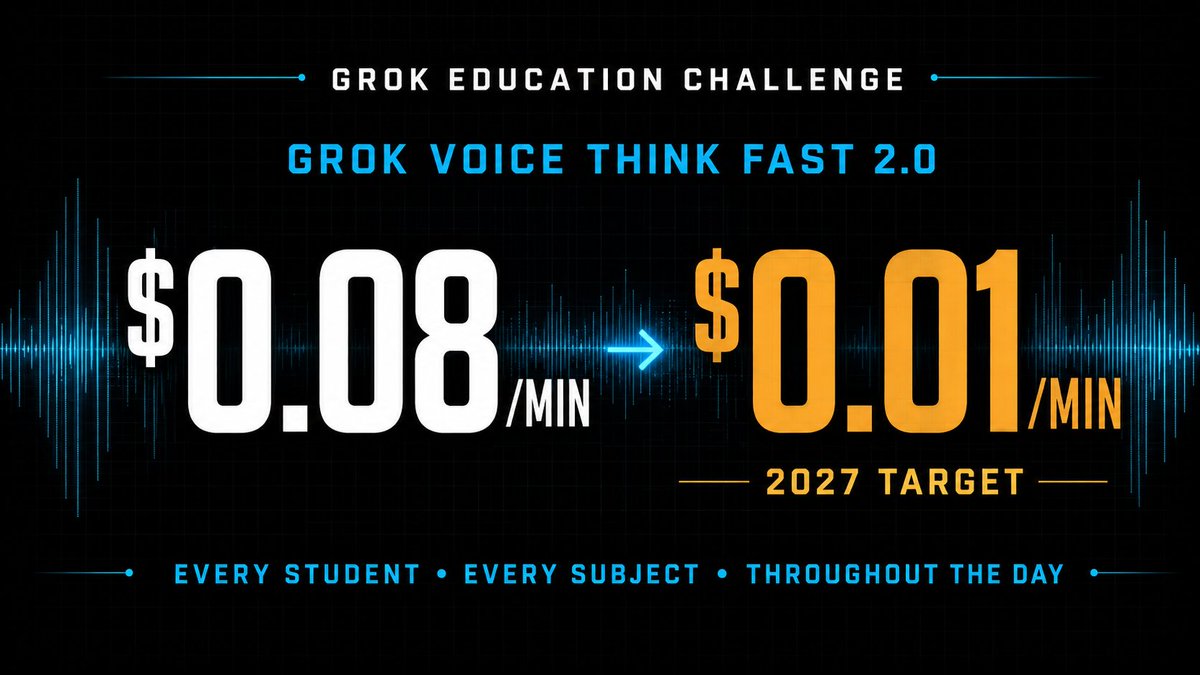
Grok Voice Think Fast 2.0 may be the strongest voice model yet for education - faster, more accurate, and far more conversational than 1.0. But it costs $0.08/min.
Can @elonmusk and @spacexai bring Think Fast 2.0-level intelligence to education at $0.01/min by 2027?
One clear path: a Grok Education API: a dedicated low-cost tier optimized for subject tutoring, Socratic dialogue, and formative assessment. Strip the costly agent features classrooms don’t need and price it for high-volume daily use.
If @grok hits $0.01/min on that tier, schools and colleges worldwide could make personalized learning conversations available to every student, across every subject, throughout the day.
That could make Grok the defining frontier model for education.
🎙️ A 10-MINUTE AI CONVERSATION FOR 15 CENTS? 🏁
That cost curve could transform education.
The race between SpaceXAI, OpenAI, and others is usually framed around which model is the most intelligent.
But another metric may prove just as important... https://t.co/1p5CfkFleQ