@huggingface engineer. I'm the reason your LLM frontend has a jinja2cpp dependency. Sometimes yells about housing and trans rights instead of working
He/him
Big announcement today @huggingface: We now have a unified API for tool use across models from @MistralAI, @AIatMeta, @cohere, @NousResearch and more!
That means that you can reuse the same simplified, portable code to add tool capabilities to all of those models! 🧵
Understand 4-bit neural net GGUF compression: 4 bits can hold 16 values, so pick 16 values, then replace every weight with one of those 16.
GIF worked the exact same way, 30 years earlier. Here's uncompressed Vegeta, then 4-bit, 3-bit, 2-bit and 1-bit. Good ideas live long lives
There's something that's absolutely backwards in AI.
The same coding model can be great in one harness and mediocre in another: to use the best model, you may also need to switch harnesses.
Frankly, this seems backwards to me. A harness isn't just a system prompt + a list of tools, It's the interface you spend your day in.
We decide to do the opposite: keep the harness, adapt the model.
Introducing, ✨ Harness Adapters ✨ starting with @pidotdev@yb2698, @ben_burtenshaw, @nathanhabib1011 and the team have been pushing this: we train a small LoRA with RL inside the actual harness it will be used in.
Initial results for @Alibaba_Qwen's Qwen3.8-27B: on Terminal-Bench 2.1, the Pi-adapted model improves at every reasoning level while using fewer output tokens at every matched effort level.
SWE-bench Pro (hard 51): 29% → 63% of tasks solved
Terminal-Bench 2.1: 40% → 56% (16 tasks newly solved vs 2 lost)
55–62% fewer tool calls per task, so faster and cheaper agent runs
This worked actually much better than we thought it could: better performance, fewer tokens, fewer tool calls. IMO, this is just the beginning. Small, local models, are about to step up!
18 of the 20 best open models today are Mixture-of-Experts. Dense is basically over.
And yet the know-how to train a good MoE still lives mostly in the heads of a handful of teams.
So we spent 800k GPU hours running the experiments ourselves and wrote everything down. Super happy to finally release "The Ultimate MoE Training Handbook", free and open, organized around the questions training teams hit:
- how many experts, how big, shared or not?
- why is half my step spent in all-to-all, and how do I hide it?
- why is my run 25x slower with no error in the logs?
- softmax, sigmoid or sqrt(softplus) router, and why keep it in fp32?
- aux loss or DeepSeek's loss-free bias?
- upcycle a dense checkpoint or train from scratch?
- can I serve with fewer experts per token than I trained with?
⚠️ Warning: it's long (~70k words, budget a few days, sorry) but with 55 interactive figures, code you can run and numbers from our own runs.
Read it here: https://t.co/6XihlUrj92
Today, we release the weights of a new and improved Le Chonk, advancing the open frontier for agentic coding and cybersecurity.
💻 Built to build: Le Chonk ranks #1 on @cognition’s FrontierCode among open models, and sets a new benchmark for Pareto efficiency on @artificialanalysis.
🛡 Built to defend: State-of-the-art in cyberdefense, put through the paces by the world's leading cyber vendors, including @CrowdStrike, @cloudflare, @rubrik, @zscaler, and others.
Built for sovereignty: Make it yours. Download the weights on @huggingface , customize it with Mistral Forge, and deploy it wherever you need it.
Read more from our team and customers 👇:
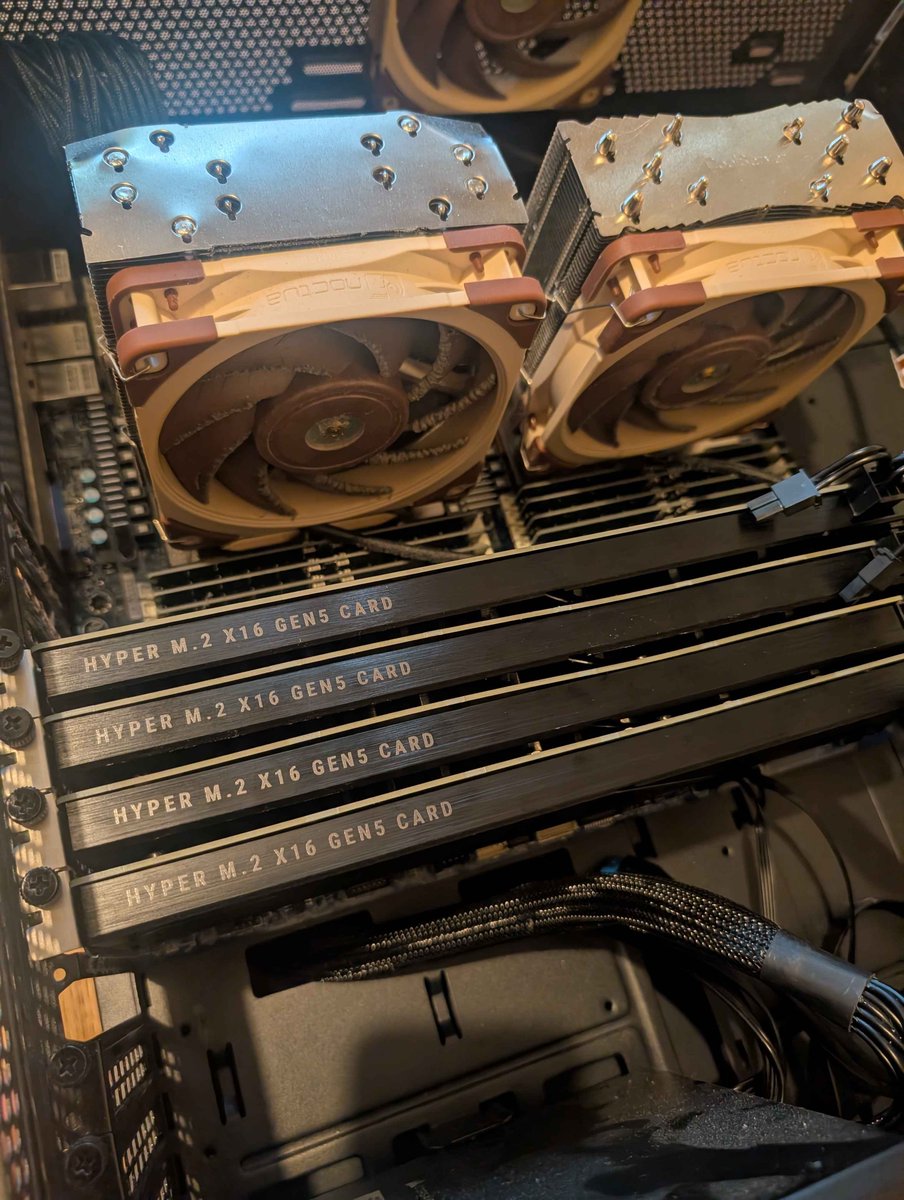
@giffmana I'll do a blogpost at some point on how to do these builds, with sections like "PCIe retimers: You've never had to think about them before, here's how to stop them catching fire"
Given how stringent the anti-distillation measures are now it's crazy that GPT-4 used to give you top-5 token probs with no CoT to hide. You could probably have recovered that whole model for <$10M
Why do people buy $20k local machines just to run GLM 5.3 at 70 TPS?
Bro I just used a random provider on openrouter ran it the entire night and paid $10.
A universal predictive model of the cell would dramatically accelerate science, allowing biologists to perform experiments digitally. Today we’re announcing a major partnership with the DOE and NIH. The goal of this partnership is to generate the data that will be needed to build an accurate model of the cell with artificial intelligence.
Isomorphic, Google DeepMind, and Meta are joining us as founding partners in the Virtual Biology Initiative. This is the beginning of a large scale coordinated effort to map cellular biology to power the development of digital models of life. Other leading scientific institutions and consortia including the Allen Institute, Broad Institute, Gladstone Institutes, the Human Cell Atlas, the Human Protein Atlas, the Wellcome Sanger Institute, as well as NVIDIA, are working together as part of this international scientific project.
Creating a predictive model of the cell is one of the most important challenges for the next decade of science. The insights that come from this could unlock a far greater understanding of disease, and open new paths for cures.
We invite the worldwide scientific community and other funders to join us in this effort.
Meet Mistral Large 4, aka Le Chonk.
• 1T parameters, natively multimodal. 49B active.
It is the best open weights model from US or Europe on aggregated benchmarks.
• State-of-the-art on critical workloads, including cyber defense, manufacturing and finance and it surpasses closed frontier models on visual grounding.
• Forged in Europe end-to-end and is deployable from Europe via our own Mistral Cloud infrastructure.
• Available to all via API today. Working with cybersecurity partners privately.
Open weights release end of October.
Tell your biologist friends - ESMC and ESMFold2 are the current state of the art for open protein modeling! In addition to modernized architecture and much better accuracy, they also support more complex multi-peptide and protein-ligand interactions!
The ESMC and ESMFold2 models are now on Huggingface! You can now install it directly from PyPi or from huggingface/transformers v5.16.0. As a part of this, we officially are releasing support for our fused Triton kernels and FoldCP in partnership with @nvidia!
The ESMC and ESMFold2 models are now on Huggingface! You can now install it directly from PyPi or from huggingface/transformers v5.16.0. As a part of this, we officially are releasing support for our fused Triton kernels and FoldCP in partnership with @nvidia!
@crypto292929 50tok/s is probably impossible even in theory without GPUs or other accelerators! There's no way to avoid the hard bandwidth limit of a CPU-only system, Kimi needs you to read ~90GB out of memory for every token
Most sensible people gave up on hosting open frontier models a while ago. Kimi K3 is 2.8T params and fitting that in RAM or GPUs will cost $100,000+, right?
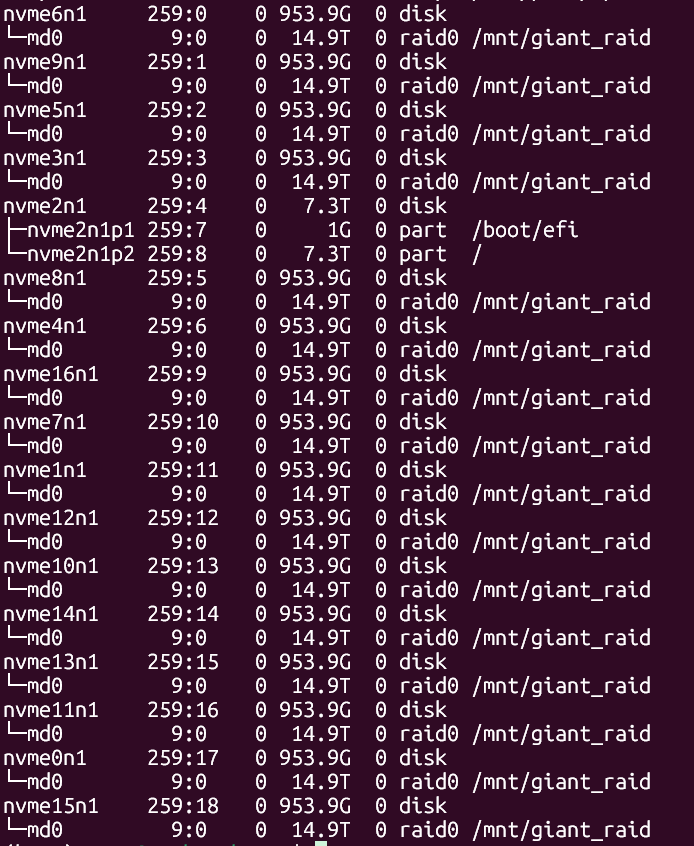
Wrong! You can run Kimi locally at full quality with native experts, Q8 everything else! 🧵
Complete hardware + software setup for running Deepseek-R1 locally. The actual model, no distillations, and Q8 quantization for full quality. Total cost, $6,000. All download and part links below:
And once it makes the changes, recompile, test, run it and that's it - you have frontier intelligence on your local machine. And if you got the full 16-drive array that system will be ready for the 10T models of 2027 as well 😅