EasyHybrid: An Interactive Graphical Environment for Quantum, Classical and Hybrid Simulations with pDynamo3
https://t.co/QubHmOCGjy
@HagenGustavo@carseq#JCIM Vol66 Issue3 #ApplicationNote
A great research opportunity is open now at my former lab. If you're interested in computational protein engineering, this call is for you. I learned a lot during my time under @JanBrezovsky1 group and can confirm that the mentoring is top tier 💯 https://t.co/K3aeP5nghO
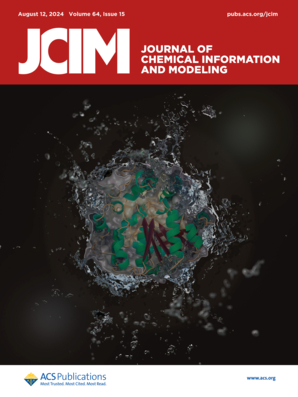
Super proud of @carseq work, both scientifically, but also sci-art. His cover idea was just published at JCIM! Cool art, interesting project, go see for yourselves :) https://t.co/ecjlLIJloz @ACS4Authors@UAM_IBMiB#sciart#compchem#biochem
Finally, in https://t.co/6UZfy0V6O1 we show that water molecules passing through wide tunnels make few or no H-bonds. However, in narrow tunnels, water molecules form several H-bonds to overcome repulsion and move efficiently
@JanBrezovsky1 @surpeta_b
#sciart#bioinformagician
In our recent paper https://t.co/6UZfy0V6O1, we observed that when water molecules cross shallow spaces, several Hydrogen bonds are formed with the protein to stabilize the transport
@JanBrezovsky1 @surpeta_b @igorMarchlewski@aravind_ram_ Cedrix Dognmo
More videos soon 😉
The insights we obtained, allowed us to provide a deeper explanation of phenotypical differences in a natural variant of the human epoxide hydrolase
Kudos to my awesome team @JanBrezovsky1 @surpeta_b @igorMarchlewski@aravind_ram_ Cedrix Dongmo
3/3
We know that water can traverse almost any barrier by entering minuscule spaces. Does the same happen at molecular level in proteins?
In our recent paper, together with @JanBrezovsky1, we study and challenge common views of water transport in proteins https://t.co/6UZfy0V6O1
1/3
Here, we revisit the rules defining open tunnels in enzymes allowing them to work. So far, it was common to consider only those > 1.4 Å to be accessible to water molecules. Surprise, about 1/5 of waters flows by much smaller tunnels!! #Bioinformatics, #biotechnology#compchem
I’m very happy to see online our new review about my beloved SERRATE protein published in @TrendsPlantSci. Great collaboration with @MonikaJozwiak2 and Artur Jarmolowski and nice support from Zofia Szweykowska-Kulinska, and Dawid Bielewicz @plantrnagroup. https://t.co/7v7TN4V2XS
The results we got with @MedicagoCrew and @JanBrezovsky1 showed that natural substrates of our ABCG protein can traverse the tunnel without energetic penalties 🙂
Read all the spicy details at https://t.co/KB1JR0JIfD
Last two animations for our paper #sciart#Blender3d
1/2