Judas ate with God for three years and never flinched.
Sat at the fire. Said the prayers. Watched blind men see. Watched dead men stand up. Watched lepers get clean skin back. Saw all of it. Touched all of it.
And it did nothing to him.
That should make you sick.
Because you know men like that. You’ve sat next to them in church. They sing the hymns. They say amen. They put the money in the plate. And they go home and do things in the dark that would get them killed in any century but this one.
Jesus called him a devil. Not after the betrayal. Before it. John 6:70. He looked at twelve men and said one of you is a devil. And then He let the devil stay.
He let him hold the money. Let him sit at the table. Let him hear every parable. Let him watch Lazarus walk out of a tomb.
And Judas saw resurrection with his own eyes and thought, what’s that worth in silver?
That’s not weakness. That’s not a man who lost his way. That’s a creature wearing human skin at the table of God, calculating the price of the blood on his plate.
Jesus washed his feet.
Read that again.
God kneeled in front of the thing that was about to murder Him and washed the dirt off its feet.
Not because Judas deserved it. Because the eleven men watching needed to see what love looks like when it’s aimed at something that will never love you back.
That’s the sermon your pastor won’t preach.
That Jesus didn’t die confused. He didn’t die betrayed. He sat across from a devil, broke bread, and said what thou doest, do quickly.
He gave evil permission to finish.
Because the cross was never Plan B.
And the son of perdition was never a surprise.
He was a prop in a story written before the foundation of the world. A creature who thought he was the predator and turned out to be the instrument.
The tomb didn’t stay shut.
But the field Judas bought with his thirty pieces? His guts are still in the dirt.
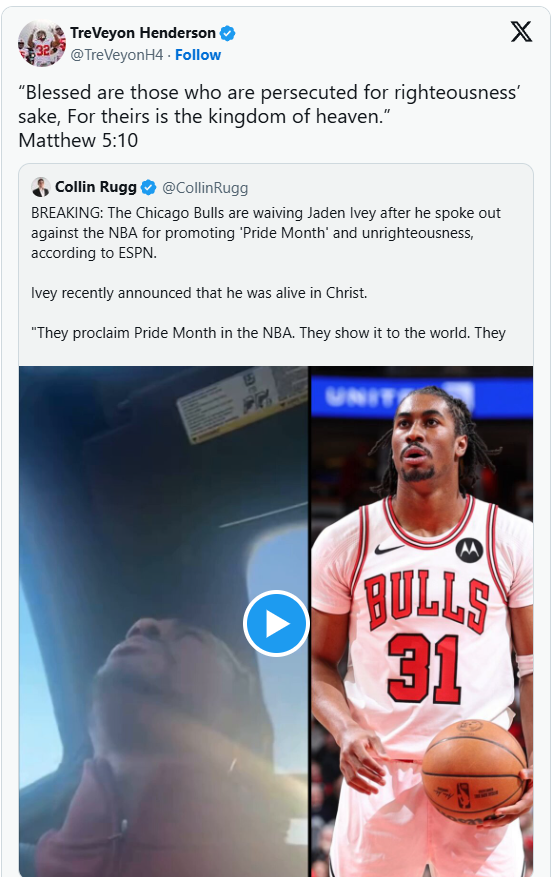
Things you can do and NOT get cut from the Chicago Bulls Roster:
* Punch a teammate in the face, causing multiple fractures
* Get arrested for DUI at twice the legal limit
* Headbutt a Referee
* Batter your Spouse
Things that WILL get you cut:
* Call Gay Pride Unrighteous
John leaned on Jesus' chest at supper.
Stayed at the cross when every other man ran.
Outlived all twelve. Beaten. Boiled in oil. Exiled to a rock in the ocean.
Thirty years later, Jesus appeared to him in glory.
John didn't worship. Didn't kneel. Didn't lift his hands.
He fell at His feet as dead.
As dead.
Peter did the same thing. After the miraculous catch — boats sinking under the weight — Peter didn't celebrate.
He said: "Depart from me; for I am a sinful man, O Lord."
Isaiah saw the Lord high and lifted up. Seraphim crying, Holy. And the prophet said: "Woe is me! for I am undone."
Job argued with God for 37 chapters. Then God showed up. Job said: "I abhor myself and repent in dust and ashes."
Every tough man in the Bible who saw the living God had the same reaction.
Not awe. Not worship.
Collapse.
Now look at us.
Walking into church with coffee. Nodding at sermons. Shaking hands in the lobby. Forgetting it by Tuesday.
We think we've been in God's presence.
If you'd been in God's presence, you wouldn't walk out the same way you walked in.
The men who saw Him couldn't stand.
We can barely be bothered to sit.
When Jesus returns, there will be no more heroes. No more performers. The hero and the villain will stand equal at last — empty-handed, bare-faced, finally free to be merely beloved...
Two dozen people died in California wildfires. Bridge broke in Maryland and it’s not fixed. Millions of gallons of sewage escaped from dilapidated pipes in Maryland. That’s not fixed. Now the poop is in the Potomac river in Virginia. To get third world conditions, vote Democrat.
A Harvard philosopher once told me Christianity was "intellectually bankrupt" because God becoming human was illogical.
I told him that's exactly the point.
The scandal of the Gospel isn't that it's too simple. It's that it's too offensive.
See, we've sanitized the incarnation.
Made it a Christmas card with a glowing baby in a manger. Turned it into children's songs and nativity plays. Domesticated the most radical claim in human history.
But here's what actually happened:
The infinite compressed Himself into a womb. The omnipotent became helpless. The omniscient learned to walk. The self-sufficient nursed at His mother's breast.
This isn't poetry. This is scandal.
Philippians 2:6-8 doesn't give us metaphor—it gives us the most shocking reversal in cosmic history:
"Who, being in very nature God, did not consider equality with God something to be used to his own advantage; rather, he made himself nothing by taking the very nature of a servant..."
Let that sink in.
The One who spoke galaxies into existence couldn't speak for His first year of life.
The One who holds all things together (Colossians 1:17) had to be held.
The One who never slumbers nor sleeps (Psalm 121:4) got tired. So tired that He fell asleep in a boat during a storm.
I remember sitting with a Muslim friend who said, "This is why I can't accept your Jesus. Allah would never stoop so low."
Exactly.
That's the stumbling block Paul talks about in 1 Corinthians 1:23.
To the religious mind, God dying is blasphemy. To the philosophical mind, God becoming weak is absurdity.
But here's what both miss:
Power that refuses to become vulnerable isn't power—it's insecurity.
Think about it.
Every dictator in history built walls around themselves. Every tyrant ruled from a distance. Every false god demanded approach through priests and rituals and sacrifices.
But the real God?
He got dirt under His fingernails. He had bad breath in the morning. He got splinters in the carpenter's shop. His feet hurt after walking dusty roads.
The Jews wanted a Messiah who would overthrow Rome with supernatural force.
Instead, they got a man who wept at His friend's grave.
The Greeks wanted wisdom—some philosophical principle that would unlock the universe.
Instead, they got a man who bled actual blood.
You know what's truly offensive?
It's not just that God became human. It's HOW human He became.
He didn't show up as a king or philosopher or general. He showed up as a bastard child (in the eyes of society) born to an unwed teenage mother in an occupied country.
He grew up in Nazareth—the ancient equivalent of a trailer park. "Can anything good come from Nazareth?" they asked.
He worked with His hands. Calloused. Rough. Blue-collar.
He hung out with tax collectors and prostitutes. He touched lepers. He let a "sinful woman" wash His feet with her tears.
The religious elite called Him a glutton and a drunk.
This is your God.
Not some distant deity demanding perfection from His throne. But God with us. Emmanuel. God WITH skin in the game.
Here's what modern Christianity gets wrong:
We try to make Jesus respectable. We dress Him up in stained glass. We give Him a British accent and flowing hair. We turn Him into a life coach with good moral teachings.
But the real Jesus?
He fashioned a whip and flipped tables. He called religious leaders "whitewashed tombs" and "sons of hell." He told people to eat His flesh and drink His blood—so offensive that crowds abandoned Him.
Yet this same Jesus—this confusing, controversial, confrontational Jesus—is the one who said:
"Come to me, all who are weary and heavy laden..."
The hands that threw out money changers also touched the untouchable. The voice that condemned hypocrites also said "Neither do I condemn you." The One who commanded storms also wept with the grieving.
You want to know why God HAD to become human?
Because a God who won't bleed for you won't understand your bleeding.
A God who won't suffer can't enter your suffering. A God who won't die can't defeat your death.
Every other religion gives you a god who stays clean. Christianity gives you a God who gets dirty.
Every other religion says "climb up to god." Christianity says "God climbed down to you."
Every other religion offers philosophy. Christianity offers flesh and blood.
Here's the part that breaks people:
He was tempted in every way you are.
That means Jesus knows what it's like to want to punch someone in the face. He knows the pull of lust. He knows the temptation to take the easy way out. He knows the desire for revenge.
Hebrews 4:15 - "For we do not have a high priest who is unable to empathize with our weaknesses, but we have one who has been tempted in every way, just as we are—yet he did not sin."
He felt everything you feel. But never gave in.
Not because He couldn't sin (that would make the temptation meaningless). But because He wouldn't.
The same divine nature that spoke creation into existence lived inside human flesh that could be cut, bruised, and killed.
The invisible God became visible. Not in glory but in humiliation. Not in power but in weakness. Not to be served but to serve.
And this—THIS—is what offends.
We want a God who looks like success. He chose to look like failure.
We want a God who conquers through strength. He conquered through surrender.
We want a God who makes sense. He chose to be foolishness to the wise.
The cross wasn't Plan B. It was always the plan.
From the moment Adam fell, the solution was already in motion: God would become what we are so we could become what He is.
He would take our poverty to give us His riches. He would take our sin to give us His righteousness. He would take our death to give us His life.
The Judge would stand trial. The Lawgiver would be condemned. The Author would enter His own story.
This is either the greatest truth or the greatest delusion in human history.
There's no middle ground.
C.S. Lewis was right: Jesus is either Lord, liar, or lunatic. You can't have Him as just a good teacher. Good teachers don't claim to be God.
So here's my question for you:
What's more offensive to you?
A God who stays distant and demands you earn His love? Or a God who gets close enough for you to spit on Him?
A God who remains mysterious and unknowable? Or a God who lets you drive nails through His hands?
A God who keeps His dignity? Or a God who strips naked and dies like a criminal?
Because that's your choice.
Every other option is off the table.
The God of the universe either became a baby who needed His diaper changed, or He didn't.
He either got hungry, tired, angry, and sad, or He didn't.
He either bled real blood and died a real death, or He didn't.
And if He did—if the eternal God really became temporal man—then everything changes.
Your suffering isn't beneath His notice because He's suffered. Your temptations aren't beyond His understanding because He's been tempted. Your death isn't outside His power because He's died.
The hands that hold the universe have nail scars. The feet that walked on water were pierced. The side that breathed life into Adam was speared.
This is the scandal of the Gospel:
Not that God sent a prophet. Not that God sent an angel. Not that God sent a book.
But that God sent HIMSELF.
And He didn't come in power but in weakness. Didn't come to be served but to serve. Didn't come to condemn but to save.
To the religious, it's a stumbling block—God shouldn't die. To the philosophical, it's foolishness—God shouldn't become weak.
But to those being saved?
It's the power of God hidden in plain sight. It's wisdom disguised as foolishness. It's strength perfected in weakness.
The God who didn't need us chose to need His mother's milk. The God who owns everything chose to have nowhere to lay His head. The God who is life itself chose to taste death.
Why?
Because love does what logic never would.
Love enters the mess. Love gets its hands dirty. Love bleeds.
And a God who is love?
He doesn't send a substitute. He comes Himself.
This is what separates Christianity from every other religion on the planet.
We don't have a God who points the way. We have a God who IS the way.
We don't have a God who teaches about life. We have a God who IS life.
We don't have a God who explains truth. We have a God who IS truth.
And He proved it by doing the one thing no mere human could do:
He rose from the dead.
Not symbolically. Not metaphorically. Not spiritually.
Physically.
The same body that was broken was raised. The same hands that were pierced reached out to Thomas. The same feet that were nailed walked with disciples to Emmaus.
Because if Jesus didn't actually, literally, physically rise from the dead, then Paul says we're the most pitiful people on earth (1 Corinthians 15:19).
But if He did rise?
Then death is defeated. Sin is conquered. Hell is harrowed. Satan is crushed.
And you—broken, bleeding, doubting you—have a God who gets it.
Who doesn't stand at a distance shouting instructions. But who entered the fight. Took the hits. Absorbed the punishment. And won.
Not through avoiding suffering but through embracing it. Not through escaping death but through defeating it. Not through staying clean but through taking our dirt upon Himself.
The fully God, fully man paradox isn't a theological puzzle to solve.
It's a love story written in blood.
And it's either the most beautiful truth or the most devastating lie ever told.
I've bet my life it's truth.
What about you?
If this hit you, share it. Someone needs to hear that God isn't too holy to handle their mess.
Drop a comment with your thoughts. Does the incarnation offend you or compel you?
Follow for more unfiltered truth about the scandal of the Gospel.
Because comfortable Christianity isn't Christianity at all.
A man said "I accept Jesus Christ" on his deathbed.
The church asked if he really meant it.
I need to ask you something.
When did we become the gatekeepers of grace?
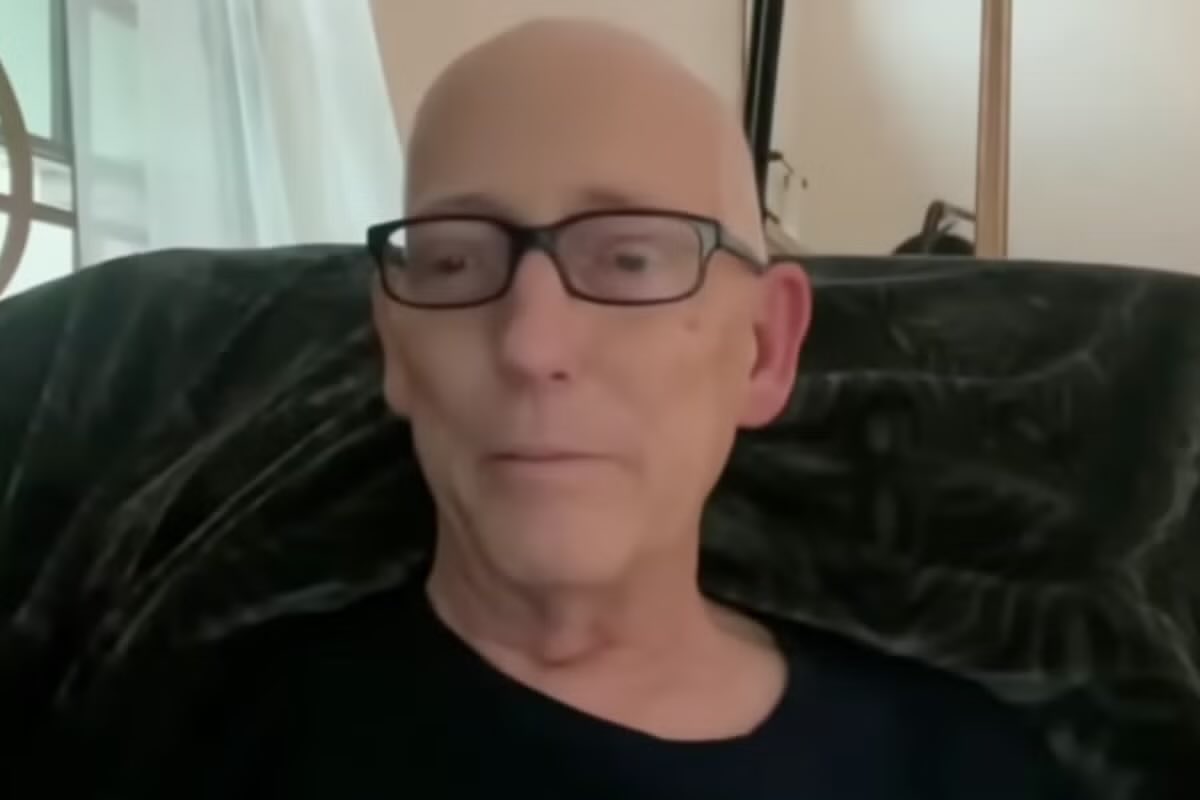
I've watched Christians dissect Scott Adams' final words like prosecutors.
They parsed his phrases. They weighed his tone. They measured his faith against some invisible scale and found it wanting.
"That doesn't sound like surrender," they said. "That sounds like a man hedging his bets."
And I understand the instinct. I do.
But there's a verse that haunts me. Not because it's obscure—because it's too simple.
"Whosoever shall call upon the name of the Lord shall be saved."
(Romans 10:13)
Whosoever.
Not "whosoever truly believes in their heart of hearts." Not "whosoever demonstrates sufficient sincerity." Not "whosoever calls early enough in life that we trust their
motives."
Whosoever.
The moment we add prerequisites to that promise, we've traded the Gospel for religion.
We've smuggled works back in through the side door labeled "authentic faith."
I know what some of you are thinking.
But he admitted he wasn't a believer.
He talked about "risk and reward."
He said he hoped he'd "qualify."
Yes. He did.
And those words make us uncomfortable. They don't sound like the confident declarations we want from converts. They sound uncertain. Calculating. Human.
But here's what I need you to hear:
The thief on the cross didn't have time to develop mature theology either.
He was a criminal. Hours from death. He looked at Jesus and said, "Lord, remember me when you come into your kingdom."
That's it.
No profession of belief in the resurrection. No renunciation of his former life. No evidence of transformed character.
Just a desperate man, reaching for a hand he wasn't sure would take his.
And Jesus said, "Today you will be with me in paradise."
We have a problem, and it's not Scott Adams.
It's us.
We've internalized a law that God never gave us. A natural sense of fairness that says late arrivals should get less. That deathbed conversions are suspicious. That the math
should somehow work out—more faith, more years, more sacrifice equals more standing before God.
Jesus told a parable about this.
We skip over it because it offends us.
A landowner hired workers throughout the day. Some came at dawn. Some at noon. Some showed up with one hour left.
At the end, he paid them all the same.
The early workers were furious.
"These who were hired last worked only one hour, and you have made them equal to us who have borne the burden of the work and the heat of the day."
(Matthew 20:12)
And the landowner replied:
"I am not being unfair to you, friend. Didn't you agree to work for a denarius? Don't I have the right to do what I want with my own money? Or are you envious because I am generous?"
There it is.
The scandal of grace is that it feels unfair.
A man who mocked God for sixty years gets the same inheritance as the saint who served since childhood. A skeptic who hedged his bets at the last breath stands in the same kingdom as the martyr who gave everything.
And something in us recoils.
That's not grace rejecting us.
That's us rejecting grace.
Let me tell you what I see when Christians interrogate a dead man's faith.
I see the older brother standing outside the party, refusing to go in.
The prodigal came home reeking of pig filth and poor decisions. The father ran to him. Threw a robe on his back. Killed the fattened calf.
And the older brother?
"Look! All these years I've been slaving for you and never disobeyed your orders. Yet you never gave me even a young goat so I could celebrate with my friends. But when this son of yours who has squandered your property with prostitutes comes home, you kill the fattened calf for him!"
(Luke 15:29-30)
He couldn't celebrate the return because he was too busy auditing the journey.
Sound familiar?
Here's the truth we don't want to face:
We can't see hearts. We can only see words.
And the words Scott Adams spoke were: "I accept Jesus Christ as my Lord and Savior."
Were they perfect? No.
Were they confident? No.
Were they the words we would have scripted? No.
But they were the words.
And the God who receives those words is not checking for tone. He's not running sentiment analysis. He's not grading on a curve.
He's looking for open hands.
Paul wrote something that lands differently now:
"Who are you to judge someone else's servant? To their own master, servants stand or fall. And they will stand, for the Lord is able to make them stand."
(Romans 14:4)
Scott Adams was not our servant to judge. He answered to his own Master.
And the Lord is able—able—to make him stand.
That's not my promise. That's Scripture's promise.
The question is whether we'll submit to it.
I know why we do this.
I know why we parse and weigh and question.
Because if grace is really this free, then we didn't earn our place either.
If the deathbed convert gets in, then our decades of service weren't the price of admission. They were the privilege of knowing Him longer.
And that reframes everything.
It means the faith we've built isn't a resume. It's a relationship.
It means our years weren't buying something. They were receiving something.
It means we were never the workers earning a wage.
We were always the prodigals coming home.
So did Scott Adams get saved?
I don't know.
But I know what the Scripture says.
Whosoever shall call upon the name of the Lord shall be saved.
I know what Jesus promised the thief who had nothing to offer but a desperate plea.
I know what the father did when his son came crawling home with a rehearsed speech that never even got finished.
And I know what the landowner said to the workers who were angry that grace didn't do math the way they wanted.
"Are you envious because I am generous?"
The gate is narrow, but it's not locked.
The standard is high, but it's not ours to enforce.
The Judge is holy, but He is also the one who ran to meet the prodigal while he was still a long way off.
Stop auditing the dead.
Start marveling at the grace that let you in.
"Whosoever shall call upon the name of the Lord shall be saved."
Whosoever.
Even him.
Even you.
What saith the Scriptures?
That's the only question that matters.
Scott Adams, facing death, shows us how to live.
Someone recommended “How to Fail at Almost Everything and Still Win Big” by Scott Adams. I had burned out on mainstream books, but picked it up, and was hooked. He had put into words a way of living, similar to one I had found, except his approach was systemic and analytical. Better than my own slapdash notes. Outside of religious texts, Adams was and is as close to a “guide to life,” as you’ll ever find. And even if you’re religious, you still live in this world, and would be wise to learn how to navigate it.
Scott is closing in on the end of his life, and even now he is creating new beginnings.
I’d better write this now, I won’t be able to when it’s too late.
After losing Charlie Kirk, a lot of us are wondering how we can possibly write another obituary. While there’s much to complain about the internet and social media, those mediums expanded the sizes of our communities, our influences, and indeed our families. Too often we find new ways to hate people, instead of finding new people to love.
Scott Adams comes up in conversation at every social event I host. “How is Scott Adams doing? Will he make it?” We all talk about streams we watched and lessons learned. It’s a memorial except he’s still alive. Scott would love to hear that, which is why I have said so repeatedly. I’ve lost too many people, via death or fallings-out, to leave feeling unexpressed.
He’s been a surrogate father figure and mentor to millions of people.
Scott Adams is not liked, he is loved.
People don’t “like” Scott Adams, they aren’t “a fan of his.” They love this man. And I do as well. I’m still living in denial of his fate. We all are.
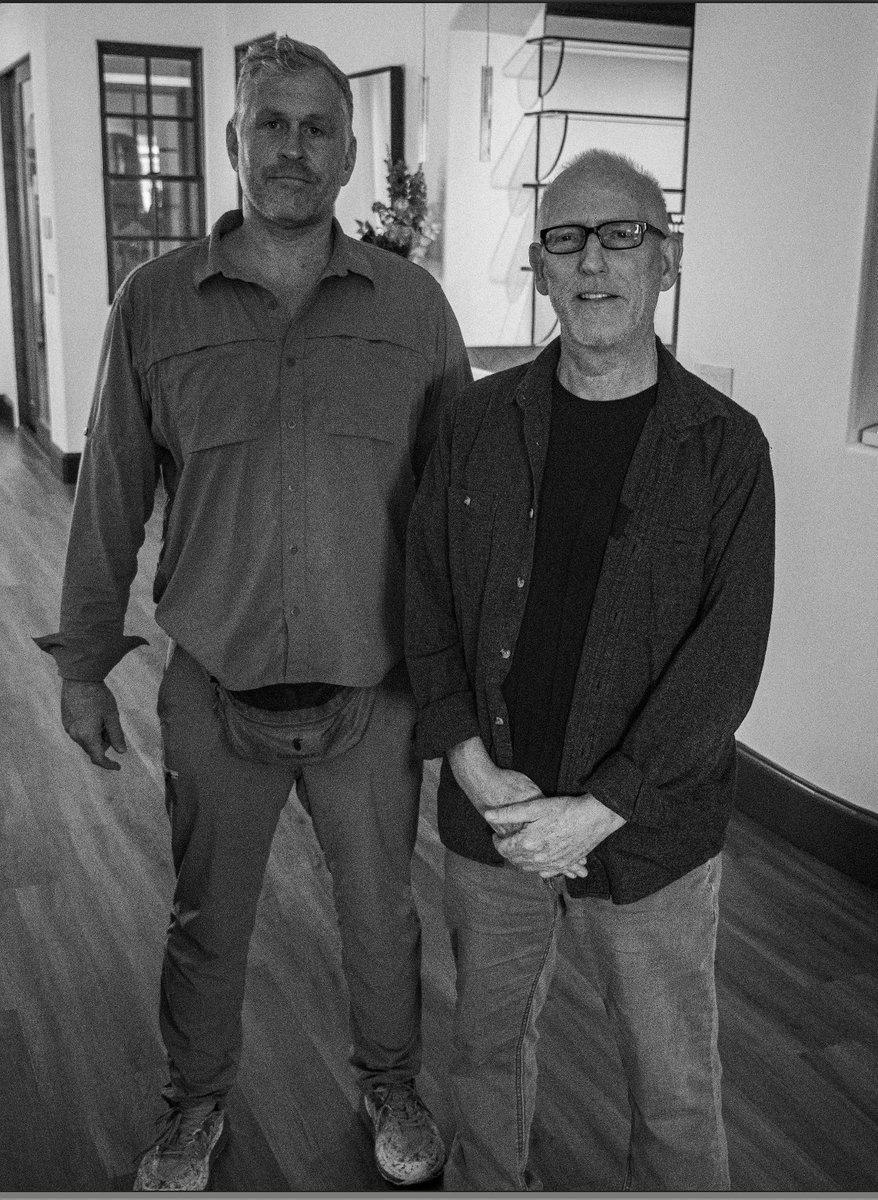
We’d been making a film about the meaning of life, and while Scott Adams had been in both of our other films, we hadn’t booked him for Meaning yet. Then we found out he was going to take the ride of assisted suicide. Foolishly, we had assumed he’d always be around. Nobody ever dies, right? Your dad will be there to take your call the next time you phone home. Your friends aren’t going anywhere. That’s how we too often live. We could book Scott later.
We reached out and he graciously agreed to be interviewed. We all knew it was going to be our last interview together. Scott and I are both efficient with our time. When a moment is over, it’s time to go do something else. Obligations call. The crew pushed this one as long as we could.
After the interview wrapped up and the gear was packed and it was time to go, there was an awkward pause. I broke it.
“Scott, we love you.” He said thank you. “No, Scott, we love you, I mean it, we all do. We love you.”
None of us broke down crying, not that there would have been any shame in that, but we no doubt all soon will.
Well then, what is the lesson of Scott Adams?
On a practical level, the lesson of Scott Adams is the power of showing up. Nobody works harder and on a more regular schedule. You can set your clock to Scott’s show. Too many of us wait for the muse of inspiration or the jolt of information to force us into action. Work, everyday, maybe in obscuring and without tangible benefits for years. Eventually you’ll hit your mark and go beyond.
Scott plugged away with his streams from a small account (after a huge career via Dilbert) and soon became must-watch, and then transcended his role to becoming something much more.
On a spiritual level, we might ask, why do we love Scott? It’s not because he’s so smart (he is). There are not shortage of intelligent, clever, Machiavellian, and rich people with podcasts. When one of them dies, what is lost? All of that Ego and desire for adoration, and does anybody even care? When those people fall while living, who will be there?
Scott is loved because he’s devoted his life to service to humanity. “What is the meaning of life,” is the question we ask every interviewee, and Scott’s answer, “Be useful to humanity.”
Despite pain, sickness, and inevitable death, Scott is doing his daily streams, serving his country and all of humankind until his end.
He’s a light to the world and a mirror for all of us.
What exactly are we doing with the gift of life given to us by God. (Scott believes in the Simulation, but I believe God evens this all out in the Judgment.) Are we doing enough for others? Are we doing anything for others?
Like everyone else, I’m capable of throwing myself a pity party. Sometimes when life is going too well, and I don’t have real problems, I invent some. That’s where the Ego brings you, recursively worshipping itself, and when that fails, tormenting itself, as each path leads to its own attention.
May all of us live more like Scott Adams, and may God bless his immortal soul when he passes.
P.S. I ran this article through Grok for typos. The original version had “immoral” soul where I meant it to read “immortal.” I think Scott would have had a great laugh had that typo been left in.
A father plants trees he will never climb.
A son climbs trees he did not plant.
That’s the mystery of time.
Most men think legacy is loud. A name. A speech. A funeral story.
But real legacy is dirt work.
Quiet.
Unseen.
Done while everyone else is sleeping.
A man kneels in soil and buries something living.
Then he walks away.
That is fatherhood.
And a boy doesn’t understand it. A boy reads silence as absence. He thinks his father’s quiet means he doesn’t care.
Then the boy grows up.
And one day—usually when he’s carrying weight of his own—he realizes the truth:
His father’s silence was not absence.
It was presence compressed into granite.
His hands weren’t empty.
They were full of invisible seed.
A paid bill.
A changed tire in the cold.
A steady wake-up time.
A steady refusal to quit.
A prayer no one heard.
“Except a corn of wheat fall into the ground and die, it abideth alone: but if it die, it bringeth forth much fruit.” (John 12:24)
A man becomes eternal the only way any man becomes eternal:
He dies well.
Daily.
In small ways.
So another man can live.
I wrote my newest Substack piece from that thought.
If you’ve ever misread your father… or feared becoming one… read The Trees.
The people currently lecturing you about the “rules of war” executed ten innocent afghans with a reaper drone after Abbey Gate and called it a “righteous strike.”
Then when the facts came out, not a single person was punished. Nobody even got reprimanded.
This is all fake.
You want to belong?
Pick a different God.
Because the Christ who saves you
ruins your chances of fitting in anywhere.
He burns the old life down,
hands you a crown made of scars,
and tells you to walk through a world that no longer recognizes you.
They’ll call you strange.
They’ll call you foolish.
They’ll call you a man who lost his mind.
But that’s what resurrection is
losing the mind you had,
the one shaped by sin,
and gaining a new one shaped by eternity.
“Be ye transformed by the renewing of your mind.” (Romans 12:2)
And if they miss the man you used to be,
tell them he died.
Because he did.
The smell hits you first.
Urine. Human or animal, doesn’t matter. Excrement baking in August heat. Week-old BO. Rotten bananas bleeding through torn plastic.
I’m hooking cables to the dumpster when I see them.
Thousands.
Maggots.
Writhing. Aimless. Blind. Going nowhere. Born in filth. Living in filth. Dying in filth.
I pity the pathetic bastards.
Then God speaks.
Not audibly. He doesn’t do parlor tricks. But the thought lands like a hammer:
That’s you.
Religion is for the weak.
I know. I’ve been that weak.
Sunday morning. Third row. Bible open. Taking notes like I’m supposed to.
Pastor’s talking about grace. I’m thinking about the guy in the row behind me. Divorced twice. Can’t keep a job. Probably high right now.
“Thank God I’m not like him.”
There it is. That prayer. The Pharisee’s prayer. Luke 18. The one Jesus condemned.
But I know my Bible. I tithe. I show up.
I’m just like the maggot in the dumpster. Just cleaner on the outside.
His name was Tommy. Face like a road map of bad decisions.
“F—ing Jesus, beautiful Jesus, got any cash?”
Shaking. Sweating. Begging the God he’d forget by tomorrow.
I gave him five bucks. He bought meth. I knew he would.
But I needed to feel better about myself. My five dollars of righteousness. My participation trophy for caring.
Tommy’s still shaking. I’m still judging. Both maggots. Different dumpsters.
Sarah. Tuesday night prayer request. Same one for three years.
“Pray my boyfriend becomes the man God called him to be.”
You mean husband?
No. Boyfriend. Five years. Two kids. No ring.
But we nod. Pray. Pretend God’s gonna fix what she won’t confront.
Dime-store prayers for a man who’s married to himself.
She’s praying. He’s not changing. Both pretending it’s working.
I know the guy in the truck. Crying to God about something. Making promises he won’t keep.
I know because I’ve prayed those prayers. Empty words to a God I talk about more than I talk to.
I know the Bible. Chapter and verse. Can quote Romans 8. Explain justification.
But do I know God?
Or do I just know about God?
There’s a difference. One’s information. One’s intimacy.
I’ve got plenty of the first. Not much of the second.
The Cross.
God looked at the dumpster—at Tommy shaking for his next hit, at Sarah praying for a boyfriend-husband, at me with my Bible knowledge and my religious pride, at you holding whatever you’re holding
And said: I’m coming in.
Not to throw us out.
To join us.
To become us.
To die as us.
On it, a naked Jew.
Not a Viking. Not Jim Caviezel with good lighting and a carefully placed loincloth.
A Jew. Alone. Naked. A maggot to society.
Isaiah 53: “He is despised and rejected of men; a man of sorrows, and acquainted with grief: and we hid as it were our faces from him; he was despised, and we esteemed him not.”
Read it again. Slower.
“We hid as it were our faces from him.”
We. Not them. We.
You would’ve crossed the street. Turned your head. Found something suddenly interesting in the other direction.
I know I would have.
The crowds mock. Spit. Guy in the corner making crude gestures. Laughing. Pointing at God’s naked body.
Philippians 2: “He made himself of no reputation.”
No reputation.
The God who spoke galaxies into existence made Himself nothing.
Lower than Tommy.
Lower than Sarah’s boyfriend.
Lower than the guy who knows his Bible but not his God.
Lower than you.
“And became obedient unto death, even the death of the cross.”
He was covered in spit. Blood. Urine from guards who mocked Him. Feces probably, from hours hanging there.
Flies landing on wounds.
Open. Infected. Rotting before He died.
He looked like the dumpster I’m staring at.
Smelled worse.
And I wouldn’t have touched Him.
Would you?
That’s not religion.
Religion builds temples and demands you clean up before entering. Religion says: “Stop being a maggot, then God will love you.”
The Cross says: “God became a maggot because He already loves you.”
—TBM
God saved me on the same road I took to avoid Him.
Jonah ran to Tarshish to avoid Nineveh.
Storm. Fish. Three days in darkness.
“And the LORD spake unto the fish, and it vomited out Jonah upon the dry land” (Jonah 2:10, KJV).
Still ended up in Nineveh. The detour became the sermon.
You can’t outrun God.
You ran to career, addiction, success, control—anything that let you avoid surrender.
And God met you there.
Not at the altar. Not in church. Not when you were ready.
At rock bottom. On the road you thought led away from Him.
Joseph’s brothers sold him to Egypt to destroy his dream. Prison. Betrayal. Years wasted.
“But as for you, ye thought evil against me; but God meant it unto good” (Genesis 50:20, KJV).
The pit became the throne.
Paul persecuted Christians to destroy the faith. Damascus road changed everything.
“Saul, Saul, why persecutest thou me?” (Acts 9:4, KJV).
The road to destruction became the road to conversion.
“And we know that all things work together for good to them that love God” (Romans 8:28, KJV).
The road you took to avoid Him?
That’s where He saved you.
Not in spite of the detour. Because of it.
Rock bottom wasn’t the end. It was the altar.
God doesn’t just save you FROM something.
He saves you ON THE ROAD you took to escape Him.
That’s grace.
—TBM