Jo Nagai was raising swallowtail butterflies at his home in Kobe, Japan, when he noticed something odd. The ones he had looked after as caterpillars seemed to recognize him. Wild butterflies fled. His didn't.
He was in second grade. He wrote a four-page letter to Dr. Martha Weiss, an entomologist at Georgetown University who had studied whether moths could retain memories through metamorphosis. He asked if she could help him design a version of her experiment for butterflies.
She said yes.
Using a muscle therapy device, Jo trained caterpillars to associate the scent of lavender with a mild vibration. When the caterpillars became butterflies, 70 per cent of them still avoided the lavender. Their brains had been completely rebuilt during metamorphosis. The memory survived anyway.
Then he bred them.
The offspring, which had never been trained, also avoided lavender. So did their grandchildren. Without ever experiencing the vibration, two generations of butterflies inherited an aversion to a scent their grandmother had been taught to fear.
Jo documented it all in a 33-page research paper and presented his findings at the International Congress of Entomology in Kobe in 2024. He was 10.
A second grader wrote a letter to a Georgetown professor, and together they found evidence that butterflies can pass memories down through generations.
-Wilderness Whisper
@japan_nobunaga I drove an old tractor from 1936 that needed a hand crank to start and a 1963 John Deere with at least 60 gears - I also drove five or six different pick ups from the 60s through the 70s and 80s plus a wheat truck from the 50s.
All from age 12.
@RobertW54737938@ChrisMartzWX Considering the difference in concrete and asphalt from 1926 to 2026 you should have record hot temperatures for the next 100 years because that is the nature of UHI.
UHI is the guarantee of many many many record temperatures in Tokyo and all over Japan…
@BobLandell@RogerPielkeJr That “larger amount of waste heat” is infinitesimal compared to UHI.
This 4% saves lives so going after it is just as misguided as going after fertilizer. It would be unhinged to choose death from heat instead of life from air-conditioning…
Anti-air-conditioning is antihuman.
@BobLandell@RogerPielkeJr The waste heat exhaust is an absolutely negligible component of the overall UHI - it’s like you’re worried about a tiny drop of urine in a pool full of toddlers leaking gallons…
It’s not making the world hotter.
@norwegianesc Never seen a more exciting and wildly creative player ever, and the whole team is crucial, so heck yeah we are rooting for Norway ALL the way!
@Elektronews@hausfath Heavy rain events have increased a little bit, however, there’s been no increase and no trend of any sort in flooding, which is something only climate change DOOMERS fail to understand.
If this was reality, we would see an increase in flooding - because it is NOT, we do NOT.
✳️ 𝗧𝗵𝗲 𝗖𝗹𝗶𝗺𝗮𝘁𝗲 𝗠𝗼𝗱𝗲𝗹𝘀 𝗪𝗲𝗿𝗲 𝗪𝗿𝗼𝗻𝗴. 𝗧𝗵𝗲 𝗗𝗮𝘁𝗮 𝗣𝗿𝗼𝘃𝗲𝘀 𝗜𝘁. 🎯
In 1990, the world's leading climate scientists gathered their best models, their most sophisticated computers, and their collective expertise, and made a solemn prediction. By 2025, the Earth would be 1.0°C warmer than it was then. Temperatures would be climbing at 0.3°C every decade. Sea levels would be surging at 6cm per decade; nearly 20cm of ocean rise already lapping at our coastlines. 🤷🏼♂️
They were wrong. Significantly, measurably, and verifiably wrong. ❌
Not wrong at the margins. Wrong at a scale that matters enormously when trillion-dollar policy decisions, energy system demolitions, and civilisational reorganisations are being justified by the precision of those predictions. 💰
*️⃣ The Temperature Failure *️⃣
Thirty-five years of observed data from NASA, NOAA, and the UK's HadCRUT network; the very institutions that champion climate action; show actual warming of 0.18°C to 0.20°C per decade. Not the predicted 0.3°C. The central prediction overstated actual warming by 33% to 40% ‼️
Observed temperatures didn't just miss the central forecast; they tracked at or below the absolute floor of the IPCC's own lowest uncertainty boundary. To put that plainly: the scientists' best-case minimum turned out to be significantly more than the world actually experienced. 🤦🏼♂️
*️⃣ The Sea Level Failure *️⃣
The 1990 prediction was 6cm of sea level rise per decade, with an explicit floor; the irreducible minimum; of 3cm per decade. By 2030, we were told to expect 20cm of cumulative rise. 😵💫
The actual measured cumulative rise from 1990 to 2025 is 11 to 12 centimetres. For the first two decades of the forecast period — 1990 to 2010 — tide gauges recorded rises of just 1.7cm to 2.0cm per decade. That is not merely below the central prediction. It fell entirely outside and below the IPCC's own stated minimum uncertainty boundary. The worst-case floor was still twice what actually happened. 😳
*️⃣ The Most Damning Detail *️⃣
Here is where the story becomes genuinely extraordinary. These predictions were made under a specific emissions assumption; the Business-as-Usual Scenario A. The models assumed a certain level of CO2 pouring into the atmosphere. 🤔
What actually happened? Real-world CO2 emissions since 1990 have comfortably exceeded that Business-as-Usual trajectory. We emitted more than the models assumed. Significantly more. China alone built enough coal-fired power stations to dwarf the emissions reductions achieved by the entire Western renewable transition. 🏭
More emissions than predicted. Less warming than predicted. Less sea level rise than predicted. ✅
If the models were simply imprecise, higher emissions would have produced higher temperatures; tracking above the forecast, not below it. The fact that warming underperformed predictions despite emissions outperforming them points to something more troubling than random modelling error. It points to systematic overestimation; models running hot, calibrated toward alarm rather than accuracy. 🔥
That is not science. That is confirmation bias wearing a lab coat. 🥼
The data doesn't lie. The predictions did. 🤥
Friedrich Hayek: “Socialism assumes that all the available knowledge can be used by a single central authority. It overlooks that the modern society is based on the utilization of widely dispersed knowledge.”
@BjornLomborg@JayinKyiv@grok HOGWASH!
As of July 6, 2026, Russian farmers have harvested approximately 119 million tons of grain, including about 86 million tons of wheat. This is slightly ahead of last year's pace, with average yields and grain quality higher than in 2025.
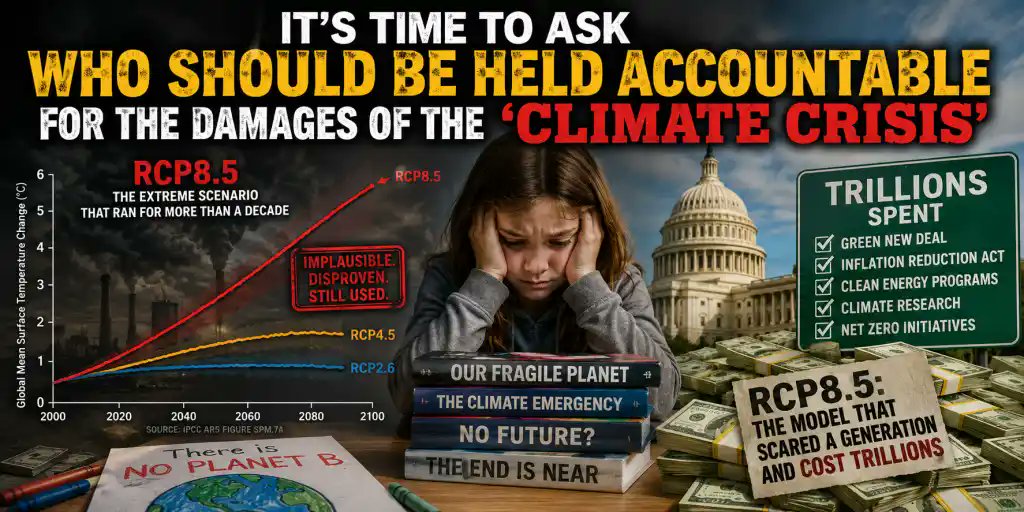
𝗜𝘁'𝘀 𝗧𝗶𝗺𝗲 𝘁𝗼 𝗔𝘀𝗸 𝗪𝗵𝗼 𝗦𝗵𝗼𝘂𝗹𝗱 𝗕𝗲 𝗛𝗲𝗹𝗱 𝗔𝗰𝗰𝗼𝘂𝗻𝘁𝗮𝗯𝗹𝗲 𝗳𝗼𝗿 𝘁𝗵𝗲 𝗗𝗮𝗺𝗮𝗴𝗲𝘀 𝗼𝗳 𝘁𝗵𝗲 '𝗖𝗹𝗶𝗺𝗮𝘁𝗲 𝗖𝗿𝗶𝘀𝗶𝘀'
Activists sued energy companies for allegedly misleading the public on climate risks. The same legal standard should now apply to the universities, media, and researchers who taught kids the world was ending by presenting RCP 8.5 as the expected future rather than a discarded worst-case model.
That scenario drove classroom panic, government reports, and trillions in spending long after experts called it unrealistic.
Who else gets held accountable?
Read the full article:
https://t.co/gmbNCqTEFJ
@JohnStossel I have to say that the world I grew up in and every choice that every parent made that was essentially the same or similar to every other parent in the US at that time is now ILLEGAL. Every choice made by every parent 50 years ago. ILLEGAL. But still completely legal in China.🙃
🔥🚨LATEST: Canadian engineer John Tse is going viral after revealing his umbrella that follows him around as if he is in a futuristic movie. Tse created a fully autonomous umbrella that will assist people that need both of their hands while providing cover.
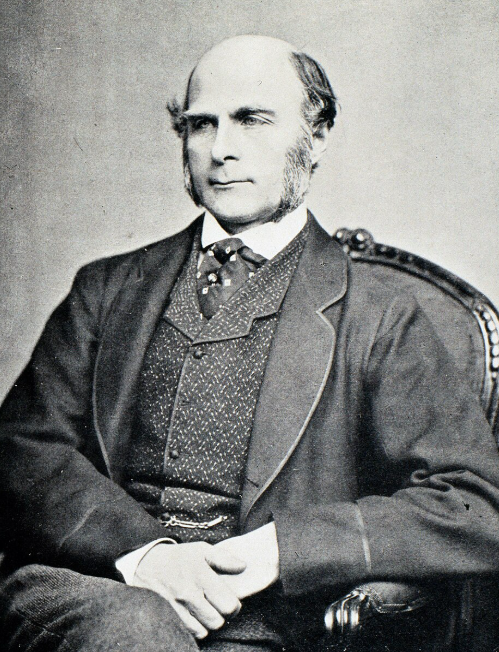
In 1907, Sir Francs Galton went to a livestock exhibition and accidentally stumbled on a phenomenon that explains why central planning doesn’t work. Seeing villagers taking part in a contest to guess the weight of a slaughtered ox, he decided to analyse the results. While individual guesses varied wildly, Galton realised that the mean of the guesses were remarkably close to the true weight of 1,198 pounds. In fact, the villagers had collectively managed to come within 1% of the correct result. He also noted that the supposed experts – farmers and butchers – guessed poorly on their own. What Galton observed was the “wisdom of crowds.”
In 2004, Journalist James Surowiecki popularised the idea in his book called “The Wisdom of Crowds”, where he put forward the thesis that individual errors averages out over large (diverse and decentralized) groups, leaving the average estimate to converge towards the truth.
That the judgement of large groups of individuals is generally more accurate than estimates from experts helps explain why centralised government bureaucracies struggle to match the efficiency of a free market. Friedrich Hayek labelled this phenomenon "spontaneous order." Complex social systems do not originate from central planners, but emerge naturally using the dispersed knowledge of individuals acting purely in their own self-interest and responding only to local market signals. The free market condenses the collective wisdom and preferences from all market participants into a market price. Central planners cannot possibly acquire or process the amount of information contained in that single number.
When central planners try to design an economy and fix prices, they are fighting against the mathematical reality demonstrated by Surowiecki: small homogenous groups of “experts” acting on incomplete information cannot replicate the result of the aggregate of individual choices. Collectively, we possess more knowledge than even the cleverest expert could hope to obtain. History has demonstrated how central planning leads to shortages or surpluses as bureaucrats fail to guess what the free market could have told them.