🧵 1/11 Half of U.S. adults already use AI for financial advice: what advice are they getting?
New paper: we ask people to write prompts seeking financial advice from LLMs & simulate the lifetime impact of following that advice (w/ @timdesilva, @wdwlin &
@AkuzawaMatthew)
An experimental test of efficient coding shows that experience tends to crowd out the effect of descriptive information on optimal allocation of coding resources, from @caryfrydman and @lawrence_j_jin https://t.co/hmF1IW9427
Been away from socials, but want to mention a new project that I'm really proud of.
In this pre-print we present evidence for a simple solution on how to find accurate answers to open-ended questions: select the person fastest to respond (thread ⬇️)
https://t.co/69WOQPxOGw
Now out in the JF with Constantin Charles @c_charles_23 and Mete Kilic @mkilicLA! In an experiment, we find that subjects report asset valuations that are far too insensitive to their expectations -- as in field data among @Vanguard investors
https://t.co/ekgbRwsdGJ
One other key finding is that the passthrough from beliefs to actions depends heavily on the *type* of beliefs. For a given distribution of beliefs, valuation is way more sensitive to objective beliefs compared to subjective beliefs
💡Implication: the growth of target date funds as defaults might be good for investors by helping align choices & preferences (more to come on this)
Note that if non-participation was driven by loss-aversion, as some literature suggests ,this would not necessarily be the case!
This is amazing. The bias that language models have in computing expected value depends on the training data. And when the training data matches the distribution of real-world stimuli, you get biases that look like those in human choice data
10/10 Our result suggests that language models have internalized these classical patterns reported in economics and psychology. And these behaviors likely emerge from learning to calculate expected values.
RIP Danny Kahneman
Kahneman recently told me in a discussion about collective intelligence that if he had at least another decade to live, he'd found a department to study the role of noise in human behavior.
Of course noise--a phenomenon often with counterintuitive effects--is well studied in collective behavior, information theory, dynamical systems + engineering, etc., but remains somewhat underappreciated in the social sciences.
One my favorite concepts of Kahneman's + Tversky's is the simulation heuristic (Judgement Under Uncertainty, 1982, Chapter 14)--the idea that we natively assign higher subjective probabilities to scenarios that are "easier" to consciously run forward or play out as a counterfactual. So many questions about computation, intelligence, + consciousness are raised by this simple idea.
https://t.co/ceQVKg9Mlb
A broadly important open micro-macro question that is finally getting traction is whether heuristics + biases (like the above) are as K+T and their disciples argue necessary corrections to standard economic theory or would (in some compressed form) follow naturally + simply as predictions from the equations *if* we had the right model. For more on this idea, see the work of Ole Peters.
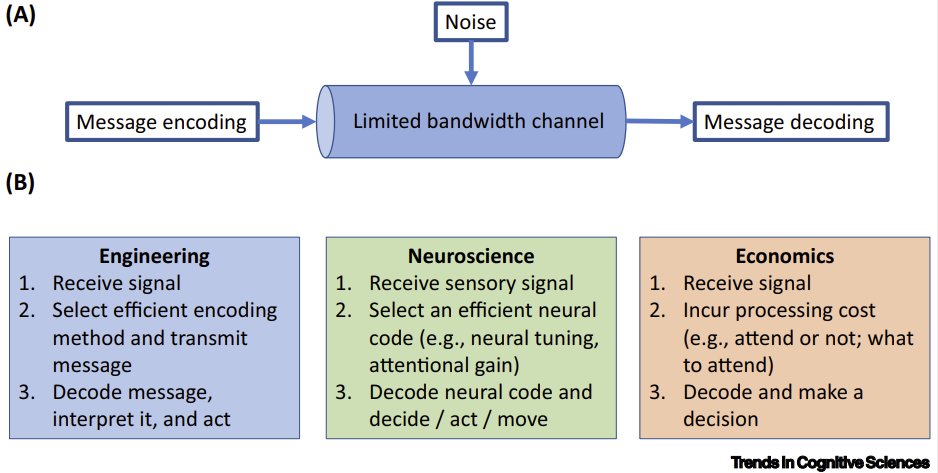
Take a look at our Review just published in @TrendsCognSci
Rationality, preferences, and emotions with biological constraints: it all starts from our senses
Free access to our article (online and PDF) for about 40 days!! don't miss it 👇
https://t.co/kRTqBvdDOe
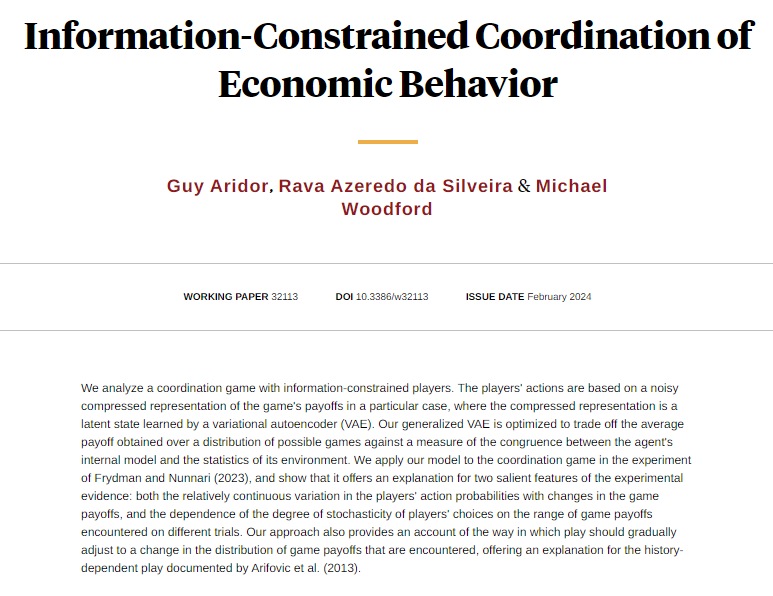
Interesting new explanation for behavior in coordination games using machine learning. Data on context-dependent coordination from a recent paper with @NunnariSalvo
Variational autoencoders can model imprecision in the way that people coordinate their behavior in laboratory experiments, and adapt to new environments, from Guy Aridor, Rava Azeredo da Silveira, and Michael Woodford https://t.co/yOC4Wlw1An
Ok folks, here is the job ad for our Empirical IO Assistant Professor position and how to apply:
https://t.co/Fca7SsM8G6
We'll be moving fast so please encourage all of your students to apply quickly.