Casa helps you secure your bitcoin. For the long term.
Take self-custody of your BTC and other assets with an inheritance plan.
Support: [email protected]
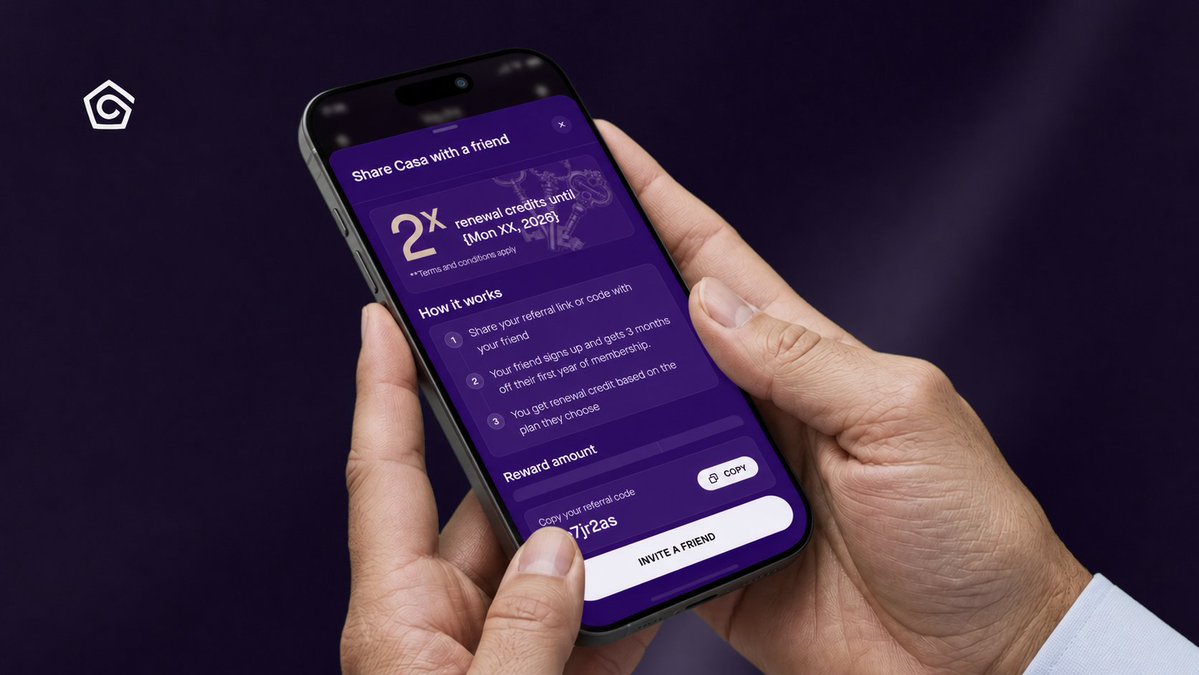
Through September 30, give three months off any Casa membership and earn double referral credits when someone uses your code at web checkout.
To help you introduce friends to Casa and bitcoin multi-vendor multisig, we are hosting a free webinar on Thursday September 24 at 7am PT. Join us and build your own multi-vendor 3-key vault, learn how to maintain it over time, and ask us anything about self-custody or multisig along the way.
https://t.co/imudiqZWAG
Through September 30, give three months off any Casa membership and earn double referral credits when someone uses your code at web checkout.
To help you introduce friends to Casa and bitcoin multi-vendor multisig, we are hosting a free webinar on Thursday September 24 at 7am PT. Join us and build your own multi-vendor 3-key vault, learn how to maintain it over time, and ask us anything about self-custody or multisig along the way.
https://t.co/imudiqZWAG
Through September 30, give three months off any Casa membership and earn double referral credits when someone uses your code at web checkout.
To help you introduce friends to Casa and bitcoin multi-vendor multisig, we are hosting a free webinar on Thursday September 24 at 7am PT. Join us and build your own multi-vendor 3-key vault, learn how to maintain it over time, and ask us anything about self-custody or multisig along the way.
https://t.co/imudiqZWAG
One key protecting your bitcoin is where nearly everyone starts. It is simple, it works, and for most of bitcoin's history it was the only option that seemed reasonable for everyday bitcoiners.
Multisig used to be a tool for engineers. Now it is where bitcoiners go as their holdings grow.
A 3-key vault puts your bitcoin behind three keys instead of one. Any two of them can move it, so one compromised key still leaves a thief with nothing.
People have protected what matters with more than one key for centuries.
Bitcoin can work the same way.
COLDCARD BTC MIGRATION VIDEO
Here is an explainer video showing you how to do two things:
1. Set up a Casa multisig with your current Coldcard and send the assets from the Coldcard to the multisig. This eliminates the risk of loss from the CC vulnerability. Useful for people who only have a CC and don't want to send to an exchange or hot wallet.
2. Second part of the video (starting around minute 7) shows moving assets out of the Coldcard Mk3 single sig. This might be useful for anyone trying to move their assets right now that hasn't touched their CC in 4 years.
Doing this was a fun reminder of how using a Coldcard outside of Casa is still surprisingly hard even though I know the gist of it and have been doing this for 8 years 😂.
If you want help migrating to Casa, DM me or the Casa account and we will direct you to the team.
With 360 Bitcoin wrench attacks cataloged, it's time to take the archive to the next level. Over the weekend I clanked out this interactive dashboard; feedback is welcome!
https://t.co/bty25Jo05Z
Had a sales call this week: camera off, obviously fake name.
Totally fine by us @CasaHODL
Reminder: to become a Casa member you need
❌ No KYC
❌ No ID
✅ One email (doesn't need to be your real name)
✅ Bitcoin payment if you want
Plus full access to our advisory team, face and identity optional.
We're a privacy company. We act like one 🔐
Reporting from the front lines of the AI enhanced cybersecurity frontier, I share my thoughts on the latest episode of What Bitcoin Did.
https://t.co/NG1UnJxYPb
No one, including Casa or your wallet provider of choice, will ever call you or direct you to reveal your seed phrase.
Casa client or not, here are the top three things you can do to protect yourself and your bitcoin against social engineering attacks:
In this essay I argue the quantum migration debate is far more nuanced than just "freeze or don't freeze vulnerable bitcoin." Rather, it's a question of how to minimize total property-rights violations if ECDSA no longer reliably proves rightful ownership.
https://t.co/Iy34b020k4
Wallet descriptors are not as big a problem as multisig detractors want you to think - they are pretty simple to deal with and not a single point of failure like a passphrase is.
Single key self-custody puts one key in charge of all of your bitcoin. Adding a passphrase looks like the next step up, but it hands you a second secret that is its own single point of failure.
A 3-key multisig vault splits that job across three keys, any two of which can sign. We recommend spreading them across hardware from different makers, so no single manufacturer acts as its own single point of failure.
As a Casa member you hold two of those keys with the third held by Casa. Casa's key is there for convenience and to help recover your vault if you lose a key.
On the 24th, we are hosting a free workshop on getting started with multisig self-custody and how to remove single points of failure with your current setup.
Register for free here: https://t.co/imudiqZWAG
Secure your bitcoin as if it's worth 10x what it is today.
Run that rule over a singlesig setup and see how far one device gets you.
Four threats account for most of what we see: a social engineering attack, a phished device, a physical attack, a lost seed phrase. One device is often not enough to defend against all four on its own.
We compared singlesig, singlesig plus passphrase, and a 3-key vault side by side, so you can see what your setup stands up to.
https://t.co/bpgtFGoKbY
"What happens to my bitcoin if Casa disappears?" is one of the most common questions we get, and you can answer it for yourself in about two minutes.
Open your vault in the Casa app, tap Deposit Funds, and export the wallet descriptor. Load it into Sparrow and your vault reappears outside our app, with the same policy and the same addresses down to the first one on the list.
The descriptor tells any wallet where your bitcoin lives. The keys you hold are what move it.
Every vault comes with a Casa key which is never required to move your bitcoin. The Casa key exists to help you recover your vault if you lose a key and to make signing easier.
Through September 30, give three months off any Casa membership and earn double referral credits when someone uses your code at web checkout.
To help you introduce friends to Casa and bitcoin multi-vendor multisig, we are hosting a free webinar on Thursday September 24 at 7am PT. Join us and build your own multi-vendor 3-key vault, learn how to maintain it over time, and ask us anything about self-custody or multisig along the way.
https://t.co/imudiqZWAG
🚨Scam Alert🚨
Threat actors may have compromised the email provider(s) used by Trezor and BitBox; malicious emails claiming both have bad RNGs that require security updates are being sent and the emails don't appear to be spoofed. No such security advisory has been issued!