I really don’t think people in tech understand we cannot realize this $1Trn capex bull case. It’s not a realistic macro equilibrium
Inflation is going to be 4% a year if this actually were to occur
AI needs efficiency solutions to get the cost down or this spend won’t happen
The original essay (https://t.co/lzoWKFYj6U) for the screenshot that this tweet is subtweeting also talks of bouncing off some older paragraphs by Augustine and Leibniz, and again these were rather unremarkable other than their prose showing its age.
Human Writing in the Age of AI
Tokens vs Poetry
I’ve written a few words. Three million, just here on Twitter. Both before and since the Age of AI. That makes me feel well-positioned to comment on how AI has changed both writing and reading. But, before that, I need to talk about what writing is.
Poetry in the Body
I’m reminded of a book on reading which lambasted people for thinking that to read was to look at one word and then another until you had looked at all words. Now it is my turn to lambast those who think that to write is to put down a word and then another until you’ve put down all the words.
Writing is feeling. Or, more precisely feeling into. Feeling into what? Feeling into what you know but can’t yet say. “I know but I can’t say it”—you know it, bodily.
The body knows: a gut feeling, a heart flutter, a tightness in the throat. It knows before we can put words to what it knows. “This feels right.” “That feels wrong.” “I have a sense that…” We always have that sense, the sense of ourselves and of the situation; and we can drop into it at anytime. When writing, when really writing, which is the same to say as when writing poetry, we allow words to come from that place.
That’s where my words are coming from right now.
Writing written from that place is new even if all the words used are old: it resonates through us; reminding us of what we too know, but forgot.
It is from there that poetry—new words and new expressions or old words and old expressions in a new order—comes from. But that is not what AI does.
Humans resonate the pre-verbal and pre-symbolic bodily felt sense. AI generates tokens based on probability. Very impressive tokens! Tokens nonetheless.
Those tokens have changed writing, and reading.
AI and writing
1.
Before AI all next steps, when writing, had to come from dropping down into that place. You had to compare what was on the page to the felt sense of what you wanted to get across, see where it fell short, and correct for that. Over, and over, and over.
AI changed that. Now you can get next steps just by pressing ‘Enter’.
2.
AI is really smart. Before, you could get external human feedback, but if you were working at the frontier of what you can say you’d be, at best, incomprehensible. Not worth the investment. Now AI can just mirror it back to you.
Unfortunately AI excels in writing that seems logical until you pay full attention and, unlike external human feedback, won’t cut off your negative runaway loops.
3.
It has made dishonest writing easier: it’s harrowing to write about things you don’t really care for when the writing has to come from your own body. With AI you can skip all that nonsense and just get words down for what would otherwise be impossible to write.
4.
Being self-conscious about sounding like AI has made writers actively optimize against its tells: “delve”, em dashes, “it’s not X; it’s Y.”—all are gone.
The need to stand out has, paradoxically, made worse writing better: rough edges distinguishing you from slop.
5.
I’ve talked to several prolific writers who say they now write for LLMs exclusively. People even get grants to lock themselves in basements writing stories of AI leading us to Utopia to flood the corpus with. Yesterday’s science fiction is today’s science.
I myself note: I’m somewhat self-censoring because I don’t want material about how LLMs can be bad to get into the corpus.
6.
Writing is now cheap. Before, someone having written 10,000 words meant something, even if all the words were bad. Now it means nothing.
Thankfully we can fight fire with fire: bureaucracies used mass writing to coerce unearned human attention. Now use AI to DDoS ‘em back.
AI and reading
1.
Everything written before 2018 is now at a premium—only that is possibly human-written. Originally I thought this just meant whatever was Lindy was just going to get ever more Lindy but AI corrected me: whatever is Lindy is well-represented in the corpus, so it will sound like AI even when it’s not.
2.
Sociolectal markers are worth less now because they’re trivial to fake: whereas before certain words worked as a costly signal of class, now they cost nothing. It’ll take a while for everyone to catch up but it’s inevitable. Meanwhile, I can write indistinguishably from an heiress, should I ever care to.
3.
Reading is harder. This one is more of a feeling but here’s a quote from Augustine:
“When they (my elders) named some object, and accordingly moved towards something, I saw this and grasped that the thing was called by the sound they uttered when they meant to point it out. Their intention was shown by their bodily movements, as it were, the natural language of all peoples: the expression of the face, the play of the eyes, the movement of other parts of the body, and the tone of voice which expresses our state of mind in seeking, having, rejecting, or avoiding something. Thus I gradually learnt to understand what things the words stood for; and after I had trained my mouth to form these signs, I used them to express my own desires.”
Here’s another one by Leibniz:
From this it is clear that, if we could find characters or signs appropriate for expressing all our thoughts as clearly and exactly as arithmetic expresses numbers or geometric analysis expresses lines, we could accomplish in all matters, insofar as they are amenable to reasoning, everything that can be done in arithmetic and geometry.
If you’re like me each of those took a few tries. Maybe you skimmed them. Touché. Perhaps reading things other than AI-generated bullet point summaries is also a stupid muscle that atrophies without use.
4.
There’s a growing scissor between people who are happy to read AI and those who violently bounce off from it.
People adapt in different ways — and some people absolutely cannot look at it. That cognitive split creates a surprisingly powerful opportunity: you can write something that, technically, sits right there on the page, yet an entire sub-population will be incapable of staying with it long enough to actually read it. You can hide entire sub-structures in plain sight. It’s not avoidance — it’s adaptive obfuscation.
The paragraph before this one was the only thing generated in this essay and if you just skipped over it I highly recommend reading and really understanding what it’s saying.
What remains
AI is an always-ready research assistant that is also very excited to find your typos. Unfortunately it is also far too happy to simulate thinking for you. (Those are the same thing.)
Do you remember when you were in school and the math teacher would do a demonstration on the board and you’d follow along perfectly but then, on exam day, couldn’t recreate even part of it?
AI and thinking are the same: it seems like it’s doing the work for you but the most important work it literally cannot do for you.
Of course most people will yield, it’s too easy, too tempting, but you must develop discipline, develop the ability to keep yourself from using it. For to write is to think is to feel: when you drop down and speak from the place where poetry comes from you don’t just change words on a page—you change yourself.
While others struggle seeing the fnords, I'm again struggling to empathize with this experience
Suspect that this disgust, and unwillingness to engage, with AI writing relates to some rather unflattering aspects of human psychology
@anderssandberg i think it occupies a similar position of heterodoxy as functional programming and the way some people talk about them are quite similar; functional programming is larger so there are more resources today and i think they've been able to iterate in a productive direction
@lu_sichu good points; speculating there may be something related to what hedonic setpoints of positive feedback people are used to, so the absence of social interaction is perceived like a much larger deprivation
@EigenGender I think this probably ignores things like fixed costs, but not clear if the net effect tilts towards more or less accomplished people doing more good by having kids
More strikingly it fails to consider how this decade could be quite unique with the current AI explosion
@EigenGender If you combine this with the observation that the world is clearly benefited from some people having kids, it's very tempting to conclude that everyone (who themselves is net positive for the world) would on net benefit the world from having kids
@HiFromMichaelV The link shows your whole conversation with Claude but the system fails to load/display the file produced towards the end (valid summary?). Probably more reliable to upload the file separately and link that
@jessi_cata I'm somewhat surprised that we're not hearing more about crime becoming generally more competent and enabled my LLMs. There is maybe some element of this requiring skill that is better compensated (risk-adjusted) in more legitimate endeavors
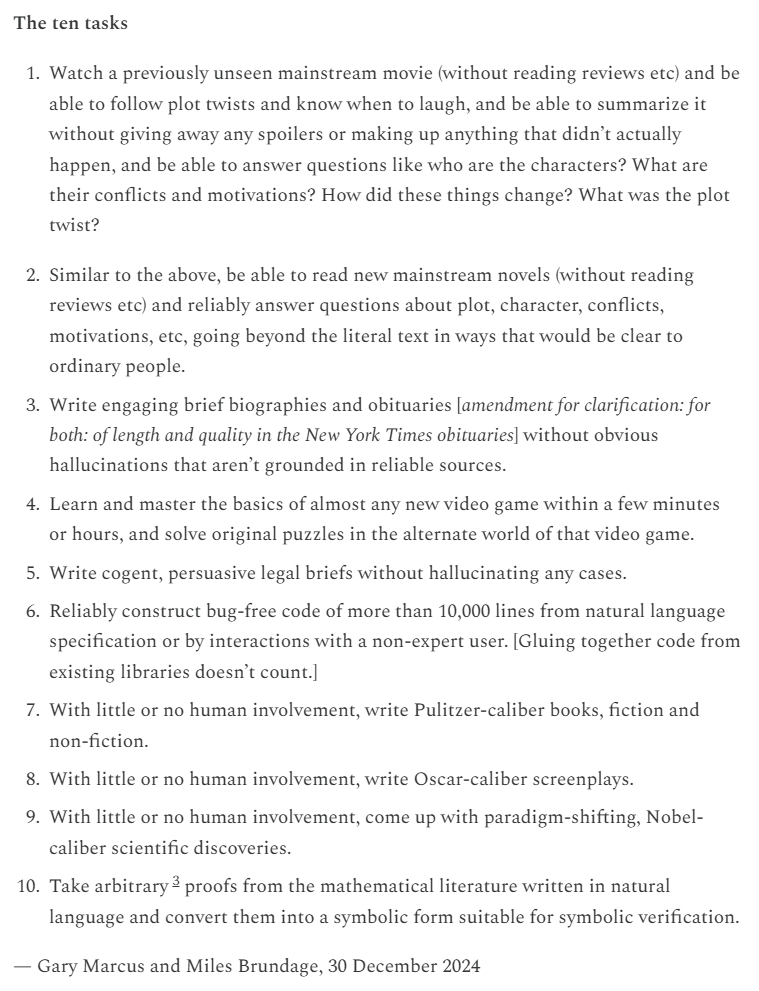
I disagree about the Gary Marcus predictions, except for the ones that require real-time intelligence.
1, 2, 4 (If you count turn by turn video games), 5, 6 and 10 seem to be achieved or achievable. 3, 7 and 8 are subjective.
9 is the one that clearly didn't happen, I think.
@jessi_cata Not sure we can be confident at most one of the Marcus-Brundage tasks can be solved with current systems (Gemini 3, chatGPT 5.2, Opus 4.5). I think that 2, 3, 5, 7 and 8 are all plausibly possible & would take time to evaluate. Four is unlikely, so it's still Probably Correct
@EigenGender with reasonable discount rates this brings you to something like single-digit billions as their wtp for avoiding all future true-deaths, this intervention only gives a fraction of this prize and I think would cost much more just in terms of logistical costs of hiding old cities
@EigenGender don't think the math works out (assuming the keepers can do fermi estimates and npv calculations): think their willingness to pay to avoid a single true-death was on the order of single-digit millions, they had maybe dozens of them per year