A talk I really liked at SIGGRAPH 2026: Dreamworks presented the stylized volumetrics they used on Bad Guys 2. There's no actual volumes at all! It's all handdrawn inspired stuff: some 2D, some projected onto 3D geo. Really cool/clever stylization work!
https://t.co/SsFZKNn6b0
We just pushed a new version of esoterica to github. This is the culmination of around 2 years of work. Massive improvements across the board most notably a modern DX12 renderer.
If you want to build your own engine, it's a great starting point!
https://t.co/wP0aYNCE0f
Absolutely beautiful rant about AI in Linux Kernel from Linus yesterday:
I realize that some people really dislike AI, but this is an area
where I'm willing to absolutely put my foot down as the top-level
maintainer.
Linux is not one of those anti-AI projects, and if somebody has issues
with that, they can do the open-source thing and fork it.
Or just walk away.
AI is a tool, just like other tools we use. And it's clearly a useful one.
It may not have been that "clearly" even just a year ago, but it's no
longer in question today.
There are other questions around AI (like what the economy of it will
actually look like in the end), but "is it useful" is no longer one of
those questions. Anybody who doubts that clearly hasn't actually used
it.
Yes, it can also be a somewhat painful tool, both for maintainer
workloads and just from a "it keeps finding embarrassing bugs"
standpoint.
But the solution is not to put your head in the sand and sing "La La
La, I can't hear you" at the top of your voice like some people seem
to do.
The solution is to make sure those LLM tools _help_ maintainers
instead of just causing them pain. There's no question on that side.
We're not forcing anybody to use it, but I will very loudly ignore
people who try to argue against other people from using it.
And no, AI isn't perfect. But Christ, anybody who points to the
problems at AI had better be looking in the mirror and pointing at
themselves at the same time.
Because it's not like natural intelligence is always all that great either.
The kernel project has been and will continue to be about the technology.
Sure, the social angle of working on open source is important and
often a very motivating part of the project, but in the end that's a
side benefit, not the _point_ of the project.
This is *NOT* some kind of "social warrior" project, never has been,
and never will be.
In the kernel community we do open source because it results in better
technology, not because of religious reasons.
And so we make decisions primarily based on technical merit. Not fear
of new tools.
Linus
Woah, almost all of EGSR 2026 was recorded, and they posted it all to Youtube. Wow! Big props to the conference organizers for doing this!
https://t.co/ORnX76f6b6
I find that baffling that for all Andrew Kelley's distaste of private enterprise, the one thing he could learn is how to handle comms, especially when you disagree with someone.
Imagine making a programming language out of genuine effort to make the world a better place. Of course you would love people use it, right? You would be interested in making a community around it to make sure that people feel welcomed, encouraged to try and experiment, etc.
You get three huge projects running Zig: @bunjavascript, Ghostty, @TigerBeetleDB. All of them are being developed by well known people, liked in the general tech sphere.
Bun decides to switch from Zig to Rust. You never liked what @jarredsumner was doing with Zig language, felt excessive, but hey, he's leaving Zig right? He writes the post that memory safety issues felt overwhelming and too problematic and made this huge big deal out of Zig to Rust migration, everyone knows about it. You want to write a blog post response.
What do you write?
You're bothered that it's framed as "memory safety" and simultaneously happy that "comptime abuse" (lol) has come to an end.
You could challenge @jarredsumner points, offer alternative moves, maybe even invite him over for a public talk.
Instead you... lash out on the guy, attack his management skills (???), talk about "beginner energy"?
What the post achieved? Would someone be confident to start an ambitious project in Zig now? Will they be called an idiot by the guy who's in charge of Zig's development because of wrong use of comptime? I bet @mitchellh and @jorandirkgreef will spend some time thinking what does it mean for their projects.
Absolutely ridiculous!
And finish the post with "¯\_(ツ)_/¯"
Aaaa!
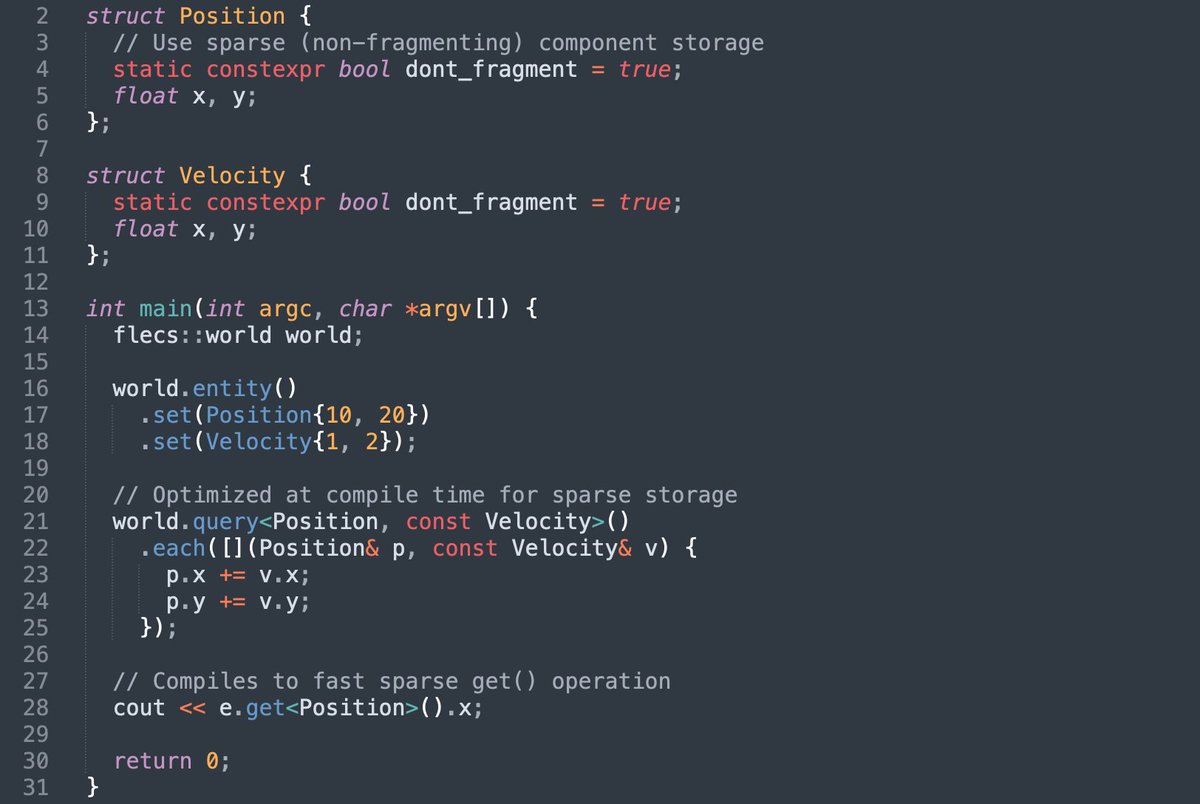
The next version of Flecs introduces compile-time C++ traits that massively boost sparse storage performance.
Flecs is now a true hybrid ECS where you can freely pick storages without sacrificing speed or flexibility! 🚀
More info: https://t.co/SHD8XMHxqG
📢TriFlow: Generating Artist-Like 3D Mesh Topology via Nearest-Vertex Vector Fields (ECCV'26)📢
Compact 3D meshes with clean, artist-like triangle topology - structured connectivity you'd expect a human modeler to make🙂
🌐https://t.co/PsrCkwUrCJ
▶️https://t.co/nlLTliWEEa
RenderDoc v1.45 is now available! This version has a number of bugfixes that have been found since v1.44.
Full release notes: https://t.co/dFgiZ7dmjn
Binary builds: https://t.co/aK8hVBqaxb
My humble experiments with crepuscular rays and cloud shadowing. A lot of useful information came from "Volumetric Clouds and Atmosphere in DOOM: The Dark Ages" by Yixin Wang, published in GPU Zen 4. More importantly, I launched it in real-time in Metal 4 using lvk-metal (https://t.co/ad1xgYhGYO) — my addon for @corporateshark's LVK library. Fully open-source and free to use for everyone, just like LVK itself.
I’m happy to announce the release of a new open source 3D physics engine called Box3D. I’ve been working on this project for a few years now, but it represents over 20 years of experience writing physics engines for games. Read more here: https://t.co/2d9aVuUsxj
In this thread: three cool rendering papers that DisneyResearch|Studios is publishing at EGSR this week. The authors of these papers are peers that I get the privilege of working closely with frequently, and these are projects I've been excited to watch develop! (1/17)
One of my proudest open source libraries, Earcut, just got a big refresh — now 55% faster on average (and up to 3x faster on complex polygons with many holes), and comes with a new refine function that updates any triangulation to Delaunay quality. Also got open issues to zero ✨