A new Catalyst pilot fund will start in August 2026, with a total grant pool of 2M $ADA.
We look forward to working with the community and supporting the Cardano builders. More details soon.
Read the announcement on the Forum and share your thoughts.
https://t.co/MbM7xZ7IKc
Cardano just became significantly more attractive to the US financial market. 🇺🇸
After a lot of work behind the scenes at the CF, @brale_xyz is now LIVE on Cardano.
Why does this matter?
American fintechs, enterprises and financial institutions can now leverage Cardano for:
🔹 Regulated stablecoin issuance
🔹 Programmable money and token-level compliance
🔹 Payments, settlement and treasury management
🔹 Connectivity between traditional banking infrastructure and on-chain finance
With the GENIUS Act reshaping the US stablecoin market, having the infrastructure in place to support regulated digital dollars is strategically important.
Combine this with Cardano’s programmable token standard, decentralised infrastructure and growing institutional ecosystem, and you start to see a very compelling proposition for American businesses.
Every new business that uses Cardano for its daily financial operations has the potential to generate recurring economic activity, irrespective of crypto market cycles.
This is how we build sustainable adoption.
Connecting traditional finance with decentralised infrastructure. Removing barriers. Opening new markets.
A big thank you to the teams at Brale and the Cardano Foundation who made this happen.
Cardano is stronger than ever. And we’re not slowing down.
Developers Office Hours, Friday 15:00 UTC
Adnan (@skepticus_x), Founder & CEO of SyncAI, on anyqr: bringing USDCx on Cardano to real-world QR payments with non-custodial on-chain escrow while merchants get local currency.
Register: https://t.co/kITfahSNb8
Project Catalyst is helping bring Swisscom Trust Services’ digital signature technology into Cardano business workflows through BlockSign.
Swisscom Trust Services is one of Europe’s leading trust service providers. Its published customer references include UBS, Mercedes-Benz, Baloise and Helvetia.
BlockSign connects that established trust infrastructure with Cardano: advanced and qualified electronic signatures, integrated business workflows and verifiable document-hash evidence.
Swisscom Trust Services has itself publicly highlighted the collaboration’s Cardano anchoring.
A key achievement: BlockSign GmbH has been ISO/IEC 27001:2022 certified since 12 August 2025. Issued by DQS, the certification covers our information security management system for electronic signature and identity services across Web2 and Web3.
Certification was originally envisaged for a later project stage. We achieved it and incorporated the verifiable certificate into our revised Milestone 2 deliverables.
Our starting point:
Our Fund13 project, “Bridging Web2 to Web3 with Swisscom: Onboarding SMEs to Cardano with Digital Signing,” began with a practical goal: help businesses use Cardano through document processes they already need.
What we have built so far?
Businesses can prepare documents, involve the relevant signers and obtain signed documents with supporting verification information.
Cardano adds another layer of evidence. In workflows that use blockchain anchoring, a document hash is recorded in Cardano transaction metadata. The original document remains off-chain, while its integrity can be checked against the recorded hash.
The signature supports authorization; the blockchain record provides additional evidence of document integrity.
Real business use has guided this development. Our work with Hausakte24 includes rental-contract signing and electronically signed delivery confirmations for service-charge statements.
These use cases guide improvements in usability, responsibilities and verifiable records.
Our current focus: Milestone 3 🔵
Milestone 3 brings the document workflow together, from upload and preparation through signing, download and verification.
The work covers AI-assisted document checks, multilingual access, user guidance and scalability observations.
Demonstrations, project updates and pilot reporting show the Cardano community how the funded work translates into a usable service.
What comes next in our Catalyst roadmap?
- Milestone 4 focuses on user testing, structured feedback and documented improvements to usability and product maturity.
- Milestone 5 focuses on business integrations: connecting signing workflows to external systems through APIs and onboarding customers both within and outside the Cardano ecosystem.
- Milestone 6 brings the results together through customer reports, pilot outcomes, project documentation and public demonstrations of what has been achieved.
Our priority is sustained use: businesses relying on BlockSign in their daily operations.
Beyond the current project
We are also exploring directions that could inform future @Catalyst_onX proposals.
These include broader document lifecycle management, controlled access, decentralized storage options and stronger traceability across business processes.
We are assessing where established providers make sense and where additional development could create value. We are also investigating how decentralized evidence can complement established certificate-based trust models.
These remain exploratory directions for potential future work.
Our commitment to the @Cardano community is to make progress visible, explain what the technology contributes and build services that customers have a reason to keep using.
Our goal is lasting business adoption, beyond the final Catalyst milestone.
@Swisscom Trust Services signatures. Cardano evidence. Connected by BlockSign.
one of the objectives i'd like to see achieved next year is to largely eliminate speculation and/or poor cashflow management for project teams in delivery
namely by their ability to claim/hedge funding received in ada via @catalyst_onX with help of
A: stablecoins
B: futures
now that both are available on cardano - there's only admin/legal hurdles to overcome but the mix should be plausible
Today, the final milestone of my proposal was approved and signed.
A big thank you to @Catalyst_onX team for all the support and thanks @Cardano community for making opportunities like this possible.
We've been working with coffee producers in Mexico, developing and testing a traceability platform builton Cardano.
One of the biggest challenges was explaining how blockchain could bring real benefits to agricultural projects.
During conversations with producers, we discussed why certain records should be independently verifiable, especially when it comes to regulatory compliance.
But an equally important question emerged: What information should actually be public?
For example, a farm's geolocation can be sensitive information. We chose to record a hash instead of exposing the coordinates, allowing the integrity of that information to be verified without making it public.
This experience reinforced something I believe is essential for blockchain adoption:
We need to identify information that genuinely benefits from transparency, immutability, and independent verification, then understand how those properties can help people make better decisions, reduce costs, or save time.
I'm excited about what we've built and open to exploring collaborations, new applications, and opportunities to take the project further.
The platform is open source, so anyone interested can explore what we've built.
https://t.co/qK3lXM1u7q
https://t.co/hK2SsfMf2z
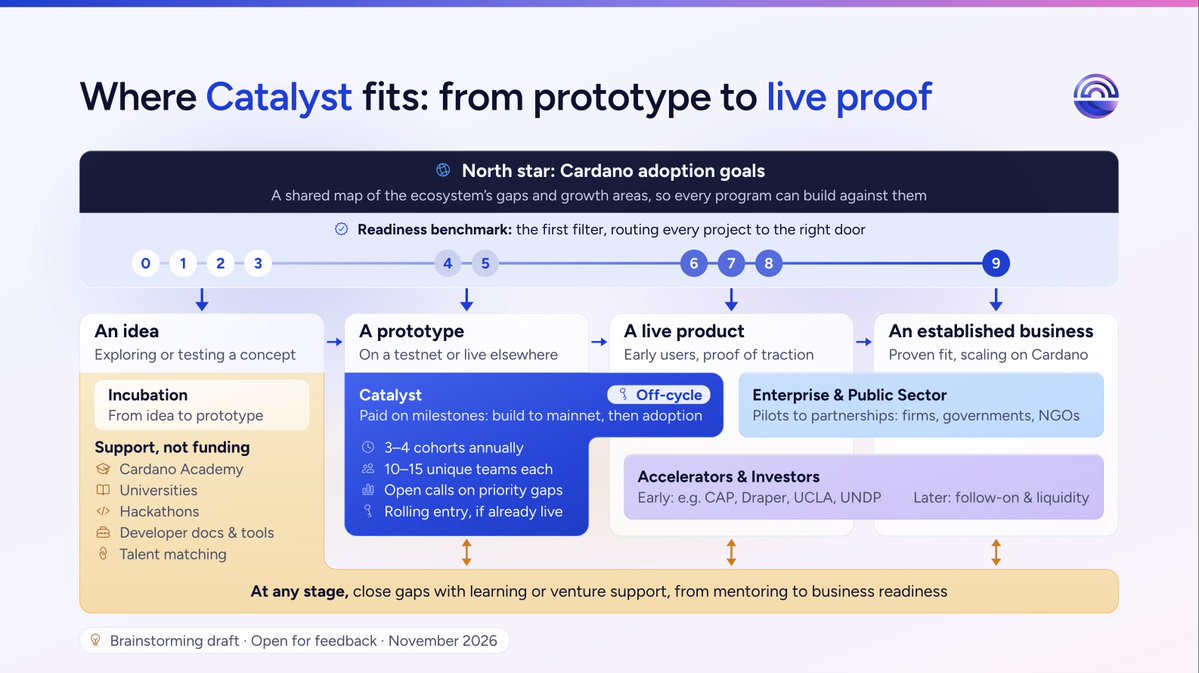
just brainstorming out in the open the ongoing @catalyst_onX reform and where it just might fit the best - this is personal sketch of how i try to picture this in my mind - so let's test some assumptions
historically - for number of reasons - catalyst served the need of everything to everyone
which worked for a while until not as much as landscape has shifted with rapidly diminishing returns
with new era as times change - that model now can - actually must - iterate because there are other facets of the ecosystem that are taking (or have already) different responsibilities
this allows catalyst to finally - for the first time in years - to sharpen its focus. so let's see how this might work out
teams show up at really different stages, and one funding round can’t serve all of them well. so the sketch splits things into four stages (idea, prototype, live product, established business) and asks which door makes sense at each one
everything points at the same north star, cardano adoption, with a shared map of gaps and growth areas so every program and institution is pulling toward the same priorities. this is set by the ecosystem at large - not programs like catalyst in isolation
im less interested in having blanket responsibility for everything - but have programs be judged on a narrowly defined benchmarks/kpis tied to the specific program against specific adoption goals
so that we can all have same conversation / expectations about what success looks like with time passing
up top there’s a readiness benchmark from 0 to 9, based on the tech readiness levels catalyst already uses for cardano and trialled in the latest pilot. every project gets a level on day one, which routes it to the right door and saves reviewers time on stuff that isn’t ready yet
in this version catalyst picks up at the prototype and takes teams through to live proof
a big reason is...AI
going from an idea to a working prototype is way faster and cheaper than it used to be, so the funding gap at that stage has shrunk a lot. at that point money often isn’t what a team needs most. feedback and the right people around them usually help more
funding goes much further once there’s something real to build on imho
so funding would start around readiness 4-5, through open calls on priority gaps, and get paid out on milestones. first the build to mainnet, then actual adoption
thinking 3-4 cohorts a year with 10-15 unique teams each (following the agility and early pilot observations), so we can count and report what’s being done against each gap
if you’re already live with early users (6-8) and miss a cohort, you could still come in off-cycle on a rolling basis, but the bar is much higher there. you’d need real usage, a track record of shipping and a clear fit with a priority gap - a trade off against not missing an obvious opportunity if it pops up
ideas (0-3) wouldn’t get direct funding. incubation helps get them to a working prototype, with cardano academy, universities, hackathons, dev docs and tools, and talent matching around it. tho am conscious that this means that we need to - where missing - figure out as an ecosystem how best to serve those execution gaps as well - as catalyst can't be responsible for all, certainly not on its own
once there’s a prototype, the team applies to catalyst and off they go
further along, live products and established businesses move into pilots and partnerships with firms, governments and ngos, or on to accelerators and investors for early rounds, follow-on funding and liquidity. learning and venture support sit underneath all of it - that makes a lot of sense to me at least
the doors after catalyst matter a lot. legacy catalyst mostly worked like an island absent of active follow on pathways
a project got its grant, and when the money ran out it either fell off a cliff or came back for another round, and that loop doesn’t help anyone grow - in fact creates dependency layer that's counter productive long term
my desire is to see these early funding loops to lead somewhere and have a chance. teams that do great work should have a next step lined up, so good people stay in cardano and keep getting better each time they move up
and for that they need a map - a clarity of expectations and tangible programs that will bring them there - this is where coordination in this ecosystem becomes invaluable
if we tell this story coherently - it will be easier to convince talent to stay and equally to attract new one coming into the space - because they can envision for next five years could look like
innovation and adoption are extremely hard to navigate where failure rates are really high by default - so we really need to be honest about expectations versus reality
yet it's the only way how humanity has learned how to progress over millenia - try, fail, try agian, fail again, try once more (maybe even something else) until finally it sticks and levels us all up
rinse and repeat and i applaud everyone who relentlesly chips into that collective sense of humanity along the way
what's on your mind today? chip in below
Cardano. Let’s talk about it.
We’re hosting a live AMA with the Cardano Foundation Executive Team this Thursday, 19 November, at 16:00 CET.
Drop your questions here, we’ll take as many as we can live. Link to Space is below.
Pilot for @Catalyst_onX has recently concluded all the onboarding steps including post due diligence checks.
The final seven:
- @wayupio by @AnvilDevAgency
- @ATLAS_DEFI_
- @L4VAprotocol
- @liqwidfinance
- nuhuman by @NucastIO
- Any to Any by @VIA_Labs
- anyQR by @SyncAI_Network
All teams are now deep in their technical phase of the @cardano build out. Next stop - demo day and adoption windows.
Looking forward to see what they'll all bring to the table. More to come soon.
AnyToAny is cleared for takeoff in the @Catalyst_onX Pilot 2026!
It will turn stablecoins and tokens on EVM chains into any Cardano token, and back, in one step.
Big thanks to @dannyribar and the Catalyst team. Now we build.
More soon👀
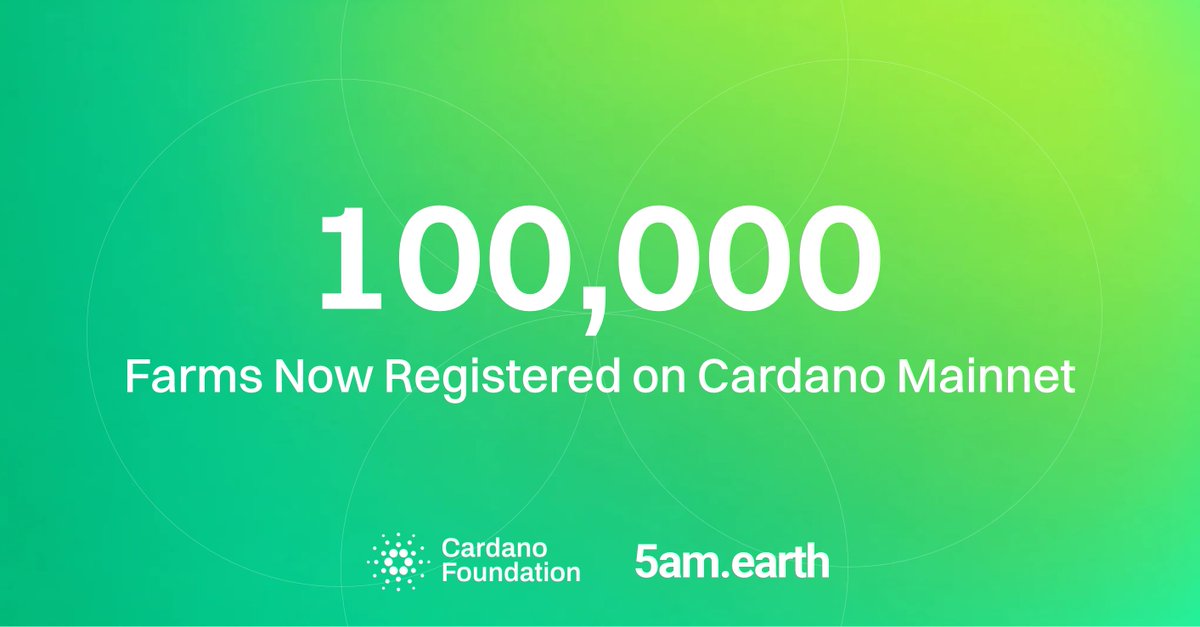
JUST IN: 100,000 farm lands in India are now registered on the Cardano blockchain.
This marks a milestone for https://t.co/QKQl4Cqs8X’s agricultural trust layer, bringing farm data on-chain to support more verifiable, reusable records across the ecosystem.
SyncAI has officially been onboarded to @Catalyst_onX for the 2026 Pilot!
It's time to connect Cardano to everyday commerce and we're going to help achieve that by making Cardano stablecoins spendable in the real world with anyqr.
Thank you to the Catalyst team for the hard work and commitment to elevating Catalyst funding standards, we are thankful for you.
Next stop: mainnet
Yesterday, we kicked off our multi-year partnership with UCLA.
In the first Cardano masterclass at @UCLAAnderson, students designed and pitched Web3 businesses with AI-assisted smart contract development.
The next generation of builders starts with education like this.
great video! 👏
as of today - seven out of twelve conditionally selected projects building on @Cardano have passed the onboarding and had their funding affirmed in this summer @catalyst_onX pilot
onboarding is where we double click across all elements of the teams + their proposals to identify where all stands in real terms
as such - with threshold standards high - it's unlikely that all twelve will get the go ahead - as this isn't a quota - it's a ceiling.
so far - the go ahead received - in no particular order - these teams:
@wayupio / @AnvilDevAgency@ATLAS_DEFI_@SyncAI_Network@L4VAprotocol@liqwidfinance@VIA_Labs@NucastIO
legacy Catalyst is being wind-down, new era is being tested and we're really excited with the team to see how it plays out. so far pretty good. cautiously optimistic that new model far exceeds the legacy capabilities
quantity < quality is the new theme
more to come 👨🍳
We're honored to be 1 of 12 selected out of 120 applicants in @Catalyst_onX to receive a 200,000 ADA grant, unlocking AI asset manager, $USDCx integration, and oracles on @PythNetwork.
This is jet fuel for our roadmap🔥
Onboarding is now complete 🚀
Thanks @dannyribar and team for the hard work!
https://t.co/vIi666ZINh
Officially onboarded to Project Catalyst!
Huge thank you to the @Catalyst_onX team and the Cardano community for the support!
Now let’s build this MONSTER. 🔥
Fully on-chain. Cardano-native. Stablecoin-powered PERPS DEX.
$ATLAS mainnet launch date dropping NEXT!