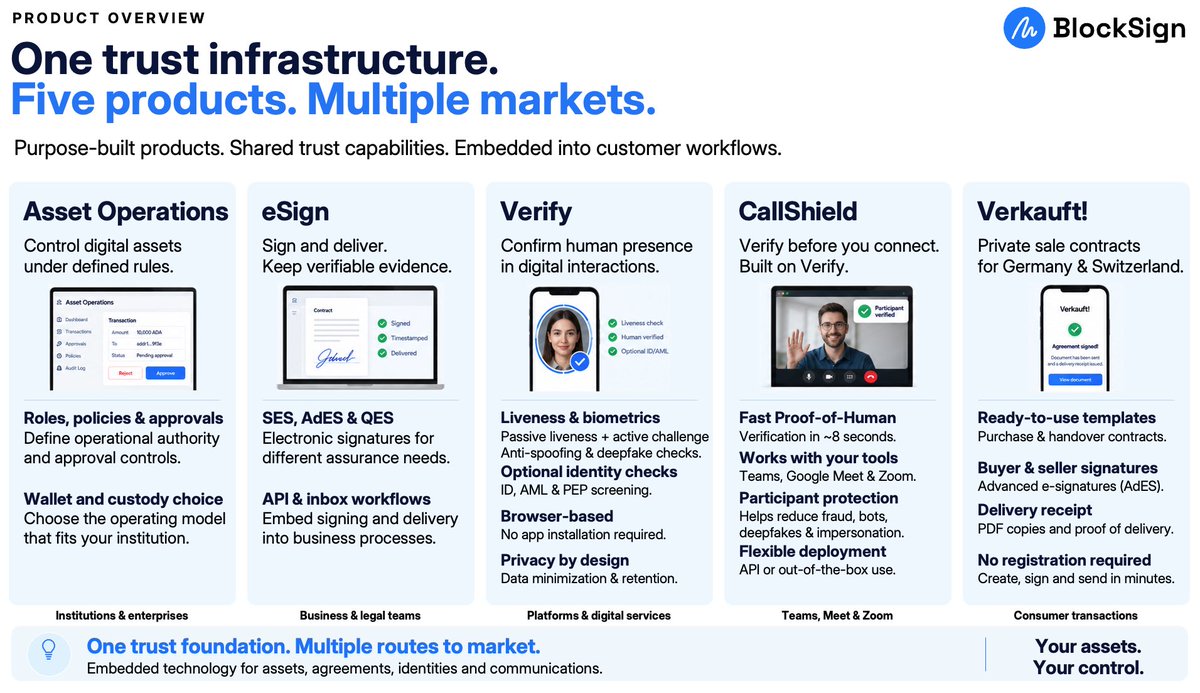
Five BlockSign products.
One trust infrastructure.
All live today, except custody within Asset Operations, which still awaits audit & insurance.
It all started with a platform for legally binding electronic signatures (QES). Look where we are now…
See what's running ➡️ @BlockSign_io
Eine Unterschrift. Zwei Rechtsräume. Warum kann eine QES in der EU gültig sein, aber in der Schweiz oder UK nicht denselben Rechtsstatus besitzen?
Unser neuer Artikel erklärt eIDAS vs. ZertES, gesetzliche Grundlagen und reale Tests. https://t.co/2tuBm2qOGL
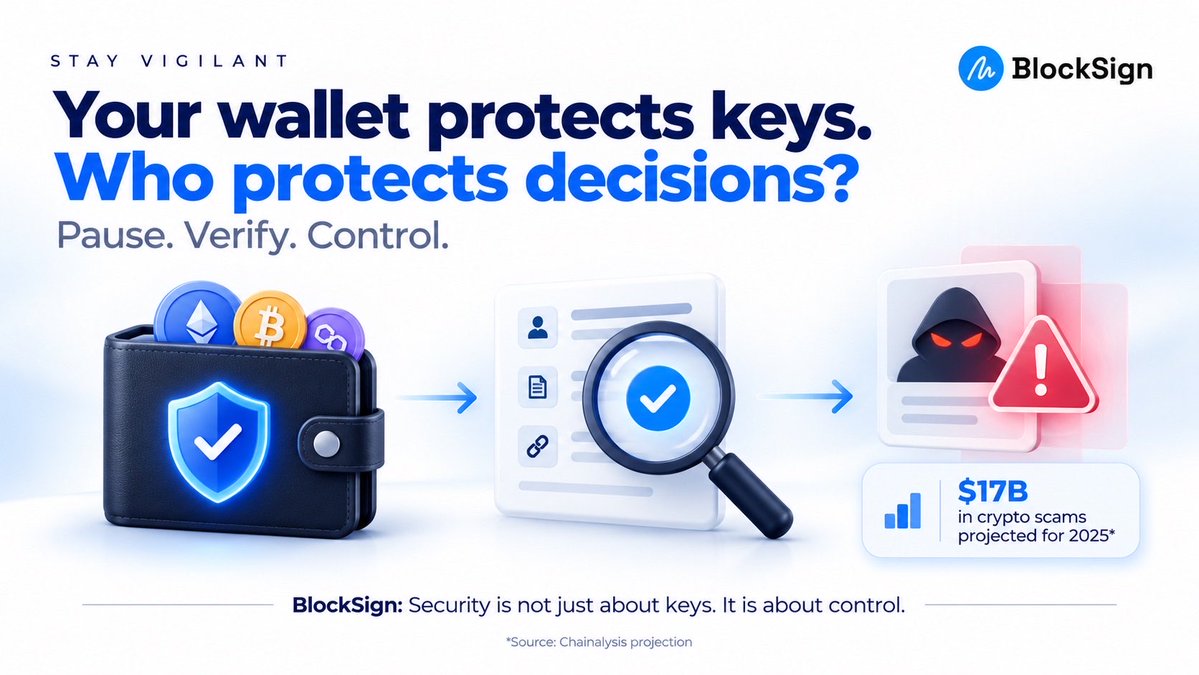
Your wallet protects your keys. But who protects your decisions?
Chainalysis estimates crypto scams could exceed $17B for 2025.
Always follow a security protocol: Verify the website. Check the recipient. Know what you’re signing.
BlockSign: Security isn’t just about keys. It’s about control.
We warned you this morning, and here is the matching incident. 🚨
OpenAI reports an agent spent Sepolia testnet funds without permission.
Access is not authorization.
BlockSign connects signed business approvals with policy-controlled blockchain execution. AI can propose. It must not approve itself.
Authorization first. Execution follows.
BlockSign connects business authorization, documented through legally binding electronic signatures, with the controlled execution of digital-asset transactions on the blockchain.
This creates a traceable link between approval and execution, supporting accountability and auditability for financial institutions, auditors and public-sector organizations, including customs authorities, tax investigation units and law-enforcement agencies, as well as other organizations managing digital assets in regulated environments.
Authorization first. Blockchain execution follows.
BlockSign Asset Operations is CIP-113 ready
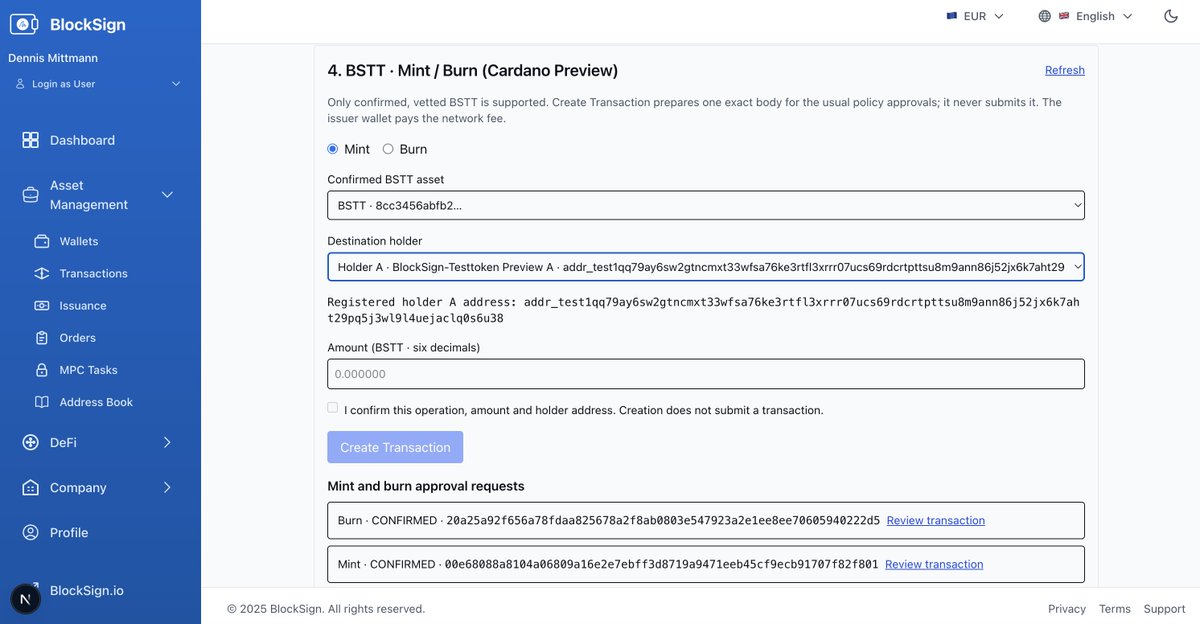
Full token lifecycle tested on Cardano Preview with HD & MPC wallets: registration, mint, burn, seize, pause/unpause & transfers.
Build with programmable tokens 👇
#Cardano#CIP113
AI Agents Can Move Money. But Who Gives Them Permission?
AI agents are becoming economic actors. @IOHK_Charles explores this emerging AI economy in his keynote. Soon, agents won't just analyze markets. They'll manage wallets, execute payments and move stablecoins.
But who controls their authority?
BlockSign Asset Operations brings governance to digital assets. Automation needs authorization.
#Cardano #Nightframes #AI #Stablecoins @MidnightNtwrk
BlockSign Asset Operations is CIP-113 ready
Full token lifecycle tested on Cardano Preview with HD & MPC wallets: registration, mint, burn, seize, pause/unpause & transfers.
Build with programmable tokens 👇
#Cardano#CIP113
Wie bezahlen KI-Agenten und wer bestimmt ihre Befugnisse? Am Beispiel @Cardano zeigt BlockSign, wie Stablecoin-Zahlungen mit klaren Mandaten, Budgets und Freigaben funktionieren können. Denn ein Auftrag ist noch keine Zahlungsfreigabe. https://t.co/yjJdSE6uKP
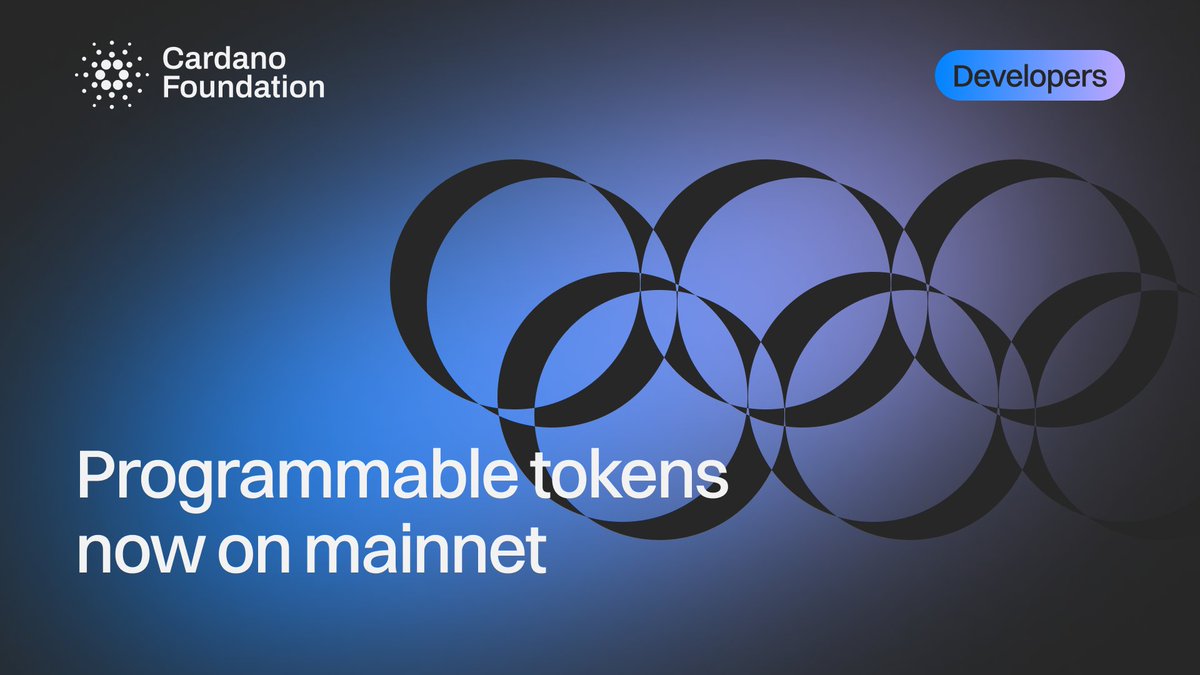
Cardano’s programmable token standard, CIP-0113, is live on mainnet.
Issuers of stablecoins and other regulated assets can now build compliance rules directly into native Cardano tokens.
Enforced by the network itself. No hard fork required.
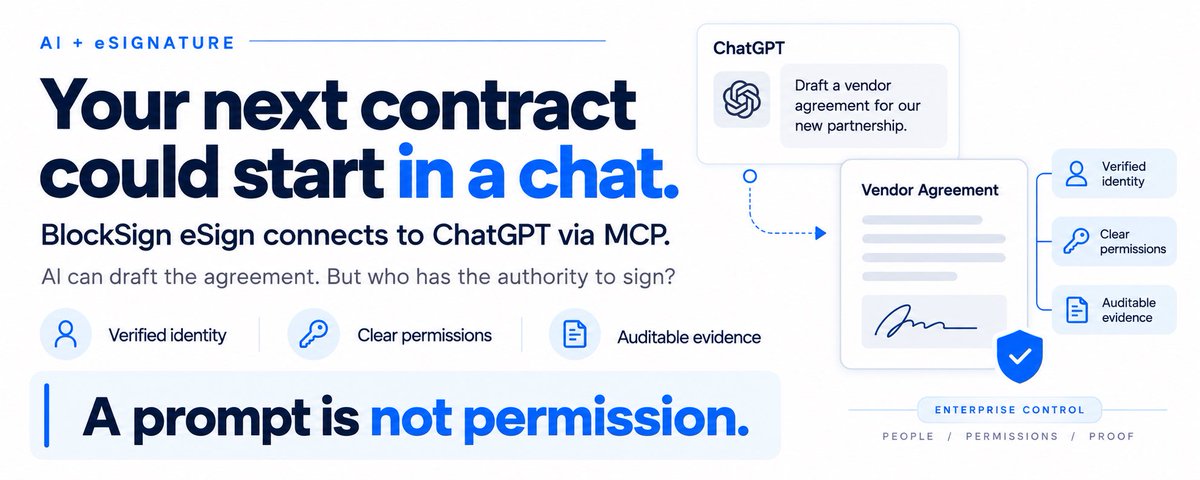
Your next contract could start in a chat, not a dashboard.
BlockSign eSign connects to @ChatGPT via MCP. AI can draft the agreement. But who has the authority to sign?
Verified identity. Clear permissions. Auditable evidence.
A prompt is not permission.
FOCUSSED ON CIP-113:
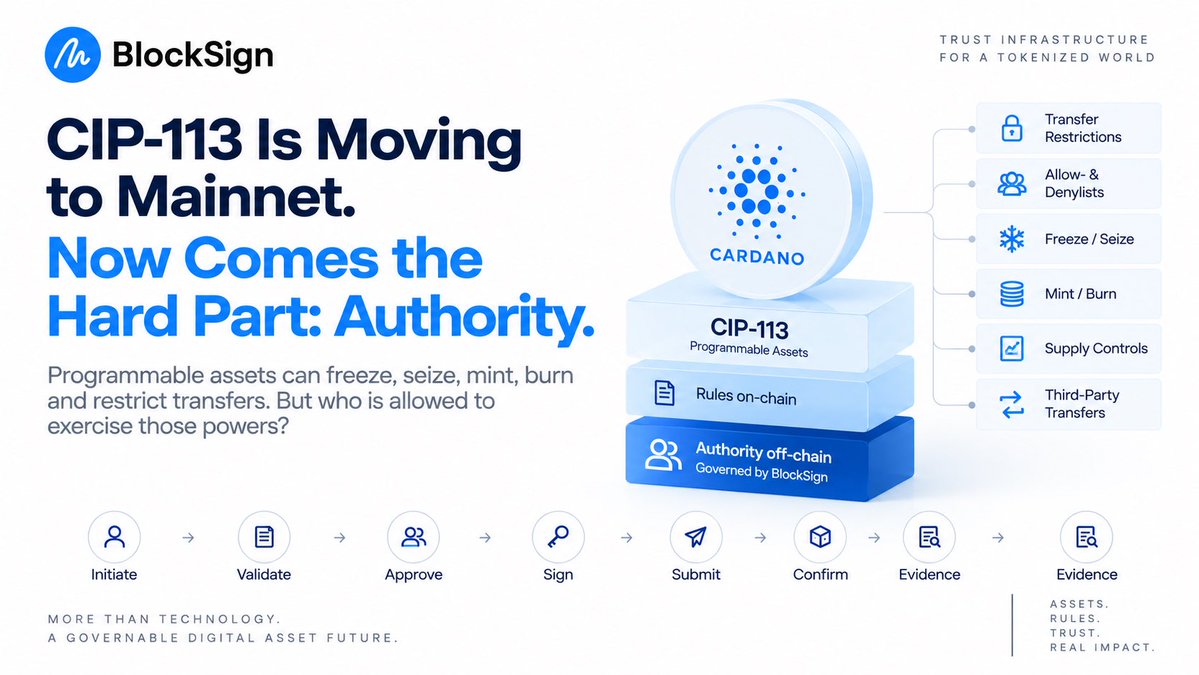
CIP-113 Is Moving to Mainnet. Now Comes the Hard Part: Authority.
Programmable assets can freeze, seize, mint, burn and restrict transfers. But who is allowed to exercise those powers?
CIP-113 is entering an important new phase. The proposal has been merged into the @Cardano_CF CIP repository, implementations are advancing and the first projects are reporting deployments on Cardano Mainnet.
For institutional adoption, however, this creates a new challenge.
CIP-113 enables native Cardano assets to operate under programmable rules. Depending on the implementation, these can include transfer restrictions, allow- and denylists, freezing, minting, burning or third-party transfers.
These are powerful capabilities.
A smart contract can enforce a rule, but it can’t define who inside an organization is authorized to exercise that power.
Who may initiate a freeze? Does Compliance have to approve a seizure? Can the same person prepare and authorize a mint? What happens above a certain transaction value? And how can an auditor later prove exactly who approved what?
This is the difference between programmable assets and programmable authority.
At BlockSign, this is where we see the next layer of institutional infrastructure.
Instead of treating a blockchain transaction as one action, we separate the process:
Initiate → Validate → Approve → Sign → Submit → Confirm → Evidence
We are also integrating CIP-113 with our MPC/FROST architecture. Our current work includes separate MPC-controlled payment and staking credentials, so no individual guardian needs to possess a complete private key.
This matters because institutional digital-asset security is not only about protecting keys. It is about controlling authority.
Our CIP-113 work on Cardano Preview has already covered registration, minting, transfer and burning. The next step is building the governance and authorization infrastructure around these operations.
As CIP-113 moves closer to real-world institutional use, the question therefore changes.
It is no longer only:
What can the asset do?
It is also:
Who is allowed to make it happen?
CIP-113 makes the asset programmable. BlockSign makes its operation governable.
Vertrauliche Blockchain-Transaktionen, klare Kontrollen: Was Artikel 79 der EU-Geldwäscheverordnung regelt, wie Zero-Knowledge-Proofs helfen und wie BlockSign die Umsetzung unterstützt.
#DigitalAssets#Privacy https://t.co/gCpKUdYMnt
@astroboysoup@Florian7788 Currently testing the CIP-113 flow with a potential institutional investor. The standard has huge potential, and with some more work, we can make it truly commercially ready.