Investor and researcher. 15y public-equity PM and VC. I track sector shifts and read emerging tech from startups through to listed names. More in my Substack!
Yesterday the Japanese MoF intervened into the FX market, sending the currency up by as much as 3.3% to the 158 for USD.
It followed the yen's slide to a four-decade low near 164 earlier in July, driven by elevated energy import costs and a wide US-Japan policy rate gap, with fiscal concerns under the Takaichi administration adding pressure.
However, as widely expected, the Bank of Japan held its policy rate at 1% the following morning. So there is no lasting support for the move.
Why it matters for US equity investors
The risk is the repeat of 2024 episode, when Nasdaq 100 fell 13% as the yen appreciated 14% against the dollar following the Bank of Japan's July 2024 rate increase and MoF intervention. Investors holding yen-funded positions sold US momentum stocks to meet the currency move.
In the absence of interest rate hikes there will be no trend reversion. The limited intervention in itself is not enough for carry unwinding like in 2024 => the risk for risk assets is limited.
Microsoft experiencing gross margin deterioration, because of the mix change. Business lines based on hardware have structurally lower margins. As capex into hardware increased considrably and will stay high for soem to come, the shift towards hardware based revenue is not over, so pressure on margins should continue. However Microsoft has levers for mitigation, such as own ASICs, routing to cheaper models, bundling, direct token billing and new product offering targeted at agentic workloads.
@coatuemgmt Yes,Google Search economics improved since they launched AI overview. Google is doing excellent job adopting the business to the new AI realities. I believe they will be key winners in the AI era.
@stocktalkweekly Microsoft controls the harness and the route to the model. So it can optimise for the best and most economically viable option, in effect controlling the money flow.
Why hyperscalers are likely key winners in AI ecosystem
Model diversification is as a margin improvement opportunity. Satya Nadella said Maia 200 delivers 30% better performance per dollar than the latest generation hardware in the fleet and now supports both OpenAI and MAI models, with a further 40% better performance per watt when running MAI models on that silicon.
Agent 365, launched two months earlier, has nearly 40 million agents registered across tens of thousands of companies, and Microsoft Purview has audited over 15 billion Copilot interactions to meet customer compliance obligations, up nearly 360% year on year. Foundry now has 100,000 customers with revenue more than doubling, the number of Foundry customers at a one trillion token annualised run rate rose 4x, and Microsoft says tens of thousands of customers including nearly 90% of the Fortune 500 ground their agents in Foundry, Fabric and Work IQ.
Nadella described keeping the harness separate from the model so that memory, context and action space sit outside any one model family, which makes every model substitutable and, in his framing, protects customers from the refusal or withdrawal of a single provider. That design deliberately erodes lock-in at the model layer and relocates it to the control plane, where identity, observability of token spend and audit trails accumulate switching costs that model access alone does not generate.
Microsoft’s business is in transition. Cloud and AI compute are driving the growth and become dominant. It changes structure of business economics. The key being that these business lines carry lower margins. I believe however that we are in or close to the trough of business transformation, where capex is high, but the related uplift from adjacent services did not arrive yet. The growth of AI related business lines open new TAM opportunities, mainly providing all round AI and agent management services to enterprises. At the same time the cost efficiency and delivery optimization will help margin expansion. The key question for me to watch is: where is the natural floor for the gross margins as cloud business scales and depreciation kicks in.
This is true to an extent. The products labs shipped are not deep enough to pose a serious competition. For it to function, they need product teams for every vertical on par with specialised solutions. So far it is not feasible. The best they can do so far is to bite on the margins from those products.
Having said that I believe that every company need to own own or at least tuned model for its core business process. You cannot outsource the decisions on key business proposition to the third party. It is a strong argument for open source.
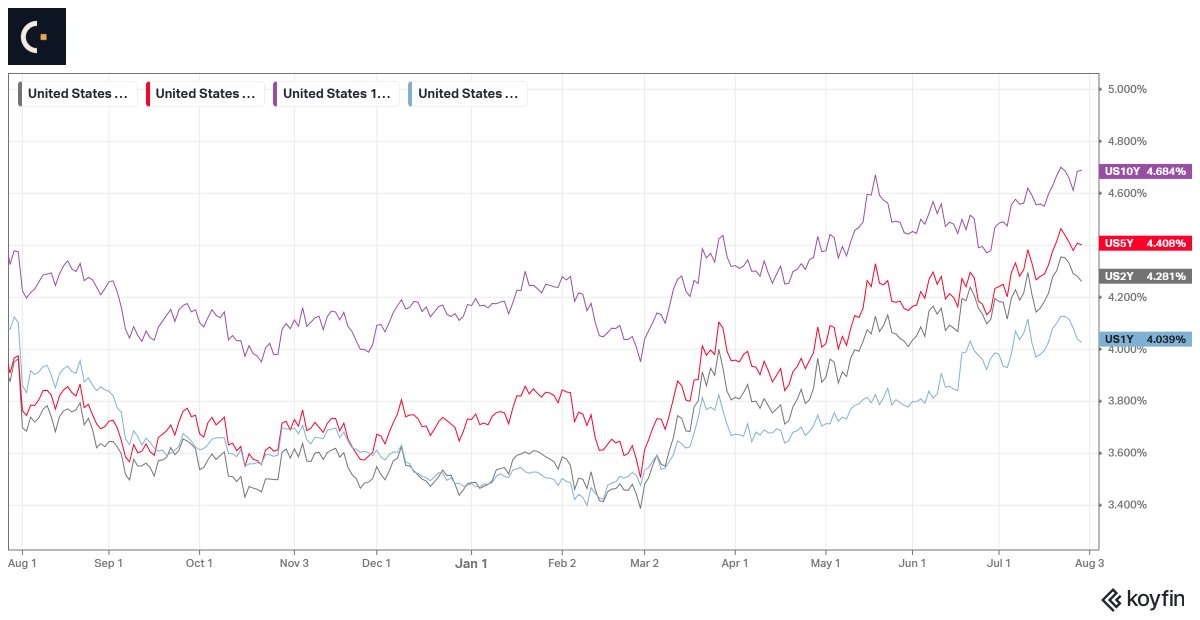
I was a bit surprised to see weaker dollar after yesterday’s FED meeting. When I looked at yield curves, there is divergence between short dated and long dated bonds. 1Y and 2Y yields went down. 10Y and 30Y went up.
Apparently the move down in the front end is the unwinding of the hike bets (were priced at around 30% probability before the meeting). Long end prices higher inflation in the longer run. Effectively the market doing tightening without formal rate hikes.
For me, as equity investor, it means higher volatility and the risk of overshooting in the absence of rates anchor. Also if the long end yields will stay higher for longer, I will need to increase my discount rates in the models, which will affect stocks with highest terminal values.
We are at or near the top in this cycle. Memory stocks are great for trading, extremely risky for investing.
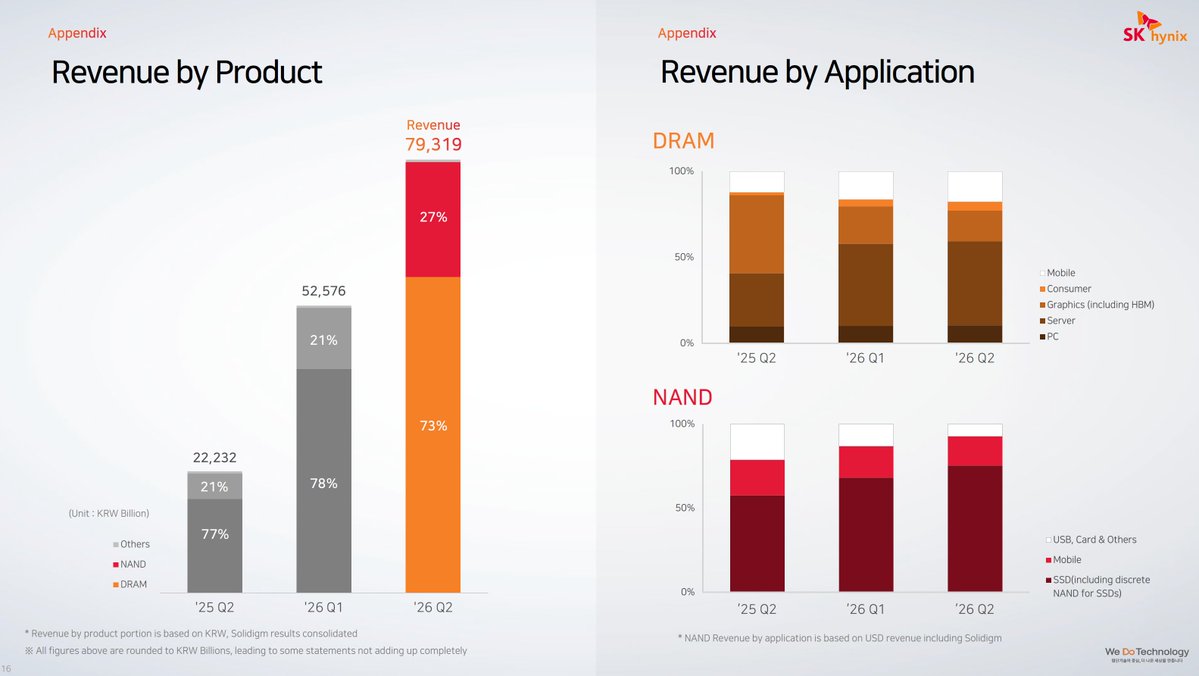
Sk Hynix grew 257% in aggregate, yet almost none of that growth came from HBM (which is protected by LTAs). >80% of revenue comes from commodity DDR and NAND. SK Hynix remains cyclical even more exposed than before.
The company grew 257% in aggregate, yet almost none of that growth came from HBM (which is protected by LTAs). >80% of revenue comes from commodity DDR and NAND. SK Hynix remains cyclical even more exposed than before. We are at or near the top in this cycle. Memory stocks great for trading, extremely risky for investing.
SK Hynix 2Q results show HBM makes around 14% of the revenue. More than 80% of the business is exposed to the memory spot pricing. The long-term agreements do not solve the memory cycle problem. I believe DDR memory is at or near its cyclical peak.
SK Hynix disclosed in its second quarter presentation that DRAM accounted for 73% of the 79.319 trillion won ($54.1 billion) in revenue and NAND for 27%. Graphics revenue including HBM falling to ~19% of DRAM revenue from 47% a year earlier.
Conventional DRAM sold into server, PC, mobile and consumer applications, together with the entire NAND business, accounted for around 86% of group revenue, up from 62% a year earlier.
Revenue from the graphics and HBM category grew approximately 37% year on year, to around 11.0 trillion won ($7.5 billion) from 8.0 trillion won ($5.5 billion), while conventional DRAM revenue grew roughly 417% and NAND revenue 359%.
The company grew 257% in aggregate, yet almost none of that growth came from HBM.
HBM is sold on annual contracts negotiated well in advance. Server DDR5 and NAND reprice quarterly against a spot market that has skyrocketed. DRAM average selling prices rose approximately 30% in the quarter and NAND prices climbed in the mid 50% range.
The re-rating of the stock is based on the assumption that HBM converts memory from a cyclical commodity business into a contracted, co-designed, defensible franchise. But the company's disclosure indicates that the AI capital expenditure cycle has instead pushed the revenue mix further toward commodity exposure, because conventional prices rose faster than contracted HBM. On these figures SK hynix enters the peak of the cycle with a larger proportion of revenue exposed to spot-referenced pricing than it carried at the start of the upturn
The company noted that LTA negotiations had been concluded with around 10 customers. We don’t know what share of LTAs is HBM and what conventional DDR. I believed it should be heavily skewed to HBM. If so the contracts would stabilise the 14% of revenue that was already the least cyclical while leaving >80% exposed to the price swings.
SpaceX: Lock up for up to 911.5m shares, ~20% of locked stock, roughly $123bn is set to expire on 6th of August. Another 28% post 3Q report. SpaceX made a lot of people rich, I am sure they are waiting impatiently to see the money at last. Very difficult to perform against such a flow.