We just crossed 7,500 subscribers on Substack and we’re grateful to everyone who has joined us.
In an internet built around outrage, clickbait, and hot takes, 7,500 people have chosen something different: serious Catholic thought.
For nearly 50 years, Catholic Answers has been on the front lines helping people understand and defend the Faith through radio, books, articles, and now Substack.
The platforms can change but mission doesn’t.
Subscribe to become part of the mission:
https://t.co/E58UWR3Rk0
This is very strange. I did a 2.5 hour debate with James White defending the proposition that the Mass is a propitiatory sacrifice, only to have an online Protestant apologist falsely claiming that I don't talk about the Eucharistic Sacrifice, and hold to views that "are actually out of step with even [the Council of Trent itself."
No evidence is given of this assertion, and when @ErickYbarra3 asks, "Do we have evidence that either
@Trent_Horn or @ShamelessPopery denies that a real and proper sacrifice takes place upon the altar?," he answers "I never claimed that they denied this."
Very strange behavior.
"The Church taught for 1500 years that heaven was in the sky"
There is simply no solid ground for such a sweeping historical claim.
At most, you could point to about five centuries of mainstream Latin theology (c.1150-1650), which placed Christ’s risen body and the saints in a real, bodily “empyrean” heaven above the stars. But the same sources deny that God is located in the sky, and they separate heaven from the visible sky.
But more to the point: there is no creed, council, or pope in the first 1500 years of Christianity that defined where heaven is. The Church did not settle this question. And if someone wanted to redefine "the Church taught" to mean "lots of theologians speculated," well, there is still no consensus of theologians across the centuries on this question.
That is why two recent popes could, without reservation, say that the depiction of heaven or God as being "in the sky" is not to be taken literally.
Pope Benedict XIV: “All of us today are well aware that by the term ‘heaven’ we are not referring to somewhere in the universe, to a star or such like; no. We mean something far greater and far more difficult to define with our limited human conceptions” (General Audience, Aug. 15, 2010).
Pope St. John Paul II: “In the context of revelation, we know that the ‘heaven’ or ‘happiness’ in which we will find ourselves is neither an abstraction nor a physical place in the clouds, but a living, personal relationship with the Holy Trinity. It is our meeting with the Father which takes place in the risen Christ through the communion of the Holy Spirit” (General Audience, July 21, 1999)
One more time:
1. Witnesses supposedly saw Jesus ascend to the sky and understood that to be where heaven was.
2. The church taught for 1500 years that heaven was in the sky.
3. Angels were given wings because heaven was in the sky.
The recent conversations on whether "loving God," doing good works, obedience, etc., are necessary for salvation continue to baffle me. Particularly, Reformed Baptists online seem to think that affirming such a thing is a denial of the Gospel (and, really, is "Catholic" at its core). On the contrary, such affirmations are explicit in their tradition.
Yes, you heard that right: Respectable, Reformed Baptist authors - who believe in justification by faith alone, perseverance of the saints, irresistible grace, etc. - explicitly argue that obedience is necessary for final salvation.
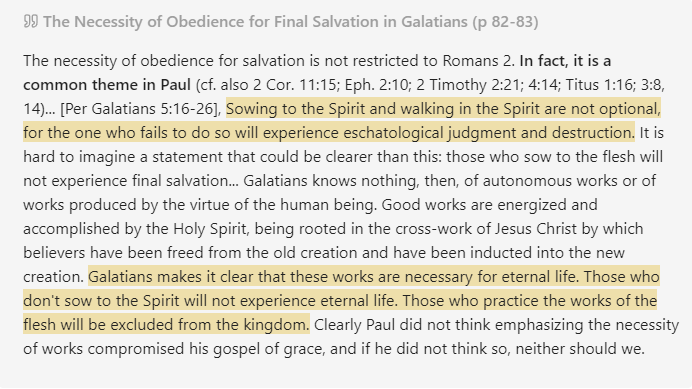
I am not merely talking about the more "theological" or "scholastic-minded" authors that you can only read if you search for Old English OCR scans online. Contemporary Reformed Baptist author Thomas Schreiner says the following in "Four Views on The Role of Works at the Final Judgment" (see attached).
Now, obviously, I am not saying this to point to some Reformed guy as if we are in complete alignment about this question. In fact, @MichaelPBarber wrote a response chapter to Schreiner addressing the areas he missed the mark on this question (i.e. can final salvation be spoken of as "merited"?). Likewise, Schreiner wrote a response to Barber's chapter (which articulates the Catholic position) criticizing our view on condign merit.
Nonetheless, Baptists don't need to be so gung-ho about avoiding what they deem to be "papist" innovations that they 1. deny the explicit teachings of Sacred Scripture and 2. condemn members of their own tradition who have clearly thought through this issue at greater length than they have.
We would be in a much better position for dialogue on what truly divides us if Baptists in particular (but, really, all of us) would broaden their reading to see that their tradition's boundaries do not exclude those who affirm the necessity of good works for final salvation.
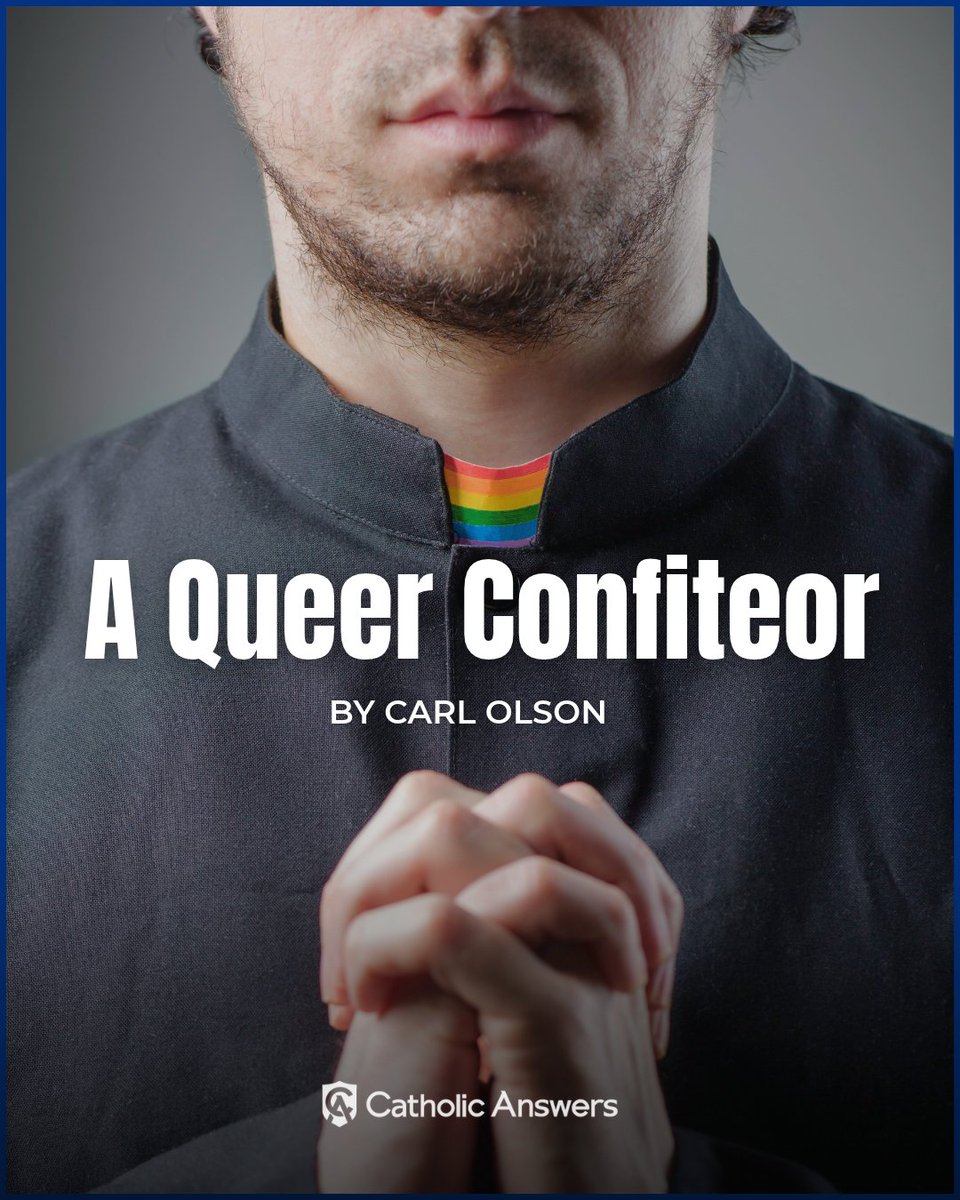
The “LGBTQ Catholic Ministry” Outreach, founded in 2022 by James Martin, S.J., recently offered the following queer-friendly “adaptation” of the Confiteor:
I confess to our Loving God
and to you, my siblings,
That I have fallen short
in my prejudiced thoughts and my biased judgements
in my careless words and my degrading self-talk
in what I have done to cooperate with injustice
and in what I have failed to do to resist it;
Through my fear, through my complacency, through my worst errors.
Therefore I ask all my spiritual ancestors, queer saints,
and you, the human family,
to pray with me,
that together we might build a better tomorrow.
Amen.
This prayer comes from an article called “An LGBTQ Catholic guide to the Mass: Praying the Confiteor,” authored by Ariell Watson Simon, who describes herself as “queer” and lives in Missouri with her “wife.” Her essay “begins a series that explores praying with the Mass from an LGBTQ perspective.”
We hardly need to be theologians to recognize the ideological and deeply secular nature of Simon’s attempt to pervert the words and focus of the Confiteor:
"I confess to almighty God, and to you, my brothers and sisters, that I have greatly sinned, in my thoughts and in my words, in what I have done and in what I have failed to do, through my fault, through my fault, through my most grievous fault. Therefore, I ask Blessed Mary ever virgin, all the angels and saints, and you, my brothers and sisters, to pray for me to the Lord our God."
In the Divine Liturgy of St. John Chysostom, we Eastern Catholics pray the following before receiving Holy Communion:
"O Lord, I believe and profess that you are truly Christ, the Son of the living God, who came into the world to save sinners, of whom I am the first. . . . O God, be merciful to me, a sinner. O God, cleanse me of my sins and have mercy on me. O Lord, forgive me, for I have sinned without number."
The intent, in both the East and the West, is acknowledging that I am a sinner, in constant need of mercy and conversion. Period.
Furthermore, implicit in these prayers is a fact that cannot be erased, even if Martin, Simon, and company seek to do so: it is Jesus Christ and his Church who tell us what is sinful and what is good—not our emotions, passions, or desires, no matter how strongly they press upon us. As Fr. Aidan Nichols writes, “it is not experience we should trust but the transmutation of experience by Scripture and Tradition."
In general, any question that asks "Why does God NEED x from us?" should be re-framed as "What good is God leading me into by commanding me to do x?"
So "Why does God need worship?" is the wrong question. Instead: "What good is God leading me into by commanding me to worship him?"
The answer: since God is goodness itself, the ultimate fulfillment of all our desires, and the only one who can free us from enslavement to sin, it is good for us to direct our thoughts, words, and actions to his praise and glorification.
If we don't do this, we will give ourselves over to something lesser that ultimately cannot fulfill us and will destroy us.
So God commands worship so that we turn away from that which kills and towards himself, who gives life.
"The worship of the one God sets man free from turning in on himself, from the slavery of sin and the idolatry of the world." (CCC 2097)
Just heard word that Isaac (7-year-old) passed away over the weekend. Please keep his parents, Daniel and Anne, in your prayers as well as Isaac's twin brother and younger brother.