A German cartel sent a man across the ocean to threaten Herbert Dow in Midland, Michigan. If Dow kept selling bromine overseas, the cartel would flood the American market and destroy him.
The cartel controlled the world’s bromine supply and fixed the price at 49 cents a pound. Dow had found a cheaper way to pull it from brine and was already selling it in America for 36 cents. Then he started shipping it to England.
The Germans made good on the threat. They dumped bromine into the U.S. at 15 cents a pound, then 12, then 10.5 — far below their own costs. Other American producers couldn’t survive those prices.
Dow didn’t lower his. He had agents in New York quietly buy up every pound of the discounted German bromine they could find. They put new labels on it and shipped it back across the Atlantic, selling it in Europe, including Germany, at 27 cents a pound.
The cartel couldn’t understand why American demand stayed so high, or why cheap bromine kept turning up in its own markets. Some members accused each other of cheating on the price agreement.
They cut the price again. Dow bought more.
After four years, the Germans gave up and left the American market.
A cartel tried to destroy an American chemist with cheap bromine. He turned them into his supplier.
A Canadian couple forgot their baby's stroller at home on a recent visit to Home Depot, so dad improvised by using a bucket to carry their little one. https://t.co/IcdJ9ZqV6X
Located in County Meath, Ireland, this stunning 300-year-old Yew Tree Tunnel at Gormanston Castle is a living architectural marvel.
Planted in the late 17th century by the Preston family, generations of meticulous training have caused the branches of these ancient trees to intertwine and fuse, creating a dark, magical green corridor that looks straight out of a fantasy novel.
[📹 patricia.jonkers]
There is a tree in the Amazon, the Sumaúma (Ceiba pentandra), that can reach about 70 metres tall, rising above the forest canopy. It has massive buttress roots that spread like wings to stabilise it in shallow soil,
sometimes large enough to stand between.
📸 amyris /Amyris Fernandez
Baseball fans encountered a furry friend trying to get its paws on stadium snacks from under the stands at Wednesday's Mets game. The raccoon snagged some peanut shells off the floor through a tiny hole and a hot dog that a fan generously slid through.
In 1895, the U.S. Postal Service needed a mail carrier for the rugged route outside Cascade, Montana. The woman who got the job was 62 years old, had been born into slavery, and stood six feet tall.
Her name was Mary Fields.
She had come to Montana years earlier to help run the grounds of a Catholic mission school. The nuns kept her on for over a decade. When a dispute finally forced her out, she was already in her fifties, with few options and no safety net.
She tried running a restaurant in Cascade. She was too generous with the food and went broke.
Then the postal route opened.
She beat out every other applicant, men half her age, because she could hitch a team faster than any of them. The postmaster hired her on the spot.
For the next eight years, she did not miss a single delivery.
When the snow sat too deep for her horses and mule, she strapped on snowshoes and walked the mail in herself. Blizzard, mud, broken trail. It did not matter. The mail arrived.
She carried a rifle and a revolver. Not for show. The frontier outside Cascade in the 1890s was not a place that forgave hesitation, and Mary Fields had no hesitation in her.
Cascade came to love her in a way that towns rarely loved anyone. When her birthday arrived each year, the schools closed so the children could celebrate with her. She was one of only two people in all of Montana whom the mayor gave permission to drink in the saloons alongside men.
She outlived most of her contemporaries, dying around 1914, well into her eighties.
Gary Cooper, who grew up near Cascade, later called her one of the most remarkable people he had ever known.
She was born into bondage. She buried that life, crossed half a continent, and built something no one could take back.
Not one delivery missed. Not one winter that stopped her. Not one generation that forgot her name.
Eight years, zero missed deliveries, on a frontier mail route she worked into her seventies. The post office has been putting that statistic on plaques ever since. Mary Fields was doing it before anyone thought to write it down.
#archaeohistories
A high school principal lost his job after breaking school rules to help a homeless student, providing him with food and a safe place to sleep. Years later, he watched that same student walk across the graduation stage—this time as his son.
The deeply moving story centers on Robert Burnside, former principal of Lakota East High School in Ohio, and Landerius “DeDe” Hayes. In 2024, 16-year-old Hayes became homeless through circumstances beyond his control. When his mother’s new address placed him outside the school district’s boundaries, officials ordered him to withdraw. Burnside refused to let the teenager be abandoned, challenging the decision and allowing Hayes to remain in school. The district ultimately viewed his actions as insubordination.
As the situation escalated into an investigation, Burnside chose to stand by Hayes, eventually resigning from a decades-long career in education. He and his wife, Angel, then took another extraordinary step, becoming Hayes’ permanent legal guardians and welcoming him into their home alongside their six other children. In May 2026, Burnside watched Hayes graduate at the Cintas Center—not as his principal, but proudly as his father.
🚨WOW!!!
A man spent 19 YEARS in a German orphanage watching other kids get picked up by their parents…
…and every single day he prayed on a rosary to meet the father he'd never met.
Today, more than 50 years later, he put that same rosary around his DAD'S NECK.
His name is Joshua Schneeloch.
He was left at a Catholic convent in Germany as a baby and never adopted. Not once. Nineteen years of watching other children go home.
"When you see other kids be picked up by parents, you start realizing: Hey, why is nobody picking me up?"
So he prayed. Every day. Same prayer, over and over:
Please. One day, I want to meet my father.
A year ago his wife, Nicole, handed him an Ancestry DNA kit.
She knew it might break his heart. She gave it to him anyway, because she believed he belonged to somebody.
A genealogist found a couple of cousins. Then a phone call: I think I found your father.
His name is Arthur Colbert. U.S. military, stationed in Europe in the late 60s. He came home to America in 1970 and had NO IDEA he'd left a son behind.
"I did not know that I had left a baby over there in Germany."
Now here's where it gets crazy…
Joshua didn't say who he was. He called Arthur pretending it was an insurance call, just fishing for answers.
And Arthur opened the door himself: I hear an accent. Where are you from?
Germany.
Were you ever in Germany?
Yes.
When?
Were you ever in Kaiserslautern?
Yes.
And Joshua went completely silent. Because he had just heard his father's voice for the first time in his LIFE.
The DNA came back 99.99%.
They met days later.
"Walking towards my dad was probably the longest walk I've ever done in my life."
Both of them cried.
And then Joshua took the rosary... the one he'd prayed on as a little boy in that orphanage, asking God for this exact moment... and he put it around his father's neck.
He carried it for 50 years so he could hand it to him.
It gets better.
Last Saturday in Joshua walked into a room with more than SIXTY relatives waiting for him.
His uncle met him at the door: "You're home, baby! You're home."
Sixty family members. For a man who grew up with none.
Joshua never gave up. He never stopped praying.
And God answered every word of it.
GOD IS SO GOOD!!!!!!!!
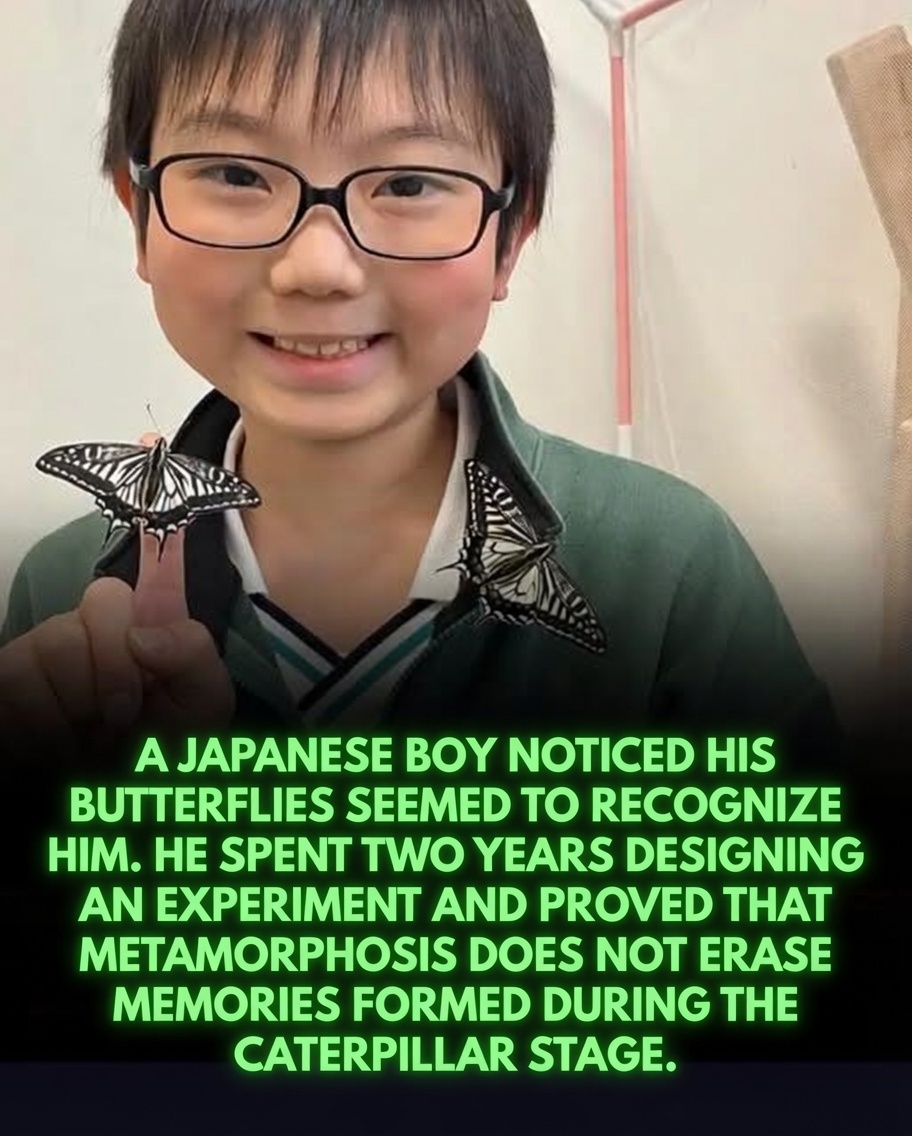
A 10 year old child’s experiment demonstrated that memories can be inherited across generations.
The story started when Jo Nagai, a second grader from Kobe, Japan, observed that swallowtail butterflies he had raised by hand appeared to recognize him, whereas wild butterflies would flee.
Motivated to uncover a scientific explanation, he contacted Georgetown University entomologist Dr. Martha Weiss, who had previously shown that moths retain memories despite the extensive cellular reorganization during metamorphosis.
Encouraged by her research, Jo suggested conducting a similar study with butterflies. This led to a remarkable international collaboration. Using a simple setup created at home, Jo conditioned caterpillars to link a gentle vibration with the smell of lavender.
Remarkably, after their brains were entirely reconstructed inside the chrysalis, 70 percent of the adult butterflies still avoided the lavender scent, demonstrating that their memories had endured the transformation.
The most surprising result emerged when Jo bred these conditioned insects. Neither the offspring nor the grandchildren had ever encountered the vibration, yet both generations displayed an instinctive aversion to the lavender scent.
At the age of ten, Jo compiled his groundbreaking observations into a 33 page paper and presented them alongside Dr. Weiss at the International Congress of Entomology in Kobe. This discovery of transgenerational memory challenges conventional views of genetics and inheritance while illustrating how a child’s curiosity can push the frontiers of scientific understanding.
In December 2007, a Barcelona newspaper ran a charity raffle to pick a local baby for a UNICEF calendar shoot.
The winning family brought their 5-month-old son.
The 20-year-old Barca player assigned to bathe him was Lionel Messi.
The baby was Lamine Yamal.
Nobody thought about the photo for 15 years.
Then the baby debuted for Barcelona at 15. Won the Euros at 16 while still doing homework. Took over Messi's number 10 shirt.
On Sunday they meet in the World Cup Final.
Messi is 39. It's likely his last one.
Yamal turned 19 two days ago. It's his first.
The baby Messi held in his hands is now trying to take the trophy out of them.
@FreddyLA7 Freddy, there's 100% chance those gaslighters are online to demotivate, discourage, and cause division. Your posts do none of that which makes their jobs (yes, most are paid) harder. Don't let the small, biting insects in life change your path.
It was the middle of the night, at about 1.30am, when Norway lost to England.
Yet thousands of Norwegians went to the Palace in Oslo and celebrated with one final Viking row.
They did not riot. They did not burn cars. They did not smash bus stops or glass windows of shops.
They smiled. The laughed. They saw the positive in their performance. They celebrated their heritage. They were proud of who they have been in the past and who they are today.
Norway might be out of the World Cup 2026 but they are in our hearts.
In the last three weeks, I think we have all fallen a little bit in love with Norwegians.
Norway lost… and there were no riots, no cars burned, no shops looted, and no destruction of their own cities. They took the loss, applauded the team, and went home. A lesson some other teams’ supporters could learn. 👏🇳🇴⚽
Dear Norway fans,
Thank you & I’ll say it again… you have been, beyond any argument, the most extraordinary supporters at this entire tournament.
From a country of five and a half million people, you crossed oceans, packed out stadiums, dressed American streets in red and white and transformed every single fixture into a carnival of noise, pride and unshakeable joy.
Three decades away from football’s biggest stage, and yet you returned carrying no sense of entitlement: only pure, infectious energy.
Your team repaid every ounce of that devotion, reaching a first ever World Cup quarter-final in the nation’s history, smashing straight through the old ceiling of the last 16 that had stood since 1938 and 1998. a stunning knockout of Brazil to even get there (a nation Norway have somehow never lost to across World Cup history).
The Viking Row wasn’t just a celebration for your own players. It moved rivals. It captivated neutrals. It swept up the entire watching planet.
England brought the run to a close. But nothing can erase what unfolded here. The finest chapter Norwegian football has ever produced. Walk away with your heads held high.
Thank you, Norway. For the emotion. For the history you carved out. For the row we’ll be talking about for years to come. Unforgettable. 🇳🇴