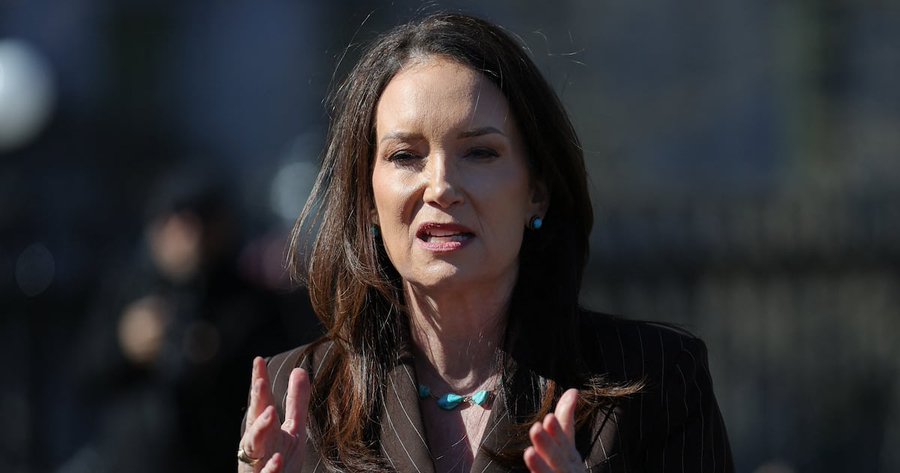
Rollins literally asked "where are all the sterile flies?" on national television.
DOGE cut the USDA screwworm monitoring program. DOGE cut USAID's border parasite prevention program. Both happened after she was sworn in.
The sterile flies were in the budget she let get gutted. That's where they went
BREAKING: Fox News Just Spent 3 Straight Minutes Airing A Detailed Case For Corruption Inside The Trump Administration.
Think about that.
This wasn’t MSNBC.
This wasn’t CNN.
This was Fox News.
Rep. Jamie Raskin walked viewers through what he says is a pattern of corruption, conflicts of interest, and abuse of power inside the administration.
And Fox aired the entire thing.
When even Fox can no longer avoid the conversation, it suggests the story has become too large to simply ignore.
Some of y’all aren’t scared enough about running out of potable water. We need it to survive, our pets and farms do too. Data centres are using it up and wasting it. They project we could run out by 2039. Thirteen years. Stop asking AI questions, it’s not worth it.
Explain it to me like I’m 5.
When Spencer Pratt doesn’t make the general election ballot, according to Trump and Republicans, it’s “fraud.”
But when Steve Hilton, Trump’s endorsed candidate, makes the general election ballot on the exact same ballot, it’s perfectly legitimate?
🚨Today's @USGAO report on ICE's Camp East Montana is scandalous:
- Evidence of a homicide was destroyed or went missing
- Detainees with HIV and diabetes were not given any treatment plans
- Cells were filthy and only cleaned weekly
- A guard lost a loaded gun in the facility
“If you want a living wage, get a better job” is a fascinating way to spin “I acknowledge that your current job needs to be done, but I think whomever does that job deserves to be in poverty.”
Let me explain this for the red hats. When people vote isn't a "random" thing.
Republicans are more likely to vote on election day because they've been told that it's evil to vote by mail (unless you're Trump).
Democrats are more likely to vote by mail.
This isn't a "random" thing like tossing a fair-weighted coin.
Let me draw an analogy for you. Imagine you put 300 blue marbles in a jar, and then you put 200 red marbles in a jar, and then you shake it up a bit.
Then you start counting the marbles. You're going to have more red marbles at first because they are on top, and the blue marbles are on the bottom.
To use THAT count to "debunk" the existence of the blue marbles would be fallacious.
This is precisely what the conservative logic is doing. They are using the same-day vote to negate the mail-in vote.
But mail-in vote is largely blue and same-day vote is largely red. And same-day vote is counted first.
Trump says voter fraud should land people in prison.
Agreed. And let's start with the politicians spreading election lies with the goal of illegally interfering with counting ballots.
In California, I just signed a law making that punishable with up to 3 years behind bars.
More to come. FAFO, Donald.
Wait, so we were told to take shorter showers, turn off the tap while brushing our teeth, and conserve water at every opportunity… but data centers can show up and use millions of gallons like it’s nothing?
A British novelist whose father worked in a bank explained the entire 2008 financial crisis in a 272-page book that a 12-year-old can follow, and the part that should scare you is how simple the fraud was once he stripped the jargon off it.
His name is John Lanchester.
He is a novelist by trade. He writes for the London Review of Books and The New Yorker. He grew up in Hong Kong because his father worked at a bank there, which means he absorbed the language of finance the way most kids absorb the language of cartoons. By the time the 2008 crisis hit, he was one of the very few writers on earth who could speak both finance and English fluently.
He sat down and wrote a book called I.O.U.: Why Everyone Owes Everyone and No One Can Pay.
In the UK it was published under the title Whoops! It came out in 2010. 272 pages. The reviews from financial journalists were almost embarrassed in their praise, because Lanchester had done in plain English what most of them had failed to do in years of professional coverage. He had actually explained what happened.
Here is the version a middle schooler can understand.
Step one. A bank gives a home loan to a person who clearly cannot pay it back. No real job. No savings. No way to make the monthly payments. The industry had a nickname for these loans. They called them NINJA loans. No Income. No Job. No Assets. The bank knew the person could not pay. The bank did not care.
Why did the bank not care?
Because the bank was not going to keep the loan.
Step two. The bank takes thousands of these loans, puts them in one giant pile, and sells the entire pile to a Wall Street firm. The Wall Street firm now owns the right to collect all those monthly payments. The original bank has been paid. Whether the homeowners actually pay or not is now someone else's problem.
Step three. The Wall Street firm takes the giant pile of loans and chops it into slices. They call the slices tranches. The top slice is supposed to be the safest because it gets paid first. The bottom slice is supposed to be the riskiest because it gets paid last. They give each slice a credit rating. The top slice gets stamped AAA, which is the highest rating you can get on earth. It is the rating used for the bonds of the United States government.
A pile of loans to people with no income and no job has just produced an investment product rated as safe as the United States government.
Step four is where the trick gets worse.
The bottom slices, the ones full of the riskiest loans, are hard to sell. Nobody wants junk. So the Wall Street firm takes the bottom slices from a hundred different piles, mixes them together into a new pile, and chops that new pile into new slices. And the top slice of this new pile, made entirely from the junk of the old piles, also gets stamped AAA.
This new product has a name. It is called a Collateralized Debt Obligation, or CDO.
A 12-year-old can see what is wrong here. You cannot take a hundred bags of garbage, dump them into one big bag, and then declare that the top of the big bag is now gold. The garbage is still garbage. The math does not change it.
But the people who ran the ratings agencies were not 12-year-olds. They were adults with finance degrees. And they stamped this stuff AAA over and over again because the Wall Street firms were paying them to do the stamping. The ratings agencies had become a paid service. The people they were rating were also the people writing their checks.
Step five. The Wall Street firms sell these AAA-rated CDOs to pension funds, foreign governments, insurance companies, and retirement accounts all over the world. Everyone buys them because the rating says they are safe.
Step six is the final trick.
Someone invents a product called a Credit Default Swap. It is insurance against a CDO going bad. The clever part, the part that Lanchester explains so well, is that you do not have to actually own the CDO to buy insurance on it. You can buy insurance on a CDO that belongs to someone else. You can buy insurance on a CDO ten times over. A hundred times over. There is no limit.
This is the equivalent of taking out fire insurance on your neighbor's house. And then on a thousand strangers' houses. And then betting against the entire neighborhood.
The smart people in the industry realized the CDOs were garbage. So they started buying credit default swaps against them. Not to protect themselves. To bet on the collapse.
Step seven was the part nobody planned for.
Housing prices stopped going up. The NINJA borrowers, who had been refinancing every year by using the rising value of their houses as collateral, suddenly could not refinance. They started missing payments. The bottom tranches of the CDOs started failing. Then the middle. Then the AAA tranches that had been declared safer than government bonds turned out to be made of the same garbage as the rest.
Then the insurance bills came due.
The biggest insurer in the world, AIG, had written hundreds of billions of dollars in credit default swaps on these CDOs. They did not have the money to pay. If AIG collapsed, every major bank on earth that had bought insurance from them would also collapse, because their "safe" CDOs would suddenly have no insurance. The American taxpayer ended up writing AIG a check for 182 billion dollars to keep the entire global financial system from falling apart.
The total damage of the crisis, by every honest estimate, runs into the trillions of dollars. Millions of people lost their homes. Millions lost their jobs. Almost nobody on Wall Street went to jail.
Here is the part Lanchester drives home in the final chapters, and the part you should not forget.
The fraud was not hidden in the math. The fraud was hidden in the complexity. Each individual step looked legitimate. Each individual product had a name, a rating, a paper trail. The reason nobody stopped it was that no single regulator, no single executive, no single auditor was forced to look at the entire chain from end to end. The garbage at the start and the AAA stamp at the end were separated by so many layers of paperwork that everyone could honestly say their specific layer looked fine.
Lanchester's central argument is the one that should haunt every person reading this in 2026.
Complexity is the disguise. Anytime a financial product is so complicated that the person selling it cannot explain it in 60 seconds, the complexity itself is the warning sign. The complexity is not protecting the customer. The complexity is hiding the fact that the customer is the product.
The 2008 crisis was not a failure of intelligence. It was a failure of plain language.
Almost every product on the market today that is being sold to retail investors, from leveraged ETFs to certain crypto derivatives to private credit funds, has the same structural pattern. Layered. Hard to explain. Stamped with an authoritative rating. And the people selling it can never quite tell you what is inside.
Which brings me to the question.
The next 2008 is already being built somewhere in the financial system right now.
Which industry, or which product, do you think is hiding the same trick under the same kind of complexity right now in 2026, and what makes you suspicious of it?
Can someone who believes California is rigging elections by counting postmarked votes that arrive after election day please explain why the IRS accepts tax returns as valid as long as the postmark says April 15th?
To every MAGA/Republican once again screaming “voter fraud” & “stolen election,” this time about California - PROVE IT. Don’t just bitch about it, prove it. And the beauty of our electoral process is that you have the perfect vehicle through which to prove it - the courts.
So either put your money where your mouth is, or put a sock in it. Thanks
For years, CEOs have sold a story that a $15 minimum wage would kill jobs.
The Washington establishment bought this trickle-down lie, and workers paid the price.
But the evidence debunks that myth.
It's long past time to raise the minimum wage.
Watching the decline of literacy at the youngest ages feels like watching an iceberg slowly approach the Titanic. What’s happening to middle-grades is also coming for YA and adult books as this demographic ages. The publishing industry itself could collapse.
Let's be clear about what happened: DOGE cut the programs and staff that tracked dangerous outbreaks like screwworm.
So this has nothing to do with Joe Biden, but Trump and DOGE definitely screwed our cattle industry.