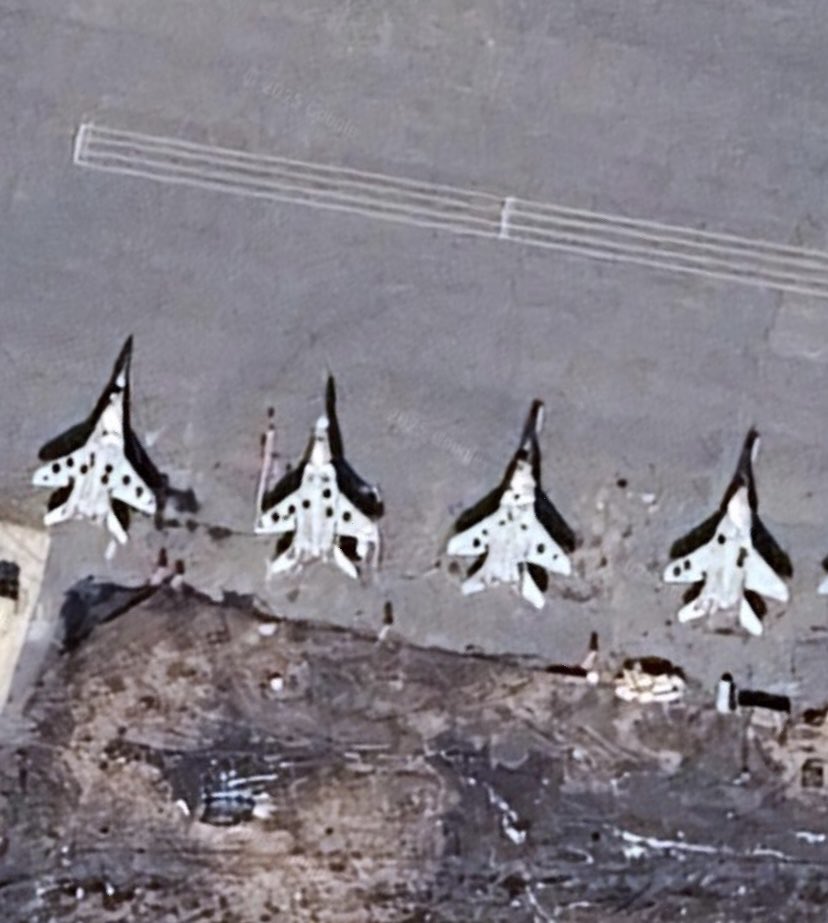
It appears Russia is taking preventive measures against potential drone attacks in Armenia, with its MiG-29 fleet at Erebuni Airbase now fitted with tires.
However, such makeshift measures offer little real protection and are unlikely to stop damage from attack drones.
An unidentified aircraft, believed to be a drone, was spotted flying over Tehran tonight as Iranian AD attempted to shoot it down. Its rapid changes in speed and altitude is particularly impressive and make you wonder what kind of aircraft it is to pull off such maneuverability.
With its major nuclear facilities reduced to rubble and its strategic position unraveling, the Iranian regime now finds itself in a state of escalating desperation. It is plausible that radioactive materials were quietly removed from sites like Natanz, Fordow, and Isfahan well before the Israeli operation, potentially months ago, preserving a degree of retaliatory capability.
While the infrastructure needed for a true nuclear weapon may be gone, Iran still possesses the technical expertise to build a radiological dispersal device. A dirty bomb, though lacking the destructive power of a nuclear warhead, could cause widespread panic, disrupt civilian life, and signal that the regime still has tools of deterrence even in defeat. Although such a weapon is unlikely to cause mass casualties through radiation exposure alone, the psychological impact, economic disruption, and long-term contamination of targeted urban centers, especially if deployed via ballistic missile, could be devastating. Given that Iranian ballistic missiles have previously managed to penetrate Israeli air defenses, there is a very real possibility that such a device could be mounted on a missile and directed at Israeli population centers. U.S. and Israeli intelligence agencies are now working urgently to uncover Iran’s next move and prevent any potential escalation.
Over the past several years, large ethnic groups within Iran have been quietly armed and organized in anticipation of a future uprising. These groups, deeply familiar with their terrain and driven by longstanding political and cultural grievances, are strategically positioned to strike at the core of the Islamic Revolutionary Guard Corps (IRGC) and other key military assets. Their capabilities include the potential seizure of tanks, weapons depots, and communication hubs, aimed at dismantling Iran’s military infrastructure from within.
However, the IRGC and Iranian Armed Forces remain operationally strong at this stage. As a result, the Israel Defense Forces (IDF) will continue executing precision strikes to degrade Iran’s external and internal military strength. The goal is to weaken critical defense nodes and reduce the risk of early failure once the green light is given to activate internal armed factions.
Timing, coordination, and sustained pressure are essential to ensure success and to minimize collateral resistance. The internal cells remain on standby, awaiting the signal to initiate.
A large Iranian military convoy has moved out of its base and is now stationary in the mountains somewhere in Iran. The person filming can be heard saying, “Get ready.”
The Iranian leadership is fully aware that the United States is likely to join Israel in its ongoing campaign to dismantle Iran’s nuclear infrastructure. With Israeli strikes already targeting sensitive nuclear and military sites, Tehran views a coordinated Israeli-American effort as a critical threat to its strategic depth and long-term deterrent capability.
In anticipation of a broader conflict, Iran has held back the bulk of its hypersonic missile arsenal, storing many of these advanced weapons deep underground in fortified bunkers, well beyond the reach of Israel’s current bunker buster munitions. These missiles, capable of evading standard missile defense systems, are not being preserved for symbolic retaliation, but for calculated, high-impact strikes against key U.S. military assets in the region.
Iran’s military planning is believed to include targets such as RAF Akrotiri and the Andreas Papandreou Air Base in Cyprus, both of which are hosting U.S. and allied aircraft involved in surveillance and regional operations. Other likely targets include Al Udeid Air Base in Qatar, CENTCOM’s forward command center; Al Asad and Erbil airbases in Iraq; Ali Al Salem and Camp Arifjan in Kuwait; Al Dhafra in the UAE; Muwaffaq Salti in Jordan; and Prince Sultan Air Base in Saudi Arabia. Naval Support Activity Bahrain, home to the U.S. 5th Fleet, and U.S. carrier strike groups positioned in the Red Sea and eastern Mediterranean, are also within range and strategic consideration.
However, despite Iran’s efforts to shield its arsenal and nuclear infrastructure deep underground, the U.S. military possesses the capabilities to neutralize even heavily fortified underground facilities. With advanced munitions such as the GBU-57 Massive Ordnance Penetrator (MOP), the U.S. can carry out precision strikes on deeply buried command centers and storage bunkers. Tehran knows that if the conflict escalates into a full-scale confrontation, its most protected sites may not remain invulnerable for long, reinforcing the regime’s urgency in calculating when, where, and if to use its most powerful assets.
Following yesterday’s unusual 246-character EAM, an even longer 290-character Emergency Action Message (EAM) was broadcasted today via the U.S. Air Force’s High Frequency Global Communications System (HFGCS).
The IDF is surprised by the outcome of its ongoing operation in Iran, having not anticipated that it would succeed in neutralizing most of Iran’s air defense systems and eliminating a significant number of top Iranian leaders, nuclear scientists, and intelligence officers within the first 48 hours. This unexpected success has prompted a reassessment of strategic objectives, with some officials now considering the possibility of leveraging the situation to potentially topple the regime.
Iran’s repeated need to appoint new officials following high-profile assassinations is steadily weakening its internal structure. Each time a key figure is eliminated, whether from the IRGC, the nuclear program, or intelligence services, it creates a vacuum that cannot be filled overnight. The replacements are often rushed, politically motivated, or lack the operational experience of their predecessors. This disrupts strategic continuity and undermines coordination between military, intelligence, and political branches.
We saw a similar pattern with Hezbollah when much of its leadership was wiped out in a series of targeted strikes. After Israel’s major attack on Lebanon, Hezbollah was unable to mount an effective response. The group struggled operationally, as the new generation of leaders lacked the authority, experience, and battlefield credibility of those they replaced. Decision-making slowed, internal cohesion weakened, and reliance on external actors like Iran deepened.
Iran now finds itself in a comparable situation. The psychological toll of these assassinations breeds distrust and paranoia within its ranks, eroding confidence and fragmenting leadership. Each new appointee knows they are stepping into a role that could make them the next target, which fuels hesitation and strategic caution. Compounding this weakness is Iran’s limited ability to respond effectively to Israeli attacks. Most of its retaliatory actions are delayed, often taking a full day to materialize, and the majority of its ballistic missiles are intercepted before reaching their targets.
Mossad may make it look easy, all these assassinations they’re carrying out, but the reality is far more complex. Each operation results from years of intelligence gathering through cyber infiltration, satellite surveillance, human assets, and intercepted communications. Over time, Mossad gained access to highly classified information, uncovering the identities, routines, and exact locations of key regime figures. That same stream of intelligence collection continues today, as the assassinations continue across Iran.
According to the Wall Street Journal, the U.S. military is operating in the air, on land and at sea to shoot down Iranian ballistic missiles fired at Israel, in response to the ongoing operation by the Israeli Air Force targeting nuclear, ballistic missile, and other military sites inside Iran.
- at least two impacts in Haifa; one noted in/on/around Haifa refinery, gas flaring from both stacks visible and lights still on, impact damage unknown.
- IDF airstrikes in Tehran and Yemen simultaneously.
- rumours of a significant strike in Yemen; targeted assassination
Today, dozens of foreign nationals crossed into Azerbaijan through the Astara checkpoint as they fled Iran.
The number is expected to keep rising, and refugee arrivals are likely to follow in the coming days.