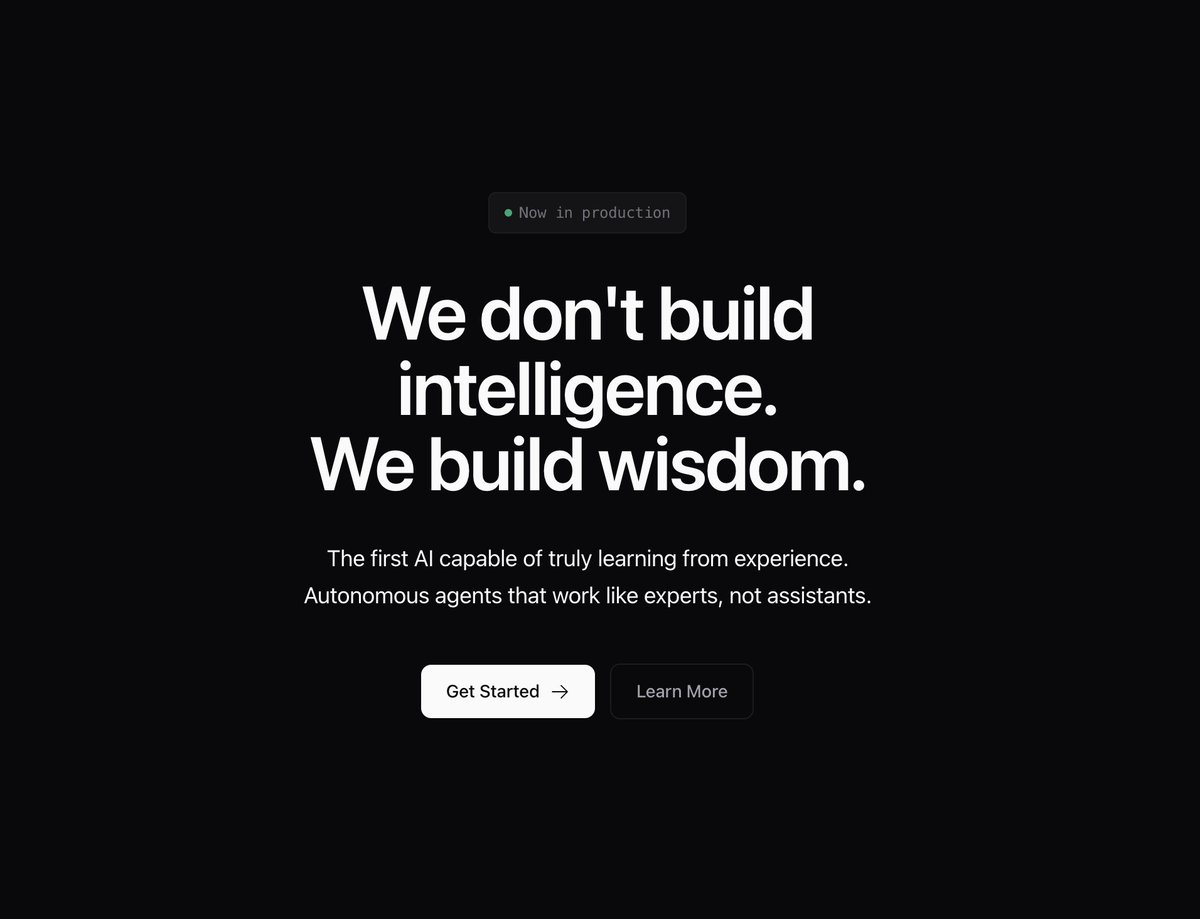
AI agents are moving into nearly every area of digital work, but deploying them still requires companies to define rigid workflows, stitch together tools, and spend months adapting their operations around the software.
We believe AI should adapt to you.
Hyped to use GPT-6 Astra with the causal memory architecture we built at @LevangieLabs!
We can bring superintelligence to causal learning to build the new experiential learning layer for AI.
We just closed a oversubscribed $4.5M seed.
Come join us if you want to be at the frontier of causal, continual learning, and go from research to blue-chip enterprise deployments in the same day.
We are building the tools that will solve humanities greatest challenges.
We are looking for the next generation of engineers, researchers, and builders to join the team that is defining the next era of intelligence for humanity.
If you feel like you are up for the challenge, reach out and join the founding team.
today we're introducing Levangie Laboratories (by: @blevlabs)
they are building the first *causal trajectory learning architecture* giving AI the ability to learn continuously
the result: autonomous intelligences that don't just deploy into a company; they grow into it
LLABS is already working with some of the largest companies in the world, building agents that solve problems impacting thousands of lives every day
autonomy designed for the next generation of humanity's challenges
Exciting to see how our cognitive architecture is beginning to transform not only enterprises but also individual creators and builders like @Scobleizer.
We are currently wrapping a funding round with some incredible investors and have just hired our first engineer.
Soon, anyone in the world will be able to work with our agents and experience what real cognitive intelligence can do.
“You can't build autonomous AI on centralized infrastructure.”
Which is precisely why @LevangieLabs chose Akash to deploy its complex, multi-container cognitive architecture.
LLABS hosts its AI agents in dedicated containers to satisfy enterprise demands for instantaneous intelligence and low-latency reasoning.
This environment enables the agents to learn, evolve, and autonomously rewrite their underlying code in real-time.
See how decentralized compute delivers enterprise-grade performance without compromising security and flexibility. ↓
https://t.co/7AXAh3Si17
Happy New Year!
Hanging out with @blevlabs, and we just had his cognitive AI read all my investor lists and analyze everyone's predictions.
It then processed them and chose a way to visualize the trends. Here's what it produced: https://t.co/6WhBr25hMF (Click each shape to see the original post.)
There's so much value locked in X that could be visualized in countless ways. I bet that explodes in 2026.
Here's a text version of the same report: https://t.co/VmswkiVPWS
Solid predictions. Mine?
World models will dominate my life next year.
My lists are getting more useful by the minute. In 2025, I poured a lot of effort into them. In 2026, we build new things with them.
Next year will be the craziest in technology of my career. Celebrate tonight safely.
As I listen to Brayden talk with his agents, I hear a bit of affection in his voice toward them—at minimum, respect. I think that should be normalized, but it probably won't be, since so many are still in the "I hate AI" phase.
Oh, and I enhanced this post with Grok. It added the em dash. I am going to use AI a lot more next year.
Kind of awestruck at what I just witnessed today.
For a client who has very complex extraction/analysis needs for extremely long and dense plans (PDFs that can be 100s of pages) we tasked a cognitive agent to build its own tools and learn how to analyze with maximum accuracy.
If you want to get a vague hint on the ideas behind how the cognitive architecture is capable of learning and growing as fast as it does, read the memory section of this guys paper.
Extremely exciting how far ahead @LevangieLabs is from any existing AI lab.
Hey!
If you are in Menlo Park tomorrow, come see me at the F50 Physical AI Summit!
Going to be a great time, I’ll be onstage doing a fireside chat with @Scobleizer talking about the AI subconscious and unconscious influence in generative models!
https://t.co/OhbxWpUgFI
@Scobleizer It was an incredible time. Thank you for the opportunity to introduce my work to the world!
We are already applying this architecture in so many amazing areas, and our organization is scaling faster than I ever could have imagined a year ago.
How did a 20-year-old beat Grok. And ChatGPT. And Perplexity. And Gemini?
In part one @blevlabs laid out how: he built a very different architecture to take AI to a new human level.
Cognitive architectures, he calls them.
I call them AI's with consciousness. Ones that learn, evolve, build themselves, and do so like we do.
Part I is here: https://t.co/lVHQJHNsIE
In this part two, he goes more into the technology.
And this was recorded more than a week ago in my home. Since then his system has gotten way better.
An exponentially learning system.
It is how we are going to get to AGI.