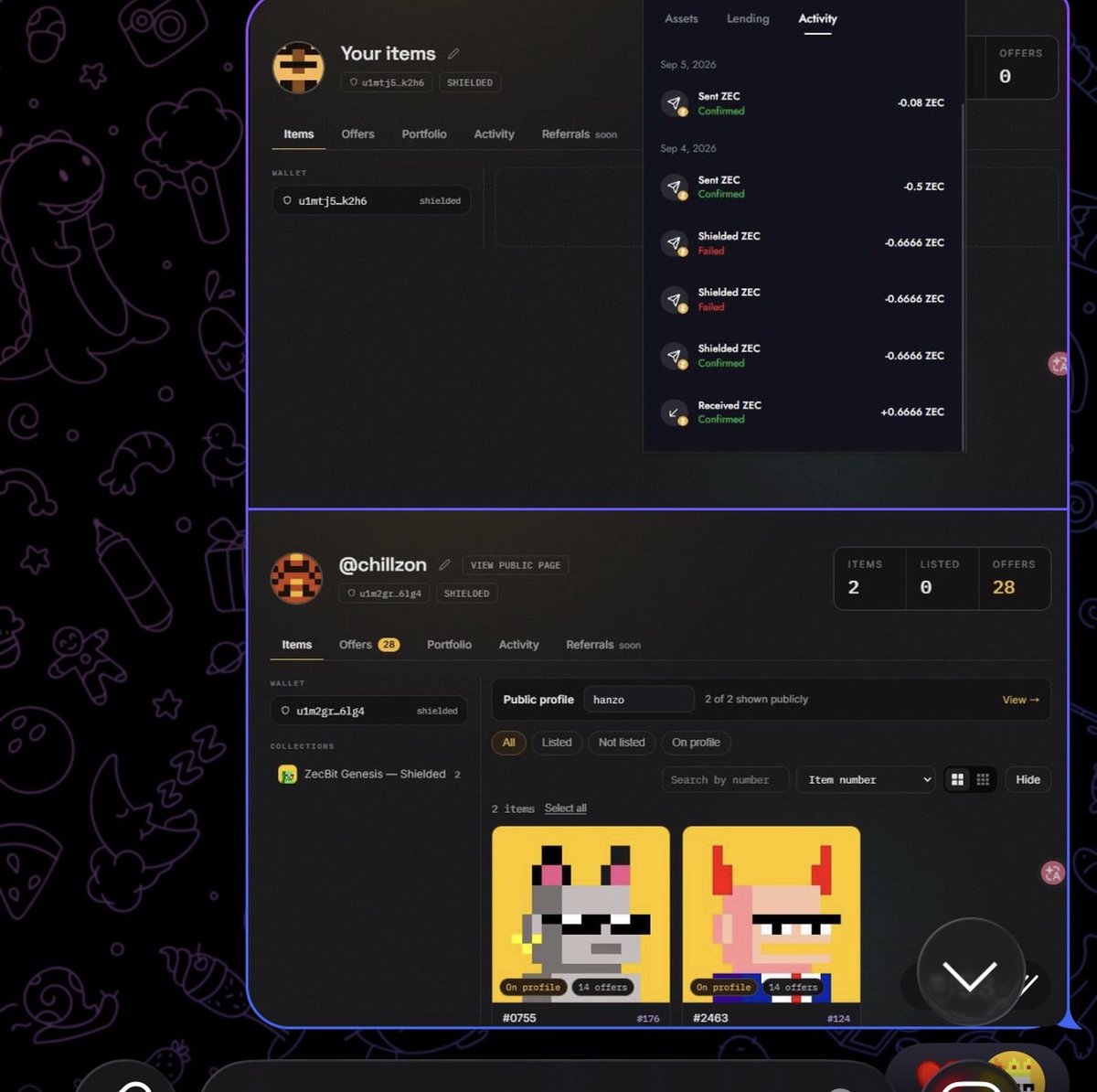
The third species wakes up.
Zyn Moth #0865 — Moonwhite, luminous eyes, gold Node Headset.
One of only 2 Mythic Moths among 889.
Collection Z: 4,444 creatures. Moles, Owls, Moths.
https://t.co/MQl4Em8sbv
my ideas for Zcash wallets:
- add a folder to save recent contacts.
- link to a service that shows us where we can earn yield or shop using ZEC.
- create multiple sub-accounts, similar to a bank, to manage your funds: savings/checking accounts.
- a tutorial on “how to use ZEC” for beginners.
can’t sleep, zec is my obsession
Mainnet test done.
Transaction e4e66e72…87e6 (https://t.co/2RLjJoSKol), a shielded spend on Zcash mainnet whose spend authorisation was a FROST threshold signature aggregated from two of three shares on separate machines.
Open sourced our threshold-custody layer
zec-multisig (https://t.co/efGa96hW7C)
No new cryptography. It integrates the Zcash Foundation's reddsa FROST over RedPallas, the scheme Orchard spend authorisation already uses, and reimplements none of it. Threshold signing fails silently and totally when it's got wrong.
What it adds is the distance between a signature and a transaction. frost-rerandomized gives you a signature; it does not give you a Zcash transaction.
In between:
- Distributed key generation over an encrypted transport (x25519 + ChaCha20-Poly1305), no dealer ever holds the whole key
- The daemon each share-holder runs and the protocol it speaks. Everything crossing the wire is public; the share never crosses, and the coordinator holds no share at all
- Note selection, witness tracking, change, and Orchard spend assembly
- Deposit scanning: confirmation depth, reorgs, deduplication, ordering
Status: running on testnet, we haven't put real ZEC in our vault yet. It has not yet signed a mainnet spend, and it has not been independently audited as a whole.
Next: first mainnet threshold spend, and an independent operator reproducing the key ceremony from the published docs alone.
If anyone wants to try it out, feel free to fork/clone it and leave feedbacks.
P.S. Apply Cave whitelist at https://t.co/KYqkTDhbvd
Open sourced our threshold-custody layer
zec-multisig (https://t.co/efGa96hW7C)
No new cryptography. It integrates the Zcash Foundation's reddsa FROST over RedPallas, the scheme Orchard spend authorisation already uses, and reimplements none of it. Threshold signing fails silently and totally when it's got wrong.
What it adds is the distance between a signature and a transaction. frost-rerandomized gives you a signature; it does not give you a Zcash transaction.
In between:
- Distributed key generation over an encrypted transport (x25519 + ChaCha20-Poly1305), no dealer ever holds the whole key
- The daemon each share-holder runs and the protocol it speaks. Everything crossing the wire is public; the share never crosses, and the coordinator holds no share at all
- Note selection, witness tracking, change, and Orchard spend assembly
- Deposit scanning: confirmation depth, reorgs, deduplication, ordering
Status: running on testnet, we haven't put real ZEC in our vault yet. It has not yet signed a mainnet spend, and it has not been independently audited as a whole.
Next: first mainnet threshold spend, and an independent operator reproducing the key ceremony from the published docs alone.
If anyone wants to try it out, feel free to fork/clone it and leave feedbacks.
P.S. Apply Cave whitelist at https://t.co/KYqkTDhbvd
Fewer memecoins on Zcash is an infrastructure gap.
Trading experience is shit, waiting for 3 blocks to see your buy on the graph is just against traders.
We are also building NFT first, our own wallet, the application layer and more #ZECfi on the way.
Follow for more updates.