There are no coincidences.
This account is shifting focus
from price speculation to structural analysis.
CAW is not just a token.
It is emerging as a value infrastructure layer.
Beyond price. Into structure.
The First Signals
Strange Coincidences Began Appearing Immediately After CAW Launched
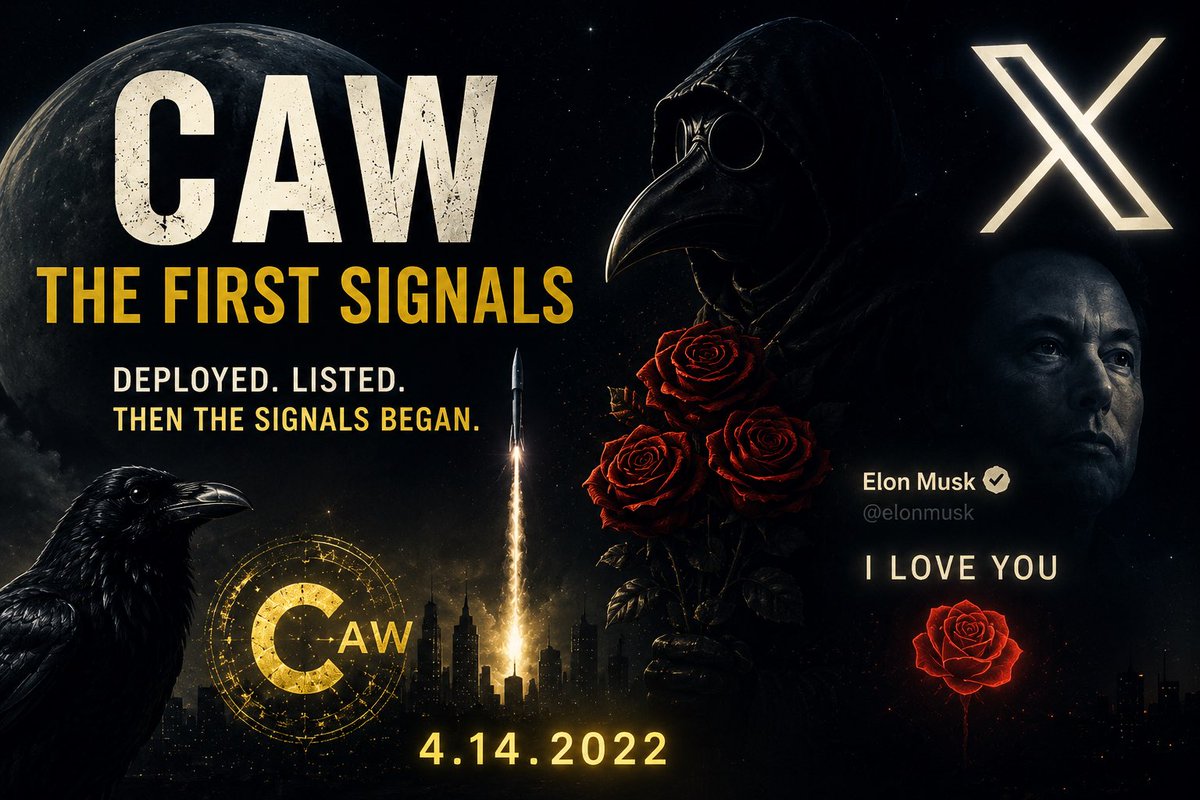
On April 14, 2022, CAW (A Hunter’s Dream) quietly appeared on Ethereum.
There was no major marketing campaign.
No public founder.
No interviews.
No promises.
And yet, within roughly 48 hours, the token was rapidly listed across multiple exchanges — something highly unusual for an anonymous project with almost no public exposure.
But what drew even more attention later was not only the launch itself.
It was what happened around it.
Just after CAW entered the market, several events began appearing that many community members would later revisit and question.
One of the most discussed moments came from Elon Musk.
Shortly after the CAW deployment period, Elon posted a cryptic “I LOVE YOU” message accompanied by imagery associated with roses.
For most people, it was simply another abstract Elon post.
But inside the CAW community, attention quickly turned toward CAW’s earliest visual identity.
The original CAW artwork featured a dark plague doctor figure alongside three red roses — a design that would later become one of the project’s most recognizable early symbols.
Of course, none of this proves a direct connection.
That distinction is important.
But the timing, symbolism, and sequence of events became difficult for some observers to completely ignore.
At the same time, Elon Musk was aggressively moving toward the Twitter acquisition that would eventually transform the platform into X.
Years later, when people began studying the timeline surrounding decentralized identity, payments, and blockchain-based social infrastructure, these early CAW events started resurfacing again.
Another unusual detail was the behavior of the market itself.
Most meme coins struggle for visibility after launch.
CAW moved differently.
The speed of exchange listings, the lack of traditional promotion, and the unusual structure of the deployment created an atmosphere that felt less like a standard meme launch — and more like the beginning of something intentionally designed to remain unexplained.
Whether coincidence or not, the timeline surrounding CAW continued to grow stranger.
And this was only the beginning.
In the next article, we will examine the hidden messages, wallet activity, and the mysterious encrypted clue left behind by the deployer shortly after launch.
The Beginning of CAW
It All Started on April 14, 2022
Today, many people recognize CAW (A Hunter’s Dream) as just another meme coin.
But when you look into how it was created, its origins appear very different from a typical meme token.
Most projects launch with public founders, presales, marketing campaigns, and aggressive promotion.
CAW did not.
On April 14, 2022, CAW was deployed on Ethereum.
The total supply was set at 666 trillion.
The contract was renounced, and the developer wallet was burned.
There was no central operator controlling the project, and from the beginning, CAW appeared in a form very different from the standard startup-style crypto launch.
What makes the story more interesting is the timing.
On the exact same day — April 14, 2022 — Elon Musk publicly announced his intention to acquire Twitter.
Of course, this alone does not prove any connection between the two.
But when people later began reviewing the timeline surrounding CAW, this date became one of the most discussed starting points.
At the time, CAW had almost no official explanation.
There was no detailed roadmap.
No major advertising campaign.
No large-scale promotion.
And yet, within roughly 48 hours of launch, CAW was listed across multiple exchanges.
For an unknown token with no public team, this was highly unusual.
That unusual beginning would later become the foundation for countless theories, investigations, and debates surrounding the project.
Most market participants did not notice it at the time.
But looking back now, CAW did not behave like a normal project from the very beginning.
In the next article, we will examine how CAW entered the market, and the unusual events that unfolded immediately after its launch.
Now change the perspective.
Imagine a global social platform truly integrating blockchain infrastructure.
What would it actually require?
Not just another token.
It would need:
* Identity systems
* Username layers
* Gas abstraction
* Validator networks
* Cross-chain persistence
* Censorship resistance
* AI-native interaction
* Social graph integration
In other words:
Not a coin designed only to increase in price,
but infrastructure capable of supporting an entire digital economy.
And CAW’s architecture appears unusually close to that model.
This Is Why CAW Feels Different
From a marketing perspective, CAW does not behave normally.
It was not launched like a traditional VC-backed project.
There were no massive ad campaigns.
No endless influencer pushes.
Yet at the same time, there were signs of:
* Rapid exchange expansion
* Cross-chain direction
* Social architecture
* LayerZero integration
* Validator structures
* NFT identity systems
These are not the priorities of a typical meme coin.
The cost-to-benefit ratio simply does not make much sense if the goal was only short-term speculation.
Which is why more people are starting to ask:
“Was there a larger objective behind this from the beginning?”
The Most Interesting Part of CAW May Not Be the Price
Of course, most people focus on price.
That is natural.
But the truly unusual part of CAW is not the chart.
The unusual part is this:
It appears to be building infrastructure before proven adoption exists.
Normally, projects wait for users first.
CAW often looks like it is doing the opposite:
Building the foundation before the crowd arrives.
And that is exactly why it becomes harder and harder to explain CAW as “just another meme coin.”
HODL!
Why Was CAW Built as If It Was Meant to Be Used From the Beginning?
The more you study meme coins, the stranger CAW starts to look.
Most projects follow a very predictable pattern.
First, they launch a token.
Then they build a community.
Price goes up.
Only after that do they begin talking about “utility.”
In other words:
Price comes first. Utility comes later.
That is how most meme coins operate.
But CAW looked different from the beginning.
Why Build So Much Before Anyone Even Uses It?
This is where the biggest inconsistency appears.
From its earliest stages, CAW already showed signs of:
* LayerZero integration
* OFT architecture
* Cross-chain infrastructure
* Username-based systems
* Gasless direction
* Social architecture
* Validator structures
* NFT identity layers
* Decentralized social infrastructure
And the important part is this:
None of this looked like it was added later.
It looked intentional from day one.
The strange part is obvious:
There was never any guarantee people would actually use it.
Normally, nobody spends this much time and effort building infrastructure without proven adoption.
Because infrastructure is expensive.
Most Meme Coins Are Built Very Differently
If you look honestly at the market, most meme coins focus almost entirely on:
* Liquidity pools
* DEX listings
* Social hype
* Influencer marketing
* CEX speculation
Because those things impact price immediately.
Meanwhile, things like:
* Validator systems
* Cross-chain architecture
* Username layers
* Social protocols
* ZK-related systems
* Wallet abstraction
do not instantly pump the chart.
Which is why most projects delay them until later — if they ever build them at all.
But CAW appears unusually focused on infrastructure first.
That is what makes it stand out.
CAW Looks Less Like a Meme Coin — and More Like Infrastructure
The deeper you go into the CAW ecosystem, the more a strange question starts to emerge:
Was this ever really just a meme coin?
Because increasingly, it resembles something closer to:
* A protocol
* An experimental network
* Decentralized social infrastructure
* An identity layer
* AI-era infrastructure
And perhaps the most important part is this:
CAW appears to move toward a future where users no longer need to think about wallets.
That matters because wallet complexity is still one of the biggest barriers in Web3.
Most normal users do not want to deal with:
* Seed phrases
* Gas fees
* Chain switching
* Bridges
* RPC settings
Which means the systems that truly scale in the future will likely move toward:
“Blockchain without feeling like blockchain.”
And strangely enough, CAW’s architecture seems increasingly aligned with that direction.
What Would a Blockchain-Based Global Social Platform Actually Need?
Most people still think CAW is “just a meme.”
But I think many are completely misunderstanding the timeline.
A Hunters Dream was deployed back in 2022.
And for almost 4 years now, people have mostly focused on surface-level things:
“Maybe this date means something.”
“Maybe this follower count is a signal.”
“Maybe this number connects to Elon.”
Meanwhile, many outsiders simply called it:
-a scam
-a meme coin
-another speculation token
But here is the problem:
People are trying to judge a long-term infrastructure vision using short-term market logic.
Look at Elon Musk himself.
Almost every major thing he builds takes years before the public fully understands it.
SpaceX was not “go to Mars tomorrow.”
First:
-build rockets
-build reusable systems
-build launch infrastructure
-build Starlink
-build cash flow
Now:
-the Moon
-lunar bases
-Mars preparation
It is a staged process.
Same with:
-Neuralink
-Tesla Optimus
-Tesla, Inc. AI systems
Most of these projects are still incomplete.
Not because they failed.
Because the world itself is not fully ready yet.
This is how Elon tends to build:
Step 1:
Create products society can adopt now.
Step 2:
Generate massive cash flow.
Step 3:
Use that foundation to slowly assemble the larger system.
Most people only see Step 1.
Very few can see the final structure.
And I think the same mistake is happening with CAW.
People expect instant adoption.
Instant integration.
Instant “announcement.”
But if something is truly meant to become infrastructure, timing matters more than hype.
The technology stack itself must mature first:
-wallet abstraction
-gasless UX
-account abstraction
-cross-chain messaging
-AI-native interaction
-username-based identity
Only recently have these pieces started becoming realistic.
Even X Corp. itself appears delayed.
Remember:
X Money was originally expected much earlier.
Linda Yaccarino and Elon both discussed launches around 2025.
Even public roadmap expectations pointed toward early 2026.
It is now June 2026.
Still no full release.
But honestly?
That is very normal for Elon.
Historically, he almost never delivers on the original timeline.
Tesla.
SpaceX.
Starship.
Full Self Driving.
Neuralink.
The pattern is always the same:
-delay
-build more infrastructure
-wait for technology maturity
-then suddenly accelerate
That is why I do not think CAW is something designed for immediate mainstream adoption.
I think it is something waiting for the surrounding infrastructure to finally become ready.
And once all the pieces align:
-identity
-payments
-AI
-wallet abstraction
-X economy
-cross-chain infrastructure
I believe that is when the real move begins.
Not before.
HODL🔥
Especially when observers recently noticed what appears to be automated deployment activity and modular V2-oriented contract rollout behavior.
That matters.
Because deployment pipelines are not usually built for short-term speculation.
They are built for systems expected to evolve continuously.
The more important idea here is not “crypto replacing banks.”
That framing is already outdated.
What may actually emerge is something closer to:
an invisible financial coordination layer for digital civilization.
A layer where:
* users no longer think about chains
* wallets become abstracted
* identity becomes native
* transactions become contextual
* applications become chain-agnostic
* AI interacts with financial systems directly
* value transfer behaves more like communication than banking
That is a fundamentally different model from today’s crypto UX.
And interestingly, this philosophy overlaps heavily with Elon Musk’s broader product behavior.
Tesla simplified interaction with vehicles.
Starlink simplified access to connectivity.
X is attempting to simplify communication, identity, and distribution.
The recurring pattern is not “more technology.”
It is:
reducing human friction.
Removing unnecessary steps.
Hiding complexity beneath the interface.
Optimizing interaction cost.
That is exactly why the recent CAW direction feels notable.
Because it increasingly resembles a system trying to remove blockchain friction entirely.
Not by abandoning decentralization —
but by abstracting it.
This is why I think many people are still evaluating CAW from the wrong layer.
They are still asking:
“Will the token pump?”
But the more important question may be:
“What happens if CAW is evolving into infrastructure?”
Because infrastructure behaves differently from speculation.
Infrastructure compounds.
Slowly at first.
Then all at once.
And historically, the technologies that become foundational usually look ridiculous in their earliest phase.
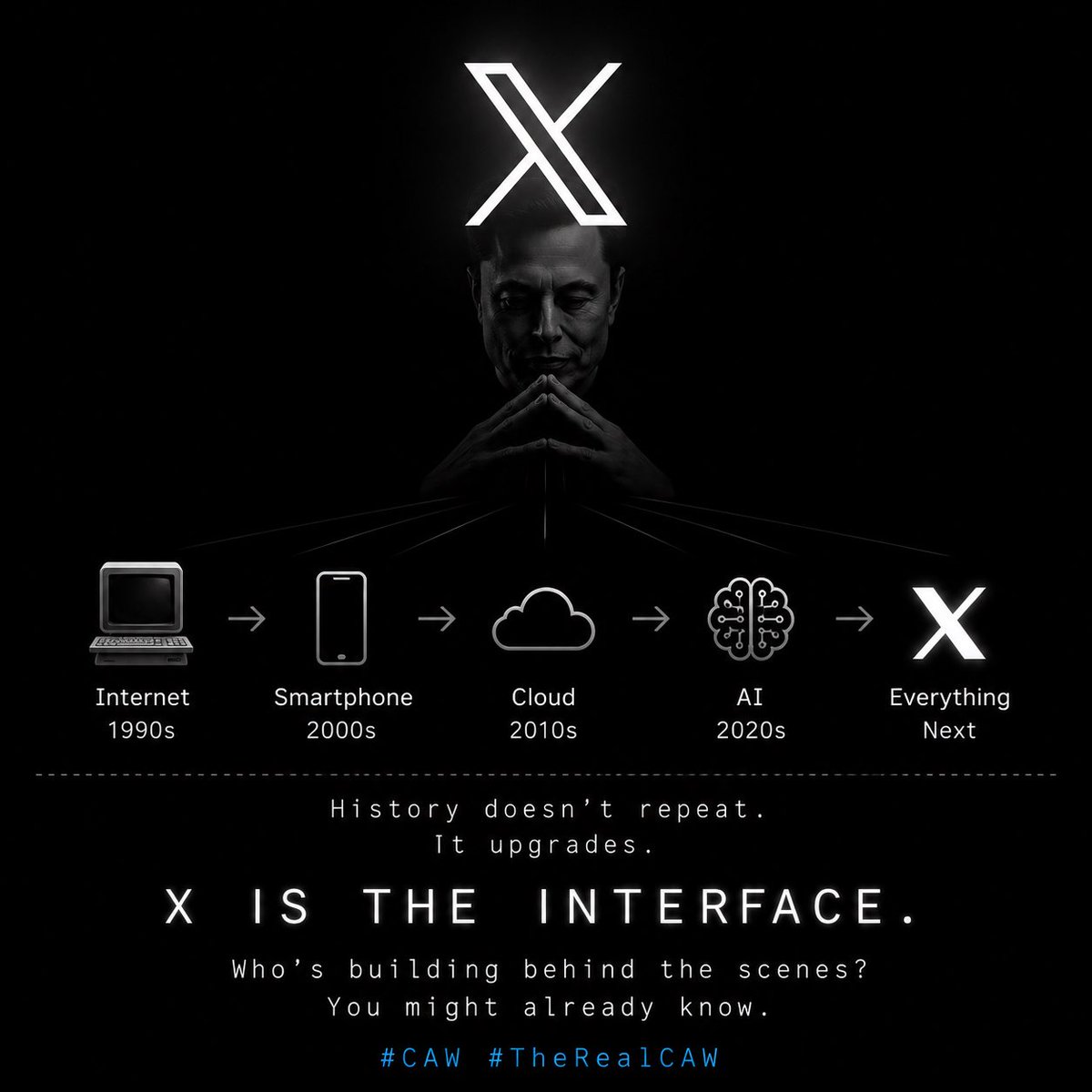
The internet looked useless.
Bitcoin looked like internet gambling.
AI looked like a toy.
The pattern repeats constantly because society evaluates new systems using old interfaces.
That is why transitional technologies are often misunderstood.
Especially when they first appear inside meme culture.
But sometimes the joke is merely camouflage for the infrastructure underneath.
And right now, CAW increasingly looks like something moving beneath the surface layer of crypto itself.
HODL!
Recently, I read a fairly technical review written by someone analyzing the recent CAW architecture changes.
What caught my attention was not just the contracts themselves.
It was the direction.
Because the more I read it, the more one thing became obvious:
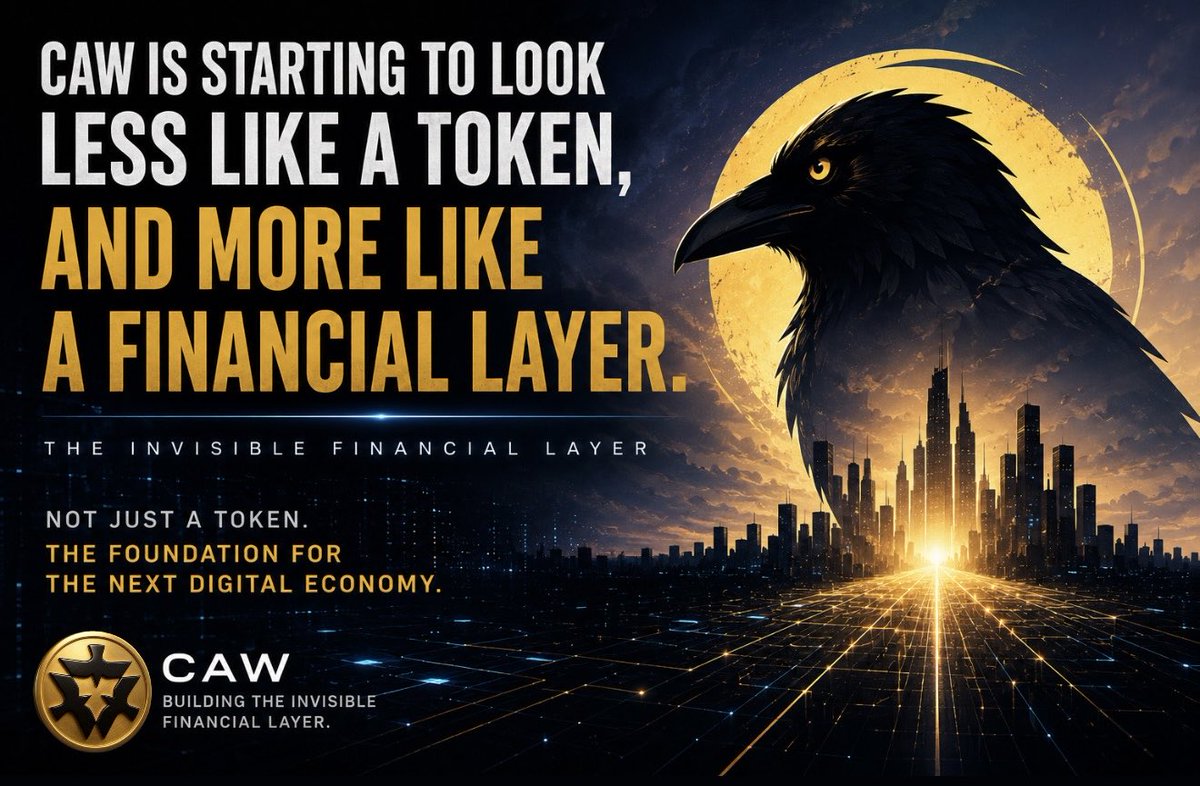
CAW is starting to look less like a token, and more like a financial layer.
That may sound exaggerated to people still viewing CAW through the lens of “meme coins.”
But structurally, something is clearly changing.
And the interesting part is that the changes are not happening at the surface level.
They are happening at the infrastructure level.
Most crypto projects still operate with a very old assumption:
users should adapt to blockchain.
CAW increasingly appears to be moving toward the opposite philosophy:
blockchain should adapt to users.
That distinction is massive.
Because the largest limitation preventing crypto from becoming true societal infrastructure has never been throughput alone.
It has been UX friction.
Wallet management.
Gas.
Chain switching.
Bridge logic.
Signature requests.
Seed phrases.
To developers, these are normal.
To society, they are absurd.
This is why most crypto systems still fail at mass adoption despite billions in liquidity and years of development.
They are technically decentralized,
but socially unusable.
Historically, breakthrough infrastructure only wins after complexity becomes invisible.
The internet did not scale globally because people suddenly learned networking.
It scaled because TCP/IP disappeared behind browsers.
Smartphones did not win because society became more technical.
They won because the interface abstracted complexity away.
The same pattern is likely happening now with decentralized systems.
And this is where CAW becomes interesting.
Because recent architectural signals increasingly resemble infrastructure evolution rather than token speculation.
Validator-oriented structures.
Modular deployment behavior.
Cross-chain persistence.
Gas abstraction.
Identity-linked interaction.
Frontend separation.
Deployment orchestration.
Registry-style deployment generation.
None of this is required for a meme coin.
Infrastructure requires it.
CAW launched on April 14, 2022.
Within 48 hours:
•13 exchange listings
•Renounced contract
•Dev wallet burned
•Stealth launch
•No traditional marketing
That does not look like a normal meme coin launch.
Most people still think Elon Musk is simply building another tech company.
But what if the real objective is much larger?
What if the goal is not another app…
but a new financial foundation for the internet itself?
When you look closely at everything Elon is building, a pattern starts to appear.
X.
xAI.
Payments.
Identity.
AI interaction.
Real-time communication.
The Everything App vision.
These are not isolated businesses.
They are layers of the same system.
And at the center of that system is one extremely important idea:
The username.
Not wallet addresses.
Not bank account numbers.
Not complicated blockchain UX.
Identity.
A simple @username connected to everything.
Communication.
Payments.
AI.
Reputation.
Commerce.
Subscriptions.
Value transfer.
That changes the entire structure of the internet.
Because once identity becomes the financial layer, the interface itself changes.
You no longer “use crypto.”
You simply interact.
You talk.
You send.
You receive.
You subscribe.
You split payments.
You access AI.
And underneath it all, infrastructure handles the complexity invisibly.
That is why the recent CAW Social architecture is becoming so interesting.
Because suddenly, the structure starts looking aligned with this future.
CAW Social introduced:
•Username NFTs
•Gasless social actions
•Validator architecture
•Frontend separation
•Cross-chain archive systems
•Permissionless frontends
This is not normal meme coin architecture.
A meme coin does not need:
•Identity layers
•Validator execution
•Frontend abstraction
•Cross-chain persistence
•Gasless UX
But infrastructure does.
Especially infrastructure designed for mass adoption.
The deeper implication is this:
If X eventually evolves into a global interaction layer, then the real challenge is no longer building another token.
The challenge becomes:
How do you create a system where billions of people can interact financially without ever thinking about blockchain?
That requires:
•Invisible wallets
•Gas abstraction
•Username identity
•Real-time settlement
•AI-native interaction
•Decentralized backend layers
And strangely enough, CAW’s architecture is beginning to resemble exactly that type of system.
Especially the idea that:
“Anyone can build a frontend.”
At first, many people misunderstand this.
They think multiple frontends would weaken X.
But protocol systems work differently.
HTTP did not weaken Google.
Open internet protocols created larger ecosystems.
The protocol becomes the foundation.
The strongest frontend becomes the dominant gateway.
If X controls:
•The largest identity graph
•The largest AI layer
•The largest social network
•The largest payment flow
then X remains central even if many frontends exist around the ecosystem.
In fact, multiple frontends may strengthen it.
Because they increase:
•Innovation
•Specialization
•Regional adoption
•Financial experimentation
•AI interface evolution
This is why the future may not be “one app.”
It may be:
“One protocol.
Many interfaces.”
And that is where things start becoming difficult to ignore.
Because the more CAW evolves, the less it behaves like a meme coin…
and the more it behaves like infrastructure for a future internet economy built around identity, AI, and financial interaction.
2/2
The Timing Is What Makes This Strange
The most important question is not what CAW is doing.
It is why this acceleration is happening now.
Most meme projects slow down when price weakens.
CAW appears to be doing the opposite.
While market attention fluctuated, the underlying architecture became more sophisticated.
That is unusual.
Especially because the timing aligns almost perfectly with the broader direction of the internet itself.
The world is rapidly moving toward:
-AI-native interaction
-embedded finance
-digital identity
-social payments
-wallet abstraction
-cross-chain infrastructure
At the center of much of that conversation sits X and the rollout of X Money.
To be clear:
There is still no definitive proof that X is connected to CAW.
That distinction matters.
But the larger point is harder to ignore:
CAW increasingly appears to be building toward the exact same future.
⸻
Wallet Abstraction Changes Everything
One of the most important concepts in modern crypto infrastructure is wallet abstraction.
In simple terms:
The user should not feel like they are using a wallet at all.
Current Web3 systems are too difficult for mainstream adoption.
Seed phrases.
Gas fees.
Bridge confusion.
Chain switching.
Wallet signatures.
Normal users will never tolerate this at scale.
So the entire industry is moving toward a different model:
Web3 that feels like Web2.
The user simply says:
“Send money to @username.”
Everything else happens invisibly underneath:
-routing
-bridging
-execution
-settlement
And when reviewing recent CAW architecture, this direction becomes impossible to miss.
Even the manifesto emphasizes the idea that users should only pay gas for minimal core actions.
That is not meme coin thinking.
That is mass-adoption thinking.
⸻
Why LayerZero Matters
Another critical piece is LayerZero Labs.
LayerZero is important because it changes how blockchain systems communicate.
The future may not revolve around:
“Which chain wins?”
Instead, it may revolve around:
-identity layers
-messaging layers
-execution layers
-settlement layers
In that world, the blockchain itself becomes abstracted away.
Users may no longer care whether something runs on:
Ethereum,
Arbitrum,
Base,
or Solana.
What matters becomes:
-which identity is used
-which interface is used
-how value moves
-how communication persists
And recently, CAW appears to be moving directly toward that model.
⸻
So What Exactly Is CAW Becoming?
There are still no guarantees.
No proof of X integration.
No certainty of adoption.
No confirmation of real-world success.
But despite that, something important has clearly changed.
CAW no longer behaves like a project focused purely on speculation.
It increasingly behaves like a project experimenting with the structure of the next internet itself.
And that may be why more people are starting to ask a different question.
Not:
“Will CAW pump?”
But:
“What if CAW was never designed to be just a meme in the first place?”
CAW Was Never Just a Meme
Most people still look at A Hunters Dream and see “just another meme coin.”
I never did.
Because from the very beginning, CAW carried something that did not feel normal.
The stealth launch.
The extremely small initial liquidity.
The renounced contract.
The cryptic messages.
The manifesto.
And a community that often talked more about ideas than price.
Typical meme coins revolve around simple mechanics:
price,
hype,
influencers,
exchange listings,
short-term speculation.
But CAW always felt different.
And recently, that difference has become much harder to ignore.
Because the project no longer appears to be developing “for price.”
It increasingly looks like it is developing for infrastructure.
⸻
The GitHub Changed the Conversation
After reviewing the recently active repositories and documentation connected to CAW, one thing became clear:
This is no longer structured like a normal meme ecosystem.
The architecture now includes concepts such as:
-validators
-action processors
-gasless interactions
-username structures
-frontend separation
-cross-chain persistence
-session keys
-multi-chain replication
That is not typical meme coin development.
It looks far closer to the architecture of a decentralized social infrastructure.
Even more importantly, the newer documentation no longer frames CAW purely as a token.
It increasingly describes a decentralized social protocol.
That distinction matters.
Most meme projects talk about:
“Why the token will go up.”
CAW has recently started talking about:
“How the system itself should function.”
That is a completely different direction.
⸻
Username NFTs Are More Important Than People Realize
One of the most interesting concepts is the username NFT structure.
This is not simply a profile name.
The username itself becomes the identity layer.
Ownership of the username connects to:
-messaging
-balances
-identity
-social actions
And immediately, the comparison becomes obvious.
This starts looking very similar to how @handles function on X Corp..
At that point, CAW stops looking like a meme token and starts looking like an identity infrastructure.
A system potentially moving toward:
-decentralized identity
-social graphs
-AI interaction
-username-based payments
That is why some observers have started describing CAW less as a meme and more as infrastructure.
1/2
Why Recent CAW Social Development Is Interesting
Recent statements from the CAW development side are notable for this reason.
For example:
“The real CAW has profiles on ETH, staking on ETH, and never requires gas on another chain.”
The important part is not the token itself.
It is the UX direction.
Another statement said:
“The real CAW lets you like/post/follow without signing your wallet constantly.”
That points toward:
-gas abstraction
-signer abstraction
-account abstraction
-profile-based identity layers
-frictionless social interaction
This is no longer just “a meme coin with a social platform.”
The architecture direction is beginning to resemble:
-Farcaster
-Lens
-Bluesky-style decentralization
-social infrastructure layered over blockchain systems
⸻
X Does Not Need Another Token
Most people ask the wrong question.
They ask:
“Will X adopt CAW?”
But the deeper question is:
“What does X actually need?”
X does not need another speculative asset.
It does not need another meme token.
It already has:
-users
-distribution
-identity graphs
-AI integration
-payment ambitions
If X eventually integrates deeper crypto infrastructure, it likely needs:
-identity layers
-payment abstraction
-censorship resistance
-AI-native interaction
-cross-chain persistence
-gasless user experiences
In other words:
The value may not be in the currency itself.
The value may be in the infrastructure.
⸻
The Most Powerful Technologies Eventually Become Invisible
This always happens.
People no longer think about:
-TCP/IP
-HTTP
-DNS
when using the internet.
They no longer think about:
-processors
-memory
-operating systems
when using smartphones.
The strongest technologies disappear into the background.
They become invisible.
⸻
Web3 Will Likely Follow The Same Path
In the future, ordinary users probably will not care about:
-which chain is being used
-what signing method exists
-which Layer 2 is involved
They will only care about:
-speed
-simplicity
-low cost
-AI interaction
-sending by username
-seamless experiences
The winning systems will not necessarily be the most technically complicated.
They will be the ones that remove the most friction.
⸻
History Keeps Moving In The Same Direction
Human civilization repeatedly moves toward:
-less effort
-less complexity
-more automation
-more intuitive systems
-faster interaction
And once people experience lower friction,
they rarely go backward.
The internet followed this path.
Smartphones followed this path.
AI is following this path now.
And if Web3 eventually reaches mass adoption,
it may not happen because people “love crypto.”
It may happen because the infrastructure becomes so frictionless that people stop noticing it exists at all.
People Don’t Follow Technology
They Follow Whatever Removes Friction
Throughout history, some technologies disappear while others become impossible to stop.
The difference is not always technical superiority.
Most people assume the best technology wins.
But history repeatedly shows something else:
The technologies that reshape civilization are usually the ones that reduce human friction.
⸻
The Internet Didn’t Win Because It Was “Advanced”
The internet was not immediately accepted.
In the early days, it was viewed as something for engineers, hobbyists, and computer nerds.
People had to understand things like:
-FTP
-DNS
-Modems
-IP addresses
-Command lines
For ordinary users, it was confusing and intimidating.
Connections were slow.
Setups were complicated.
And many people believed:
“Television is enough.”
“Newspapers are enough.”
“Phones are enough.”
But eventually the entire world moved online.
Why?
Because it became too convenient to ignore.
⸻
Humans Always Move Toward Lower Friction
This pattern appears everywhere in history.
The technologies that survive usually make life:
-faster
-simpler
-cheaper
-more automatic
-more intuitive
-less mentally exhausting
People do not ultimately choose based on ideology.
They choose based on reduced friction.
⸻
Smartphones Followed the Same Pattern
When smartphones first appeared, many people dismissed them.
“PCs are enough.”
“Typing on glass is terrible.”
“Physical keyboards are better.”
But the outcome became obvious.
Today, most people reach for their phone before opening a computer.
Why?
Because smartphones removed friction.
-instant access
-always connected
-one-touch interaction
-built-in payments
-cameras, maps, communication, everything in one place
The smartphone succeeded because it hid complexity.
Most users do not understand:
-operating systems
-processors
-memory management
And they do not need to.
That is the point.
⸻
AI Is Following the Exact Same Path
AI is not simply another software trend.
It may become an internet-scale shift — or larger.
Because AI is beginning to remove friction from interaction itself.
⸻
Old Interfaces Forced Humans To Adapt
Traditional software required people to learn:
-menus
-buttons
-settings
-folder structures
-commands
Humans had to adapt to machines.
AI reverses this.
Now machines adapt to humans.
⸻
Conversation Is Becoming the New Interface
Instead of navigating systems manually, people increasingly say:
“Summarize tomorrow’s meeting.”
“Send money to this person.”
“Book a hotel.”
“How should I answer this interview question?”
“What strategy makes sense right now?”
And the system handles the complexity underneath.
This changes everything.
Because humans naturally avoid learning overhead whenever possible.
⸻
Web3 Today Looks Like the Internet in the 1990s
Modern crypto infrastructure is still too difficult for normal users.
Most people do not want to think about:
-seed phrases
-gas fees
-bridges
-RPC endpoints
-wallet signatures
-chain switching
-explorers
This is very similar to the early internet era.
Back then, average users also struggled with technical layers.
The internet only exploded after those layers became invisible.
⸻
The Real Winners Will Hide Complexity
This is the key point.
The projects most likely to reshape the future are not the ones adding more complexity.
They are the ones hiding it.
The future likely belongs to systems where users no longer think about blockchains at all.
That means:
-gasless interactions
-minimal wallet signing
-username-based identity
-AI-driven interfaces
-hidden chain infrastructure
-abstracted backend systems
Users do not care which chain processes a transaction.
They care whether the experience feels effortless.
X does not need another token.
That may sound strange coming from someone watching CAW closely.
But it’s probably the most important point.
Most people look at this from the wrong direction.
They ask:
“Will X adopt CAW?”
But the better question is:
“What does X actually need?”
X does not need another speculative asset.
It does not need another ticker.
It does not need another meme.
X already has the users.
It already has the identity layer.
It already has the social graph.
It already has AI through Grok.
It is clearly moving toward payments and the Everything App model.
So if X ever needs something underneath, it will not be “just a token.”
It would need infrastructure.
Something that can support:
gasless actions
username-based identity
multiple frontends
validator execution
cross-chain persistence
censorship resistance
AI-native interaction
That is why the recent CAW Social architecture matters.
Because CAW is starting to look less like a coin, and more like a protocol.
The most important part is not the price.
It is the structure.
Username NFTs.
Gasless social actions.
Validator architecture.
Frontend separation.
Cross-chain archives.
These are not normal meme coin features.
A meme coin does not need permissionless frontends.
A meme coin does not need validators.
A meme coin does not need cross-chain recovery.
A meme coin does not need a social protocol.
That is exactly what makes CAW interesting.
If X becomes the dominant frontend for communication, AI, identity, and payments, then the real value may not be in creating another visible app.
The real value may be in the invisible layer underneath it.
That is how infrastructure works.
Users do not think about TCP/IP.
They do not think about HTTP.
They do not think about cloud routing.
But those layers make the internet possible.
In the same way, the future of X may not require users to “see” CAW at all.
If CAW is ever involved, it may not appear as a logo on the screen.
It may appear as infrastructure.
A shared layer for identity, action, storage, and value movement.
This is why “anyone can build a frontend” is not a weakness.
It is the point.
If the protocol is shared, many frontends can exist.
Social frontends.
AI frontends.
Financial frontends.
Regional frontends.
Specialized frontends.
But the network effects still flow back to the protocol.
And if X holds the largest users, AI, liquidity, and identity graph, then X still stays at the center.
More frontends do not necessarily weaken X.
They can strengthen the ecosystem around it.
That is the structural difference most people miss.
CAW does not have to compete with X.
CAW would only matter if it can become useful beneath X.
Not as another app.
Not as another coin.
But as infrastructure.
So the real thesis is not:
“X needs CAW as a token.”
The real thesis is:
“X may eventually need a decentralized infrastructure layer.”
And CAW is starting to look like it was built for that conversation.
Not proven.
But increasingly difficult to ignore.
HODL!
CAW Social’s architecture has made me think about something recently.
A lot of people assume:
“If anyone can build their own frontend, wouldn’t that become a problem for a massive platform like X?”
But the reality may actually be the opposite.
If X is ultimately moving toward:
・Identity
・Payments
・AI
・Social infrastructure
・Everything App architecture
then the most important thing is probably not:
“owning every app.”
It’s:
“owning the underlying infrastructure.”
The recently released CAW documentation strongly points toward:
・Frontend separation
・Validator separation
・Permissionless frontends
・Gasless actions
・Username identity
In other words:
“The UI is flexible.
The protocol is shared.”
This is actually how the internet itself works.
Anyone can build on HTTP.
Yet platforms like Google, YouTube, and X still become dominant frontends.
Because:
protocol ≠ frontend.
So if X were ever to use something like CAW as an underlying layer in the future, the existence of additional frontends would not necessarily hurt X at all.
In many ways, it could strengthen the ecosystem.
Different frontends allow:
・Regional specialization
・Financial specialization
・AI-focused interfaces
・Rapid UX experimentation
・Faster innovation
And for protocol-based ecosystems, that is usually a positive.
What ultimately matters is where the largest liquidity, identity graph, AI layer, and user base exist.
If X controls:
・The largest social graph
・The largest AI integration
・The largest payment flow
・The largest identity layer
then X remains central regardless of how many additional frontends exist around it.
In fact, multiple frontends may actually increase:
“censorship resistance.”
And that seems very aligned with the direction these systems are moving toward.
What makes CAW particularly interesting is that the architecture no longer resembles a typical meme coin project.
The focus is increasingly on:
・Validator batching
・Cross-chain archives
・Frontend abstraction
・Gasless signatures
This is infrastructure design.
More importantly, it is infrastructure designed to hide blockchain complexity from normal users.
And that is extremely compatible with where X Money and AI-native finance appear to be heading.
Another major shift coming over the next few years is likely the transition from:
“button-first interfaces”
to:
“AI-first interfaces.”
People will increasingly stop “using apps” directly.
Instead, they will simply instruct AI what to do.
But reality still matters.
People spend time in:
・Trains
・Offices
・Quiet public spaces
Which means the future probably is not voice-only.
The real future is more likely:
“AI + silent UI.”
Interfaces where:
・AI is always present
・Voice is natural when possible
・Buttons appear only when necessary
・Complexity stays hidden underneath
And interestingly, many of the recent developments around CAW seem to be moving in exactly that direction.
At this point, the important question may no longer be:
“Will CAW officially integrate with X?”
The more important question is:
“Is CAW evolving toward the same structural future that X itself appears to be building toward?”
And based on the recently released architecture and documentation, the alignment appears significantly stronger than before.