In addition, I was really inspired by the students keeping blogs as a way to log their observations and to provide a summative assessment at the end of the unit.
In Petrosino and Mann's article on modeling ecosystems, the authors show that "models should be an integrated part of any unit to drive instruction and support a better understanding of the phenomena be- ing studied" (p.33).
This reading detailed a middle school classroom that used physical, symbolic, and computational models to study ecosystems. One thing that really stood out to me throughout the unit was the opportunities for assessment. This was integrated through question asking by the teacher.
3. Example 3: Simplifying a complex claim by identifying key concepts in it this allows the students to have a clear understanding and therefore complete the task
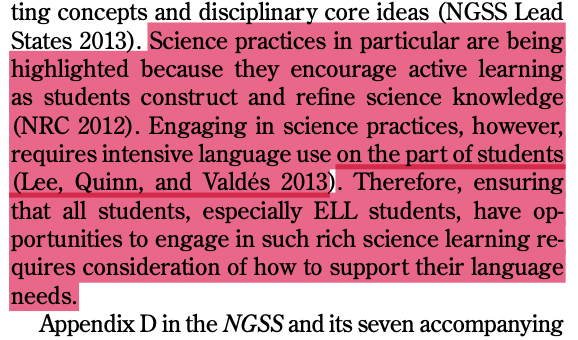
As Gonzalez-Howard et el pointed out in their article about supporting ELL's engagement in scientific argumentation, the need to engage in rich science learning also comes with a need to consider and cater towards the needs of English Language learners.
2. Doing a think-aloud to model appropriate language to use during a task which allows the teacher to not only demonstrate clear expectations but also provide them with language to engage in the task.
Strategies included in this are
1. Discussing the meaning of a keyword or phrase related to argumentation: meaning take time to explain not only expectations but key vocabulary used throughout the exploration. This should be clear to students through strategies like analogies.
Although this is unpredictable and effortful, the result of discussions using the questions in the image above is that students retain information in a meaningful way, rather than immediately recalling what the teacher just said. This sets students up to be lifetime learners!
In Campbell, Schwartz, and Windschitl's article on sense-making in the classroom, they argue that misconceptions are often a necessary step for students to build foundational and meaningful knowledge on a given topic.
This article challenges and calls teachers to move away from the "right" answer and to instead engage students in probing discussion that helps them to make meaning based on evidence and experience about what they are learning.
This is because students are working to support and understand their original claims they made since the phenomena experience. By centering students, they are active participants and investigators looking to find the answers and make discoveries themselves.
In Eve Manz's article, Getting a Grip, the idea of using phenomena to launch an elementary scientific investigation proves to be engaging and beneficial for the students. The attached image shows the benefit of phenomena, allowing students to utilize critical thinking.
By designing and adapting investigations this way, a more equitable environment is created where students can all have access to sense making. Through phenomena, the next steps including the actual investigation, evidence, conclusion and explanation, are driven by students.
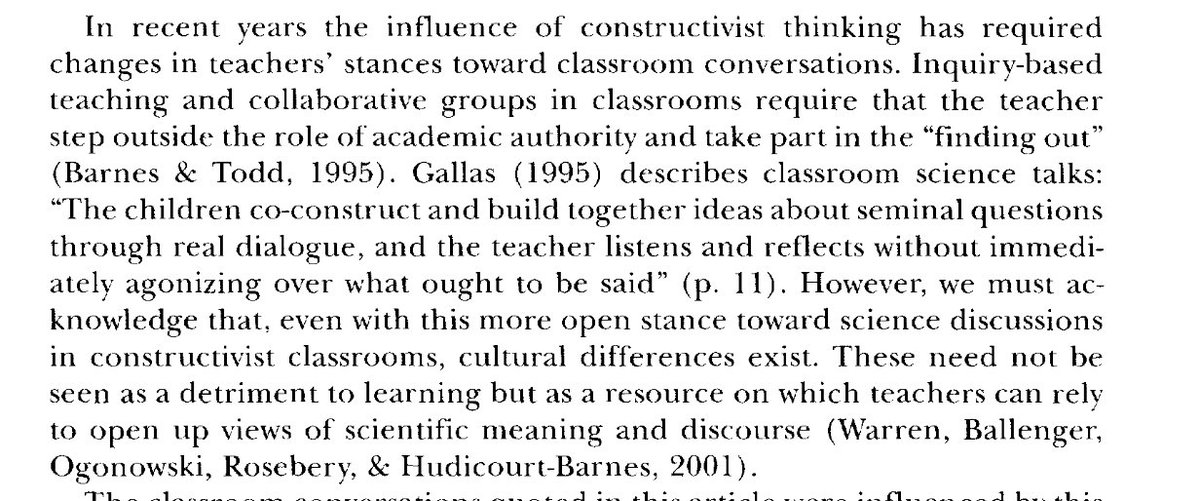
To be responsive means we are making space to "hear students' diverse voices" allowing them to explore their own questions. Teaching should be a dynamic discussion, and in order to include all students across cultures, students must be given the space to speak and question.
In Hudicourt-Barnes article, The Use of Argumentation in Haitian Creole Science Classrooms, the idea of teacher-centered conversations is challenged in order to fit a more culturally appropriate, student-based inquiry class. The result is that students felt freedom to participate
In traditional classrooms, knowledge is presumed to reside in the teachers mind, making many students strive to meet teachers expectations rather that explore and acquire knowledge for themselves. Inquiry requires discussion, scientists rarely work alone.
ISIs are beneficial because science is often the first thing to go. As teachers, it is our job to make science accessible. This requires effort, specifically in regard to ISIs. Teachers need to do their research before, during and after in order to capitalize on the experience.
Informal Science Institutions bring science learning outside of the classroom context. They work with teachers to make science experiential. ISIs "spark interest in science and provide opportunities to broaden and deepen students’ engagement" (Walsh and Strait).
This is more effortful on the teachers part, but also allows them to play a more flexible and active role, instructing, facilitating and guiding the students. This can be done through establishing and building upon an anchoring phenomenon, giving the students space to explore.
Culturally relevant science teaching requires meaningful engagement. As I have observed in my placement, it takes more effort, but making space for connections, and critical thinking allows for science to become relevant and relatable to all students.