Memoir of a Crime Scene Technician – Posting Free, Chapter by Chapter
I spent 11 years working thousands of crime scenes for the Tampa Police Department.
I started at 18 years old, in a building that felt like family, and I left at 29 carrying memories that never faded.
This memoir is the story of those years: the work, the people, the loss, the moments that shaped me, and the ones that refused to let go.
I’m posting the entire book here on X, for free, as I write it.
Chapters may not be released in chronological order, but as they develop and reach a level of completeness with which I am satisfied.
These chapters are a work in progress until the final edits are completed with the publisher, so some changes may be made along the way.
We will also have a Substack for the memoir as it develops, where the chapters will be organized and easier to follow.
Start with the Prologue below.
Follow along for new chapters, behind-the-scenes details, and more of the world inside 1710 North Tampa Street.
Thank you for reading.
This means more to me than you know.
🧵
SNEAK PEEK: One Fingerprint, One Life Sentence
----
The call came in as a home-invasion homicide, just north of Lowry Park.
One person dead. One critically wounded. No suspect.
Inside the home, the scene told a story that would take years to fully unfold.
Richard “Rick” Valdez was thirty-seven years old—a truck driver, a big man described by friends and family as gentle, kind, and devoted to his wife.
He and Linda had been married about two years. They had met in Hawaii, standing on a cliff overlooking the ocean. They surfed together and carried that love of the water back with them to Tampa.
On the morning of September 19, 1996, an intruder kicked in their front door and walked straight to their bedroom.
Rick and Linda were asleep when the man entered, armed with a gun. He demanded money and ordered them to lie face down. He pulled the electrical cord from their alarm clock and tried to bind their hands.
At that point, Rick fought back.
What followed was quick and brutal. The intruder fired five hollow-point rounds into Rick’s body, killing him where he stood. Linda was shot once in the chest. Despite her injury, she managed to activate the home’s burglar alarm. The intruder fled without taking anything.
Rick was dead at the scene. Linda was rushed to Tampa General Hospital, where she was treated and recovered from her wounds.
Neighbors reported occasional vandalism and petty theft in the area, but nothing approaching this level of violence.
What we knew was limited: a black male, approximately twenty-four to thirty years old, between five-foot-seven and six feet tall, around 160 pounds, medium build, with a mustache.
Outside of the suspect description, we had almost nothing else.
The master bedroom was the center of the investigation.
As usual, we photographed the bedroom thoroughly, enough to recreate a full panoramic view of the room. We then took individual photographs of each item of evidence we intended to collect.
Standard procedure for major cases like this was to collect any items that might contain fingerprints and bring them back to our evidence processing room at TPD headquarters. In a controlled environment, we had a better chance of finding and preserving latent prints.
The alarm clock was our most promising piece of evidence.
Once those items of evidence were collected, we set to dusting for fingerprints everywhere that it was possible that the suspect might have touched, including the front of a pickup truck parked outside the residence, where witnesses believed they had seen the suspect lingering before the incident.
Once we had finished up at the scene, I returned to police headquarters and went directly into our evidence processing room with the alarm clock.
I set it up for super-glue fuming and developed a surprisingly good fingerprint. I photographed it, dusted it, lifted it, and submitted it to the latent print examiners.
They were able to match that fingerprint with a known criminal from the area, and we got a name: Terrol Steven Sanders. A warrant was issued and entered into the NCIC database, which would hit nationwide should he be picked up anywhere in the country for any lawful reason.
About a month later, that NCIC teletype went off in a communications section in New Jersey. A man named Terrol Steven Sanders, thirty-one years old, was arrested on unrelated charges. New Jersey authorities notified Tampa police. Detectives traveled north to interview him.
The case did not break open all at once. It broke at the point where one fingerprint turned a random act of violence into a person who could not deny being there.
Faced with that evidence, Sanders confessed.
He provided details consistent with the crime scene. He admitted to the home invasion, the struggle, and the shootings. Investigators later concluded the attack was random, possibly fueled by cocaine use, and that Sanders fled empty-handed after Linda triggered the alarm.
Continued...
2/
The fingerprint on the clock radio confirmed what the confession already suggested: Sanders had been there, inside the bedroom, handling the object used to restrain the victims.
Sanders was extradited back to Florida. The case was charged as a capital offense.
The trial began in May 1998.
Prosecutors argued that the murder occurred during the commission of a burglary and attempted robbery — a felony murder. Linda Valdez testified about waking to a stranger standing over them, the demand for money, the struggle, and the gunfire. She described it simply: they were fighting for their lives.
The jury heard about the hollow-point bullets. They heard about the alarm clock. They heard about the fingerprint.
After approximately seven hours of deliberation, the jury returned guilty verdicts on all counts:
First-degree murder; attempted second-degree murder; burglary of a dwelling with a firearm; two counts of attempted robbery with a firearm; attempted kidnapping with a firearm.
During the penalty phase, the jury recommended life imprisonment without parole rather than the death penalty. The judge followed that recommendation, imposing multiple life sentences and additional consecutive terms.
Family members addressed the court. They described Rick as a man taken by a cocaine-fueled rampage. They spoke about the life that ended in a bedroom before sunrise.
In the months following the murder, friends organized a fundraiser — the Rick Valdez Classic golf tournament — to support the family. Linda later planned to scatter Rick’s ashes at sea, returning him to the ocean he loved.
Sanders appealed his conviction repeatedly.
Every appeal was denied. State and federal courts affirmed the verdict and the sentence.
As of today, he remains incarcerated in Florida, serving life without parole.
I was later awarded Employee of the Month for my role in this investigation. It wasn’t something I sought or expected, but it was gratifying all the same. The recognition meant that the long hours and attention to detail had made a difference.
----
If you're enjoying this memoir project, PLEASE feel free to share these posts to help more people discover it.
🚓 New chapters are posted here as soon as they’re written.
----
#TrueCrime #CrimeScene #Forensics #TampaPolice #Memoir #CrimeSceneTechnician #CSI #CrimeSceneInvestigation
#CrimeSceneStories #BehindTheScenes #PoliceHistory #CrimeSceneMemoir #TrueCrimeCommunity
#ForensicScience
2/
The Bronco wasn’t meant for major cases, that’s what the big labs were for, but it was perfect for nearly every call we took on a typical shift. Most scenes didn’t require the generator, floodlights, or full equipment inventory of the crime lab. What it did have was everything we needed for evidence collection, and that's all we needed, since we carried our own camera gear and fingerprint kits with us.
It was quick, comfortable, and easy enough to maneuver through tight city streets or crowded apartment complexes. For the routine calls: burglaries, recovered stolen vehicles, trips to the impound lot or medical examiner's office, it was ideal.
And honestly, it just looked cool. Everyone in the unit had a vehicle they gravitated toward, and the Bronco was mine. If it was available when I was heading out, that’s what I grabbed. There was something satisfying about rolling up to a scene in it, partly the utility, partly the aesthetic.
Unmarked Dodge Diplomat
The last vehicle in our small fleet was the old detective's car, and I can't remember the unit number, which doesn't really matter.
It was a dingy navy blue Dodge Diplomat, an ’84, if I remember right. It definitely wasn’t new, but it ran well, and the V8 under the hood could move when we wanted it to.
We didn’t have many legitimate reasons to drive fast, but that didn’t stop us from doing it now and then. Those were liberties we shouldn’t have taken, but nothing that would make most officers raise an eyebrow.
It was, in every sense, a real police vehicle. It came with a blue teardrop dash light we used at scenes where we needed to be visible to traffic, and it had a functioning siren, which we were not authorized to touch. That, of course, meant we touched it as often as possible. Played with it is probably more accurate. The trunk carried everything we needed for evidence collection. When we had to ferry technicians to a scene, the Diplomat, or the Bronco, did the job. Like the Bronco, it was simply a practical, reliable way to get from the station to the scene and back.
Sometimes, if we were especially busy and all vehicles were tied up across the city, and a new call-out could not wait, we would either have to hitch a ride with a detective or street officer, or in a desperate pinch, borrow a car from one of the district offices. Normally, policy required a cover be placed over the light bar so the public would know we weren’t an in-service police unit. But the couple of times I ended up behind the wheel, that cover wasn’t available. And even though we were professionals in every sense, I’ll admit it: I felt a little giddy. A kid-in-the-candy-store moment. Riding out in a fully marked cruiser, even temporarily, felt like being handed the keys to something iconic. It didn’t change the work one bit, but it sure added a spark to the ride.
----
If you're enjoying this memoir project, PLEASE feel free to share these posts to help more people discover it.
🚓 New chapters are posted here as soon as they’re written.
----
#CrimeScene #TampaPolice #Memoir #CrimeSceneTechnician #CSI #BehindTheScenes #PoliceHistory #CrimeSceneMemoir
🧵
SNEAK PEEK: The Vehicles That Carried Us
----
Our vehicles were more than just transportation. They were our mobile office, our toolbox, our escape from the Florida heat, or cold, during the brief stretch of time when Florida actually turned cold, and every now and then, they were even our playground.
The Mobile Crime Labs — Units 305 & 772
We had two mobile crime labs during my time, 305 and its twin, 772. Both were built on Chevy van chassis and were essentially identical to the ambulances of that era. Unless you got close enough to read the markings, most people assumed we were an ambulance there to pick up the body and take it to the morgue. That was just the way it was. We didn't hold it against them, because these units had the same box-style body, rear double doors, and rooftop air unit. The only real difference was the TPD vehicle markings.
Inside, the labs carried just about every piece of equipment we needed to process any crime scene: portable lighting, ladders, casting materials, evidence bags, tape measures, you name it. Both labs also had floodlights mounted externally so we could light up an entire yard or street corner when working at night. When one of those labs rolled up, we essentially brought a full workspace with us.
One of the best features, especially in Florida, was the generator-powered air conditioner. When it had been running for a while, the inside of that lab was cold enough to feel like you’d stepped into a walk-in refrigerator. After working a scene in the summer heat, covered in sweat and fingerprint powder, stepping into the back of the lab felt like diving into a frigid swimming pool. Along one side was a padded bench, where I would often sit after a long, sweaty stretch, filling out the information on the latent print cards I’d just collected.
305 and 772 weren’t fast or graceful on the road. They were wide, especially with their full-sized truck mirrors jutting out along each side. Some of the streets in Tampa were quite narrow, and it would be easy to clip a pedestrian or a parked car with one of those mirrors.
One night, after wrapping up a crime scene on one of those streets, where I had to park and walk a block or two to get to my scene, I headed back to the crime lab only to find that I’d been boxed in by cars parked tight along both curbs. I was facing forward toward a dead end, so there was no way for me to turn around. I was going to have to back up a full city block, at night, with only the flood lights on each side of the lab to illuminate the cars beside me. I was absolutely convinced there was no way I was getting that behemoth through without side-swiping at least one car, or sacrificing a mirror or two. I could already picture the stack of paperwork that I was going to have to fill out, along with the phone calls and the explanations that went along with a city vehicle involved incident.
But I was determined.
I eased into the driver’s seat, took a breath, and started inching backwards, slowly, painfully slowly. Back a little. Forward a little. Jut my head out the window to see how close I was on the driver side, then hop over to the passenger side and do the same. It felt like navigating a submarine through a hallway. It took nearly half an hour to get through that gauntlet of parked cars, but I did it without a scratch. It wasn’t a tremendous feat or a glamorous story, but I felt like Superman.
Ford Bronco — Unit 5096
If the mobile crime labs were the workhorses of the unit, the Bronco was the fun one. It had started its life as a drug dealer’s vehicle, later confiscated, painted white, and outfitted with Tampa Police decals, giving it the outward appearance of a standard police vehicle. As we rounded corners in certain areas of Tampa during the early morning hours, drug dealers would flee from us, not knowing that the only things we were armed with were a camera and a fingerprint brush.
Continued...
@DOGEQEEN Well, they BETTER give me a refund on my tickets!! (No, wait, I have no idea who this person is, and wouldn't pay to see them even if I did, never mind).
2/
Jurors rejected the death penalty, recommending life in prison. Dixon received two life sentences for first-degree murder and additional life terms for armed robbery, followed by more than a century in prison for attempted robberies and car theft. Miranda was sentenced to life for first-degree murder, nine additional life sentences for armed robbery, and decades more for attempted robbery. Patrick Johnson pleaded guilty to both murders and testified against Dixon and Miranda as part of a plea agreement that resulted in consecutive life sentences. Samuel Glymp pleaded guilty to armed robbery and received a mandatory prison sentence after admitting his role in the spree.
As a crime scene technician, you never knew which scene would turn out to be important.
Most of them didn’t. Most stayed exactly what they appeared to be: contained, isolated, resolved. But every so often, one of them reached forward into something larger, and the only thing connecting it to what came later was the work you did when you didn’t know it mattered.
That bullet I cut out of the ceiling during that first crime scene, the photographs I had taken as morning light bathed the interior of the restaurant, the fingerprints I lifted from the glass of the front door: none of it felt consequential at the time. But later, when detectives started drawing lines between cases, that routine work became connective tissue.
Evidence doesn’t get more important with time; it either exists, or it doesn’t. That’s why we treated every scene the same way. Not because every scene was special, but because you never knew when one would turn out to be.
----
If you're enjoying this memoir project, PLEASE feel free to share these posts to help more people discover it.
🚓 New chapters are posted here as soon as they’re written.
----
#TrueCrime #CrimeScene #Forensics #TampaPolice #Memoir #CrimeSceneTechnician #CSI #CrimeSceneInvestigation
#CrimeSceneStories #BehindTheScenes #PoliceHistory #CrimeSceneMemoir #TrueCrimeCommunity
#ForensicScience
🧵
SNEAK PEEK: Ruthless Reign of Terror
----
By the time the arrests were made, multiple businesses and individuals had been robbed, and two men were dead.
Sheriff Walter Heinrich described the crimes as “a ruthless reign of terror perpetrated by a group of reckless and pitiless criminals.”
The series began on November 29, 1990, when two men entered the Waffle House on North Westshore Boulevard. One fired a shot from a semiautomatic, described by witnesses as “Uzi-type,” into the ceiling before taking money from the cash register and from customers.
A short time later, as I sat at my desk in the Crime Scene Unit at 1710 North Tampa Street, the phone rang. It was communications, requesting me to respond to a Signal 23, armed robbery, shots fired at that Waffle House on Westshore.
At the time, there was nothing remarkable about the call. It was simply a Waffle House robbery. Early morning, or late night, depending on your perspective. A shot fired into the ceiling to get everyone’s attention.
No injuries. No bodies. The kind of call that barely registered in a city that handled violence as a matter of daily business.
We worked plenty like it.
When I arrived, the scene was already settling back into itself. Customers gone. Staff shaken but cooperative. The ceiling tile had a single bullet hole punched clean through it, more punctuation than violence.
We got started processing the scene, treating it the way we treated all of them.
Photography came first. Overall shots, mid-range, close-ups. The ceiling. The counter. The registers. The paths in and out of the room. Nothing dramatic. Nothing hurried. Just documentation.
I dusted for fingerprints where it made sense: countertops, doors, surfaces the suspects might have touched without thinking. Some scenes gave you usable impressions. Some didn’t. You did the work either way, because that was the job.
Once the photographs were complete, the bullet still had to be recovered. That meant cutting it out of the ceiling tile and packaging it as evidence. Not because it seemed important at the time, but because it might be later.
Evidence was collected, labeled, logged.
The scene cleared. Reports written.
It was routine.
Or at least it looked that way.
What we didn’t know, what we couldn’t know, was that this robbery was just one stop on a larger arc. That the same gun would surface again. That the men who fired that warning shot into a restaurant ceiling would go on to kill.
About an hour later, two men fitting the same description struck again. John Rupert, thirty years old, was shot to death in front of his Hyde Park home when he attempted to stop the robbery of a friend returning from a bar. Jewelry and twelve dollars were taken from John Ansell. Rupert died at the scene.
The same weapon surfaced again nearly a month later.
On December 26, during an attempted robbery at the Best Western Safari Inn on Busch Boulevard, night auditor Raymond Sobczak, thirty, was shot and killed. Sobczak was trying to call for a security guard when he was shot.
Later robberies at other restaurants, motels, and car rental agencies followed a similar pattern.
The case broke after a robbery at a Wags Restaurant in Brandon, when deputies located a stolen Oldsmobile used in the holdup.
Receipts from the restaurant were found inside the vehicle, along with additional evidence linking the car to the broader series of robberies.
The cases eventually ended with some of the harshest sentences the court could impose. In Hillsborough County Circuit Court, a judge sentenced Kem Dixon and Francisco Miranda to multiple consecutive life terms for murder and armed robbery stemming from the crime spree.
Continued...
🧵
SNEAK PEEK: The Homicide Team
----
On December 18, 1986, a new directive was issued. Effective immediately, all homicide crime scene calls would be funneled through R.B., the midnight-shift supervisor.
He controlled access to the specialized equipment required for major cases and was responsible for evaluating, and reporting on, the effectiveness of major crime scene processing.
From that directive, the Homicide Team was born.
The Homicide Team was formed out of necessity, not ego, and it wasn’t an indictment of the other crime scene technicians. Most of them were competent, hardworking professionals who handled an enormous volume of cases across the city.
But homicide scenes demanded a different level of specialization and scrutiny. The stakes were higher, and the margin for error nonexistent. Competency was not optional.
Competency meant technical precision, especially in photography. You didn’t get a second chance to photograph a crime scene. If the film was overexposed or underexposed, or something went wrong, that moment was gone forever. We did not have digital cameras back then—no view screen, no instant feedback. We had to trust our equipment, our light meters, and then wait for the photo lab to return the negatives.
These were cases that would be dissected in court, sometimes years later, by defense attorneys whose sole job was to find the smallest technical flaw. A single misstep could undo months of investigative work.
Those of us selected for the homicide team had demonstrated consistency under that kind of pressure, particularly in areas like photography and evidence handling. It wasn’t that others couldn’t do the work; it was that we had already done it, consistently, under the most unforgiving conditions.
Promotion to the homicide team didn’t come with fanfare. No ceremony. No announcement. The homicide team supervisor congratulated you and handed you a pager. That was pretty much the extent of it.
Most shifts had two homicide technicians working, but if there was a shortage because of staffing or multiple scenes being worked simultaneously, one or more homicide technicians would be called in from home. Sleep was often sacrificed in the name of service, but it was also exciting to be part of something so unique.
Being part of the homicide team meant always being in the thick of it. The most interesting, complex cases came to us. That exposure is the reason I never pursued my lifelong goal of going through the police academy. You had to be twenty-one to apply. I started at 18 years old, so my plan was to work civilian support services until then. Crime scene work, however, gave me access to more major cases than most street officers would ever see over the course of their entire career. Twenty-one came and went. I stayed right where I was.
Sometimes I regret that decision. Sometimes I don’t.
Because there were only a few of us, detectives knew how each of us worked, and that when we entered their scenes, we would move with them like a well-oiled machine, almost a choreographed dance. They knew what they wanted, and we had worked with them long enough to anticipate it. Evidence collection was where trust mattered most. One mistake could get crucial evidence thrown out in court, and they trusted us not to make those mistakes.
The team felt like a family. We were on call twenty-four hours a day for the most serious crimes within city limits. No crime scene technician outside of our unit handled those cases.
Callouts included suspicious deaths, suicides, and, most frequently, homicides. We averaged between seventy and one hundred homicides per year. Most never made the news. They were, to use an admittedly insensitive phrase, run-of-the-mill: drug deals gone bad, bar fights, domestic disputes. For the families involved, each was an unspeakable tragedy. For us, it was a case we worked during the shift we were assigned.
Continued...
2/
Working major cases together week after week created a familiarity that sometimes drifted into inappropriate humor, humor you hoped wouldn’t be caught on camera as you stood over a body in the street. We did our best to contain it, and usually succeeded. When the cameras weren’t around, things were looser.
I remember one case in particular. A woman had been murdered and buried in the backyard behind a suspect’s home. We set up a dig and spent the day sifting soil, collecting evidence, until the decedent was located and removed by professional services. Afterward, we filled in the hole and packed up.
As we were leaving, a detective said, “Wait, I can’t find my pager!” Someone called it. We listened.
The beeping was coming from deep underground. It was a belly laugh that we desperately needed after that scene.
On especially long scenes, detectives would send a uniform out to get food—fast food, soda, coffee. Those breaks mattered. Sometimes we sat around the crime lab eating in silence before getting back to work. Other times, after a callout, we’d go sit down somewhere and eat together, venting, decompressing.
Those meals, on scene and off, became the setting for some of my best memories.
Over time, word traveled beyond the detective division. Street sergeants, who were the only supervisors authorized to request a crime lab outside of the detective division, became aware of the homicide team’s specialization and consistency. On occasion, they began requesting us for scenes that technically fell outside the homicide team’s scope. It wasn’t a judgment on the other technicians so much as a reflection of how risk-averse the system had become when cases carried even a remote chance of escalation. Eventually, the practice became frequent enough that a new directive had to be issued, specifically discouraging street units from requesting homicide team technicians for non-homicide scenes, simply to preserve staffing balance and keep the system functioning as intended.
Most of the cases were routine, and admittedly have faded in my memory with time. Some of those cases, however, were unforgettable. Tragic. Some, horrifying. Many of those cases will appear in this memoir.
Homicide technicians were also called to testify far more often than others. There was a steady parade of cases nearing resolution, the endgame of our meticulous work. These weren’t burglaries or car thefts that got pled out. These were cases that ended in long prison sentences—or the electric chair.
Appearing in court was often a challenge.
I worked midnights for most of my time on the homicide team. We’d get off around 8:30 in the morning. I’d head home, desperate for sleep, looking forward to putting my head on the pillow in a way that’s hard to describe. And then the pager would go off. “Be at court as soon as possible.”
Being “in court” rarely meant testifying. It usually meant sitting on a concrete bench in the hallway all day, waiting to be called. Late in the afternoon, the same person who summoned you that morning would emerge and say, “Come back tomorrow.”
I served five years on the team, until it was disbanded in 1994, a questionable decision made by the new manager of the CSU, at least in the eyes of most of us at the time.
----
If you're enjoying this memoir project, PLEASE feel free to share these posts to help more people discover it. If you’d like to support it (never expected and always appreciated), I have: Cash App: $CBFrockJr and Venmo: @cbfrock.
🚓 New chapters are posted here as soon as they’re written.
----
#TrueCrime #CrimeScene #Forensics #TampaPolice #Memoir #CrimeSceneTechnician #CSI #CrimeSceneInvestigation
#CrimeSceneStories #BehindTheScenes #PoliceHistory #CrimeSceneMemoir #TrueCrimeCommunity
#ForensicScience
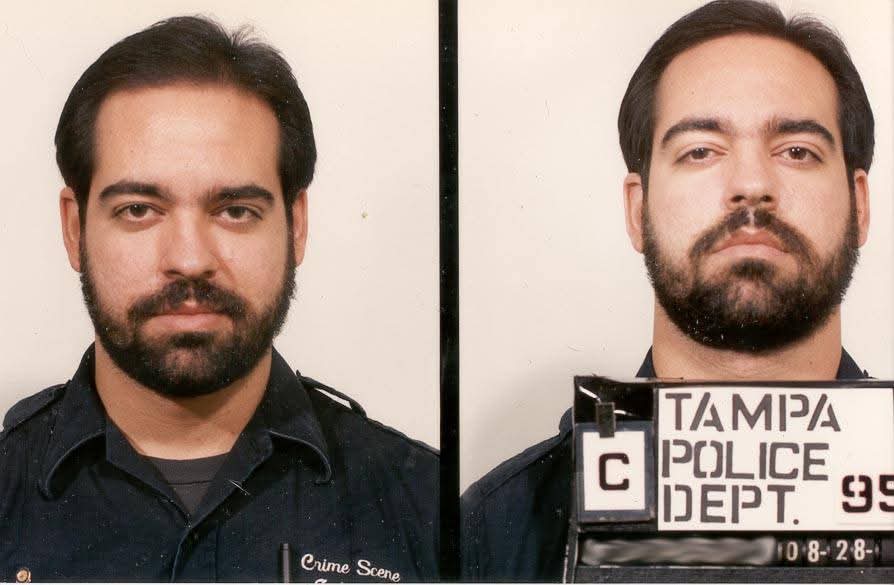
I remember taking this mugshot like it was yesterday. I needed to have my departmental photograph updated. I started with a smile, but then told myself I needed to look mean, because it's a mug shot, lol.