The wealth of those 51 billionaires are your denied claims, cut coverage, rationed medications and skipped doctors appointments.
Healthcare shouldn't be for-profit.
Demand Medicare for All.
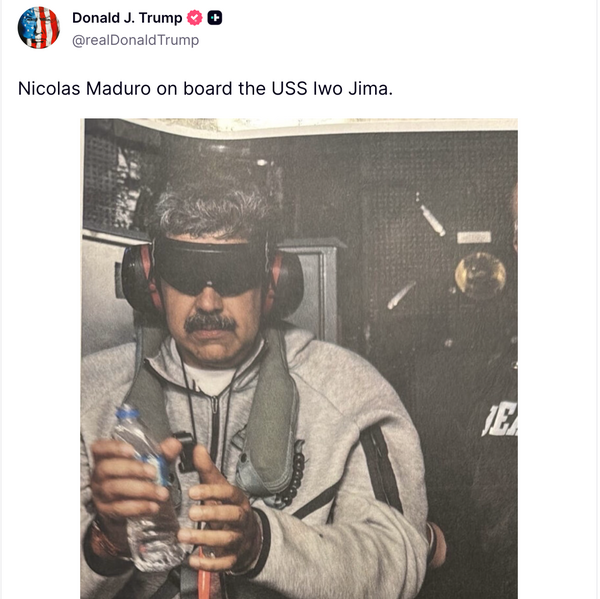
This video should unsettle anyone who takes the United States seriously as a nation.
Because it exposes something dangerous: the trivialization of the world's most consequential office. It shows how carelessly the power, credibility, and accumulated moral authority of a superpower can be squandered for a few seconds of viral attention.
In any other major democracy, this behavior from a head of state would trigger a constitutional crisis. Paris would burn. Berlin would convene emergency sessions. In the Nordic countries, resignation would follow within hours. Across functioning democracies, the public, institutions, and political class would recognize this for what it is: an assault on the dignity of the state itself. Leaders are not free to perform as entertainers without consequence. National honor is not personal property, it's held in trust.
But the United States is not just another country with a provocateur in charge. It is the linchpin of global order. It maintains formal alliances and security guarantees with forty to fifty nations. It underwrites the financial architecture, trade systems, and diplomatic frameworks that billions of people depend on daily. When the American president speaks—or posts—it doesn't land as satire, meme, or personal whim. It reads as a signal about what the country is becoming.
American power has never relied solely on carrier strike groups or economic output. It has rested on something more fragile and more valuable: trust. The belief that beneath domestic turbulence lies institutional seriousness, predictability, and a baseline commitment to dignity. That belief is now disintegrating in real time.
Millions of American companies operate globally. They negotiate multibillion-dollar contracts in environments where reputation is currency. Boardrooms in Frankfurt, Singapore, and Dubai aren't debating whether a post was clever—they're asking whether the United States remains a reliable partner. Whether agreements signed today will be honored tomorrow. Whether American leadership has devolved from institutional to purely theatrical.
Consider tourism, which sustains millions of American jobs—airlines, hotels, restaurants, museums, entire regional economies. Soft power isn't an abstraction. It materializes in flight bookings, conference locations, study-abroad programs, and decades of accumulated goodwill. A quiet, decentralized boycott doesn't require government action—only a collective sense that a nation no longer respects itself.
Now picture this image being studied by foreign ministers, central bank governors, defense strategists, and sovereign wealth fund managers. Picture them asking a coldly rational question: How do we write binding thirty-year agreements with a country whose public face will be this, relentlessly, for years to come? How do we plan for the long term when the tone is impulsive, mocking, and unbound by the gravity of office?
This is where the real calculus begins. Trillions in foreign capital depend on confidence that America is stable, credible, and rule-governed. That confidence is now being traded for what, exactly? Applause from an online mob? A dopamine rush from manufactured outrage? Content designed to dominate the news cycle rather than serve the national interest?
Every serious nation eventually confronts this choice: burn long-term credibility for short-term spectacle, or safeguard the reputation previous generations bled to build. The United States spent eighty years constructing an image of reliability, restraint, and leadership under pressure. That image wasn't born from perfection—it came from a visible commitment to standards that transcended impulse.
This isn't a partisan issue. Europeans who value democratic norms recognize something ominously familiar here. Americans—Democrat and Republican alike—who believe in responsibility and restraint should see it too. Power attracts scrutiny. Leadership demands discipline. A superpower cannot behave like a reality TV contestant without paying a price.
The presidency is not a personal broadcast channel. It's a symbol carried on behalf of 330 million people and countless international partners who never voted but whose lives are shaped by American decisions anyway. Every post either reinforces or erodes the idea that America can be counted on when it matters most.
So the question is no longer whether this is offensive. The question is whether this is who America chooses to be: a nation that trades a century of hard-won reputation for viral moments. A country that replaces statecraft with content creation. A republic governed like a season of reality television.
History offers a harsh lesson here. Great powers don't fall because enemies mock them. They collapse when they begin mocking themselves—publicly, proudly, and without grasping the cost until it's far too late.
Stay connected,
Follow Gandalv @Microinteracti1
@LorenDempster@GrainSurgeon here’s a hard truth. i looked for a protest locally so my voice could be heard. i’m 1000 miles from MN. we aren’t paid agitators. if people were paid, a media person would have joined the ranks and exposed it by now. you are the worst of humanity. nice bible quote in your profle
Maduro’s capture illustrates what I believe is one of the biggest problems in politics: people frequently treat principles as costumes—worn when convenient, discarded when costly.
Over nearly two decades working in and around politics, I’ve watched the same pattern play out again and again—and today’s events in Venezuela put it on display in neon. The US military carried out strikes in Caracas and captured Venezuelan President Nicolás Maduro and his wife, flying them to New York in what the administration is framing as a kind of “law enforcement” operation. 
Look, there are plenty of people who never even pretend to have a core set of principles they cling to. They’re utilitarians and technocrats—ruled by polling, vibes, ambition, and career incentives. Fine. At least they’re honest about being wind vanes.
But most people do claim to stand for a consistent set of ideas—constitutional restraint, limited government, “America First,” non-intervention, rule of law, due process, sovereignty, you name it.
The problem is that they’re often inconsistent, especially when the outcome is emotionally satisfying.
Today proved that again. People who claim to champion the Constitution suddenly ignore its restraints on executive power and, when pressed, point to court precedent, congressional statutes, and past presidential deviations as if those things are the Constitution.
“But… the Barbary pirates!”
“But George H.W. Bush removed Noriega in Panama!”
“But the courts said XYZ!”
“But Congress passed some statute in 199-whatever!”
So I’ve asked a simple question, repeatedly, across social media threads today: Where, exactly, is the constitutional provision authorizing the president to invade another country and depose its leader?
The replies come back empty, no constitutional provision cited. They can't, because it doesn't exist. The Constitution gives Congress the power to declare war. No "targeted strikes" or anything of the like are separately authorized for the president to execute at his whim.
That’s the whole point of written limits: the text is supposed to bind you. Instead, we get arguments that past presidents did it, and some lawyers said it was okay. This is tantamount to saying “Billy did it, so I thought it was okay for me to do it.” That’s playground logic, not constitutional rigor.
And that’s my point: there is no rigor. There’s only precedent—meaning, prior lawlessness used to justify the next round of lawlessness. The administration itself appears to be leaning on the idea that indictments and “national interests” somehow transform regime change into a lawful “arrest mission.”
Trump was elected in part because people were exhausted by foreign meddling. He was praised (by some of these same voices!) for resisting the interventionist itch. And now he’s kicking up dirt in Venezuela.
“But Venezuelans are happy!” the commenters have repeatedly said. “They’re in the streets celebrating!”
Yes. Sometimes they are. That’s not a serious argument. That’s the-ends-justify-the-means dressed up as compassion—again, playground-level reasoning.
Guess what: Iraqis filled the streets when Saddam was deposed. “Baghdad Celebrates Saddam’s Fall,” read a headline in Voice of America, for an article describing dancing and cheering as thousands poured into the streets. 
Then Iraq spiraled into insurgency, sectarian civil war, mass death, displacement, and the conditions that helped give rise to ISIS.
Libyans filled the streets when Gaddafi fell. So then we got an article titled “Libyans celebrate Gaddafi’s death” in Al Jazeera, describing jubilant crowds and the “end of tyranny.” 
Then Libya fractured into militias and rival governments, becoming a prolonged civil conflict and a humanitarian disaster.
I could go on. You get the pattern.
Here’s the deeper point that people keep refusing to learn: if your principles only apply when they’re easy, you don’t have principles… you have preferences. And preferences make terrible guardrails for state power.
Every time you cheer an exception, you’re not just celebrating a moment… you’re authoring a precedent. You're excusing the next guy, in any political party, and for any reason, to do it too.
If you’re applauding unilateral regime change today because the target is a villain, you’re also applauding unilateral regime change tomorrow when the target is someone you don’t want touched. Power doesn’t care about your intentions (or your preferences). It cares about the permission slip we seemingly always give it.
To be clear: Maduro is no hero. He’s a tyrant who has presided over ruin and repression. But the question isn’t whether Maduro is bad (he obviously is). The question is whether we are governed by law or by appetite.
Because “he’s bad” is not a constitutional argument, nor is "Venezuelans are happy and freer." It’s the (fake) argument every president uses when he wants to do something he has already decided to do.
And this is why presidents since Washington have gotten away with exceeding constitutional limits: because the public trains them to. They learn that violating restraints can spark national pride, satisfy a thirst for vengeance, and earn adoration from people who swear they oppose unchecked power—right up until it produces an outcome they like.
You want a country of laws? Then act like law matters when it’s inconvenient.
Stop treating the Constitution as a decoration.
Stop citing precedent as if it were permission.
Stop excusing today’s overreach because you hate today’s target.
Because the bill always comes due, and the payment is usually made by people who never voted for the war, never authorized the mission, and never wanted their country turned into the kind of thing it once claimed to oppose.
So yes, we can answer James Madison’s question: “Will it be sufficient… to trust to these parchment barriers (i.e., the Constitution) against the encroaching spirit of power?” Obviously not. Parchment only restrains power when the people treat it as a leash—not a suggestion. When half the country cheers the leash getting snapped because their guy did it to their enemy, the paper might as well not exist. And that's the cycle we've long been in.
Yes, Venezuela may be a little freer, for now. But listen to the triumphalism in Trump's announcement. In the same breath as announcing Maduro’s capture, he talked about sending in “our very large United States oil companies,” and about the U.S. “running” Venezuela's government “until such time as we can do a safe, proper, and judicious transition.”
This is the raw material of unintended consequences: blowback, corruption, and the kind of protracted entanglement that turns “just this once” into the next twenty years.
Count me out. I've seen this story before, and I don't like how it ends.
@clone832 i was commenting on your ‘fraction of a penny’ comment justifying the bailout when they knew they voted for more trade wars. so now deal with the consequences like the rest of us
@clone832 i hope you say the same for entitlement benefits; including SNAP, medicaid, CHIPS housing and social security. except this was preventable and inevitable. ‘trade wars are easy to win!’ a bailout for big ag. socialism that is so abhorrent and i bet not one refuses a check.
We went from “DEMOCRATS DID THIS WE ARE AT WAR TRANS IDEOLOGY DEATH TO DEMOCRATS” to “let us pray for the misunderstood white child who just didn’t know better” REALLY fucking fast, huh?
Really is a tough call.
On one hand - every Nobel prize winning economist is adamantly stating that Harris has a significantly better economic plan
But on the other hand - the dumbest people I’ve ever interacted with say Trump is a good businessman
Quite the dilemma
@sizov_andre for someone who does ‘research’ and ‘analysis’ on here, this is an incredibly poor take and shows a total lack of understanding and even a basic dive into what actually transpired.
@kannbwx in options someone bought 8,000 OCDQ 420p. those trade off CZ futures and expire in 28 days. CQ/OCDQ vol up 6% from fridays close. high prints for the year.
@unusual_whales what policy has congress enacted that she would have been privy to causing the epic rise in the stock? looks like it’s just a good buy to me.