L’IA est conçue pour réduire l’effort cognitif.
L’école, elle, organise cet effort pour qu’il devienne apprentissage.
Tout l’enjeu est là : former les élèves à utiliser l’IA sans lui déléguer ce qui fait apprendre. 🧠
🔗 https://t.co/Zy3q2fXzQb
#IA#Éducation#Apprentissage
La #pédagogie avec l’#IA ne se résume pas à autoriser ou interdire les outils. C’est une posture délibérée, où l’enseignant choisit comment intégrer l’IA en fonction de ce qu’il cherche à développer chez ses élèves.
@sydologie@sydopedago#eduX
https://t.co/92dct0FP24
ARTS & CIVILISATION
🇮🇪 "Les peintures murales en Irlande du Nord comme témoins des Troubles" (fiche)
➡️ https://t.co/YAryZLlM92
Comment les murals de Belfast & Derry témoignent-ils des Troubles? Comment préserver & protéger ce patrimoine urbain éphémère?
#IrlandeduNord#StreetArt
⭐️ Une table ronde #agrégation sur "Le Royaume-Uni et la construction européenne (1er janvier 1973-1er janvier 2021)" a été organisée lors du dernier congrès de la SAES. L'enregistrement est à retrouver sur la Clé des langues !
➡️ https://t.co/HF0cCjSwEj
#EnglishTeachers
Ce mécanisme rend la répétition espacée très concrète : l’élève comprend pourquoi certaines cartes reviennent souvent.
Lire l'article complet : CartesMémoire : Création de flashcards pensées pour la classe
▸ https://t.co/PKvZKFaC5B
#OpenSource
NEW! Retrieval practice consolidates knowledge. It can't construct it. This edition unpacks rehearsal… the stage that must come before retrieval practice… with a 6-step guide and free planning template.
This week's ⚗️DistillED: https://t.co/KnJWzldSbi
📥 Retrouvez les sujets des oraux de l'agrégation interne (session 2026) sur la Clé !
➡️ https://t.co/CKPbUDc87k
⭐️ sujets de l’épreuve orale EPC
⭐️ sélection de sujets de thème oral et de compréhension/restitution
#EnglishTeachers#agrégation
I really love the simple genius of this matrix from @mrbartonmaths.
In fact, @helenrey, @katie_a_baker, and I were just discussing this idea during our How Do We Learn? book study in relation to Rosenshine’s principles. In my experience presenting and sharing the principles with other teachers, there can be a default mindset of, “Oh, I already do that.”
What I like about this matrix is that it intentionally shifts the conversation from whether we do something to how well we do it. It invites a different line of thinking: “Yes, and can I do it better? Can I do it more?”
🌊 Et si une course au large devenait un formidable projet pédagogique ?
Avec La Course Bleue, vos élèves suivent un trimaran de la Route du Rhum en pleine traversée…
Un kit gratuit qui donne envie d’apprendre. ⛵📚
👉 https://t.co/5Uoeisjunf
#EDUcation#Professeurs
📩 Découvrez la sélection de ressources de la Clé anglaise pour le programme limitatif de la spé LLCER de terminale (2026-2027 et 2027-2028).
➡ https://t.co/q8taWTLqAl
#EnglishTeachers
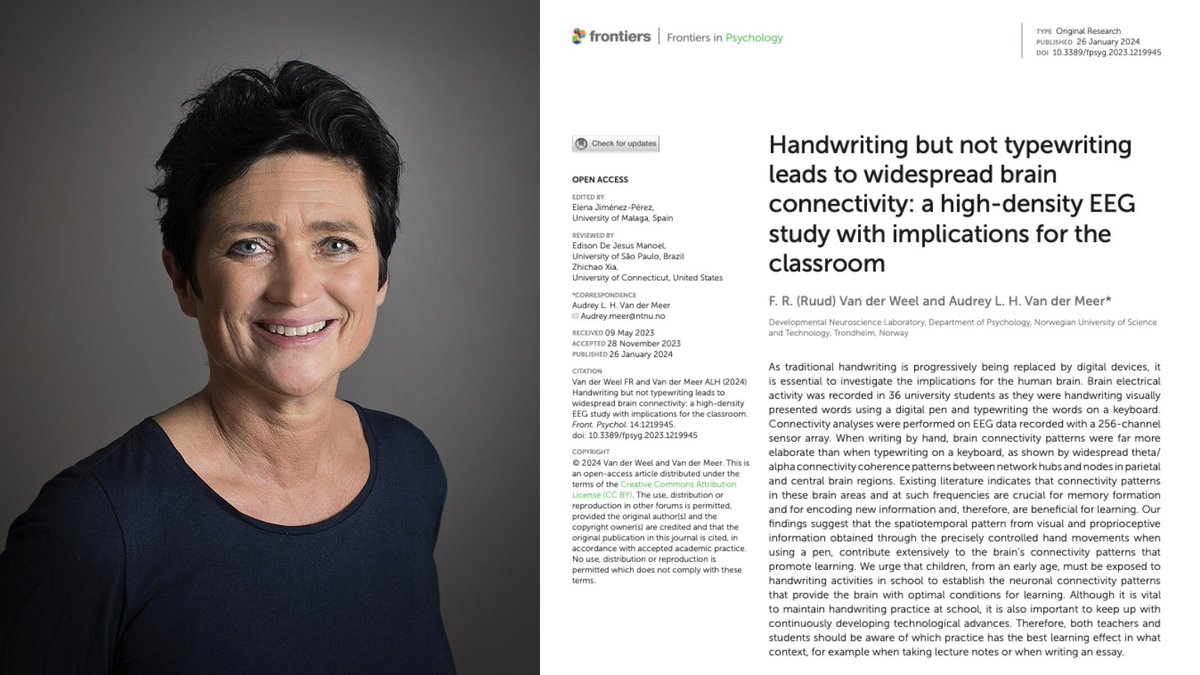
A Norwegian neuroscientist spent 20 years proving that the act of writing by hand changes the human brain in ways typing physically cannot, and almost nobody outside her field has read the paper.
Her name is Audrey van der Meer.
She runs a brain research lab in Trondheim, and the paper that closed the argument was published in 2024 in a journal called Frontiers in Psychology. The finding is brutal enough that it should have changed every classroom on Earth.
The experiment was simple. She recruited 36 university students and put each one in a cap with 256 sensors pressed against their scalp to record brain activity. Words flashed on a screen one at a time.
Sometimes the students wrote the word by hand on a touchscreen using a digital pen, and sometimes they typed the same word on a keyboard. Every neural response was recorded for the full five seconds the word stayed on screen.
Then her team looked at the part of the data most researchers had ignored for years, which is how different parts of the brain were communicating with each other during the task.
When the students wrote by hand, the brain lit up everywhere at once.
The regions responsible for memory, sensory integration, and the encoding of new information were all firing together in a coordinated pattern that spread across the entire cortex. The whole network was awake and connected.
When the same students typed the same word, that pattern collapsed almost completely.
Most of the brain went quiet, and the connections between regions that had been alive seconds earlier were nowhere to be found on the EEG.
Same word, same brain, same person, and two completely different neurological events.
The reason turned out to be something nobody had really paid attention to before her work. Writing by hand is not one motion but a sequence of thousands of tiny micro-movements coordinated with your eyes in real time, where each letter is a different shape that requires the brain to solve a slightly different spatial problem.
Your fingers, wrist, vision, and the parts of your brain that track position in space are all working together to produce one letter, then the next, then the next.
Typing throws all of that away. Every key on a keyboard requires the exact same finger motion regardless of which letter you are pressing, which means the brain has almost nothing to integrate and almost no problem to solve.
Van der Meer said it plainly in her interviews.
Pressing the same key with the same finger over and over does not stimulate the brain in any meaningful way, and she pointed out something that should scare every parent who handed their kid an iPad.
Children who learn to read and write on tablets often cannot tell letters like b and d apart, because they have never physically felt with their bodies what it takes to actually produce those letters on a page.
A decade before her, two researchers at Princeton ran the same fight using a completely different method and ended up at the same answer. Pam Mueller and Daniel Oppenheimer tested 327 students across three experiments, where half took notes on laptops with the internet disabled and half took notes by hand, before testing everyone on what they actually understood from the lectures they had watched.
The handwriting group won by a wide margin on every question that required real understanding rather than surface recall.
The reason was hiding in the transcripts of what the two groups had actually written down.
The laptop students typed almost word for word, capturing more total content but processing almost none of it as they went, while the handwriting students physically could not write fast enough to transcribe a lecture in real time, which forced them to listen carefully, decide what actually mattered, and put it in their own words on the page.
That single act of choosing what to keep was the learning itself, and the keyboard had quietly skipped the choosing and skipped the learning along with it.
Two studies. Two countries. Same answer.
Handwriting makes the brain work. Typing lets it coast.
Every note you have ever typed instead of written went into your brain through a thinner pipe. Every meeting, every book highlight, every idea you captured on your phone instead of on paper was processed at half depth.
You did not forget those things because your memory is bad. You forgot them because typing never woke the part of the brain that would have made them stick.
The fix is the thing your grandmother already knew.
Pick up a pen. Write the thing down. The slower road is the faster one.
📌 ANGLAIS - Nouveaux programmes - Classe de terminale (rentrée 2026)
➡️ https://t.co/1bAEuktBpM
Découvrez une sélection de ressources issues de La Clé anglaise pour accompagner le nouveau programme de terminale.
#SitesExperts#EnglishTeachers#nouveauxprogrammes
Pour dynamiser une séance d’histoire (ou d’EMC), rien de tel qu’un support qui donne envie d’explorer.
Globe of History propose une carte interactive 3D pour parcourir 6 000 ans d’histoire : pratique pour contextualiser, questionner, comparer. 🌍⏳
https://t.co/mMVMfdhty5
📌 Parution du Cahier #ÉduNum#SNT#NSI n°4 :
☑ Nouvelle épreuve pratique centrée sur les compétences de programmation, autonomie, compréhension et oral au baccalauréat NSI
☑ Expérimentation d’une option #IntelligenceArtificielle en classe de seconde
👉 https://t.co/KnyeIi5AuZ
Le programme de la session 2027 de l'#Agregation est disponible sur la Clé
➡️ https://t.co/HF0cCjSwEj
⭐️Shakespeare, Titus Andronicus
⭐️Carson McCullers, The Ballad of the Sad Café
⭐️Le Royaume-Uni & la construction européenne (1973-2021)
⭐️Option A - Douglas Stuart, Shuggie Bain
"The bog bodies in Seamus Heaney’s 'North' (1975)"
➡️ https://t.co/baSfnY9fw7
S. Heaney utilise les "bog bodies" pour interroger violence, mémoire & histoire en écho aux conflits nord-irlandais. Cette ressource présente le poète et propose une analyse du poème "Bog Queen".