What makes frontier models work as robot policies?
Embo-Harness distills a recipe: see wider, reason harder, and predict where to act—reaching 83.3% on RoboLab-120.
Watch the demo.
Project: https://t.co/mzCTww5crz
Paper: https://t.co/eo3Jtr2fGj
Code: https://t.co/DCjvFksBVg
Can we teach video diffusion models to reason and plan step by step, much like LLMs?
Introducing 🎬 ViDecide: a decision-centric framework for reliable visual reasoning and planning.
Key highlights:
- Causal generation with adaptive termination.
- Decision-centric diffusion training schedule.
- A new post-training approach, Corrective Fine-tuning (CFT), that outperforms GRPO, DiffusionNFT, and RFT.
Together, they boost the average success rate from 23.3% to 83.8% across logical reasoning and robot planning tasks!
Awesome work by Kaiwen @sze68zkw and the team!
🌐 Project: https://t.co/sRvaTlR7OR
📄 Paper: https://t.co/co6gwUbVwe
💻 Code: https://t.co/vkcp4MhgtP
3. Do they help VLA policies?
Yes. Using Native LAM to pretrain a VLA improves performance on RoboTwin 2.0, RoboDojo, and real-robot tasks - without generating video at inference.
Read the paper here https://t.co/dZSRiuEb3U
Native LAM turns a video world model into a latent action model: it extracts compact latent actions and replays them across scenes and embodiments - even from humans to robots.
Paper: https://t.co/ZTuYjCy6Mb
Project: https://t.co/QVR6JGH7EG
Code coming soon!
2. Do these dynamics transfer?
Yes. The same motion can be replayed in a new scene or with a different embodiment - for example, transferred from a robot arm to a human hand.
Frontier models seem better at deciding where a robot should act than at generating every low-level motion.
Forcing joint- or trajectory-level actions hurts performance; directly predicting the end-effector destination works better.
Spatial perception may be the real driver.
What makes frontier models work as robot policies?
Embo-Harness distills a recipe: see wider, reason harder, and predict where to act—reaching 83.3% on RoboLab-120.
Watch the demo.
Project: https://t.co/mzCTww5crz
Paper: https://t.co/eo3Jtr2fGj
Code: https://t.co/DCjvFksBVg
Introducing Xperience 2, the next generation of physical AI data foundation.
We paired 4,230 first-person demos with 3D scene scans in unprecedented quality. Long after we leave a site, we can put a robot in a simulation of that same space and try tasks we never recorded before!
https://t.co/nrfeKORz2b
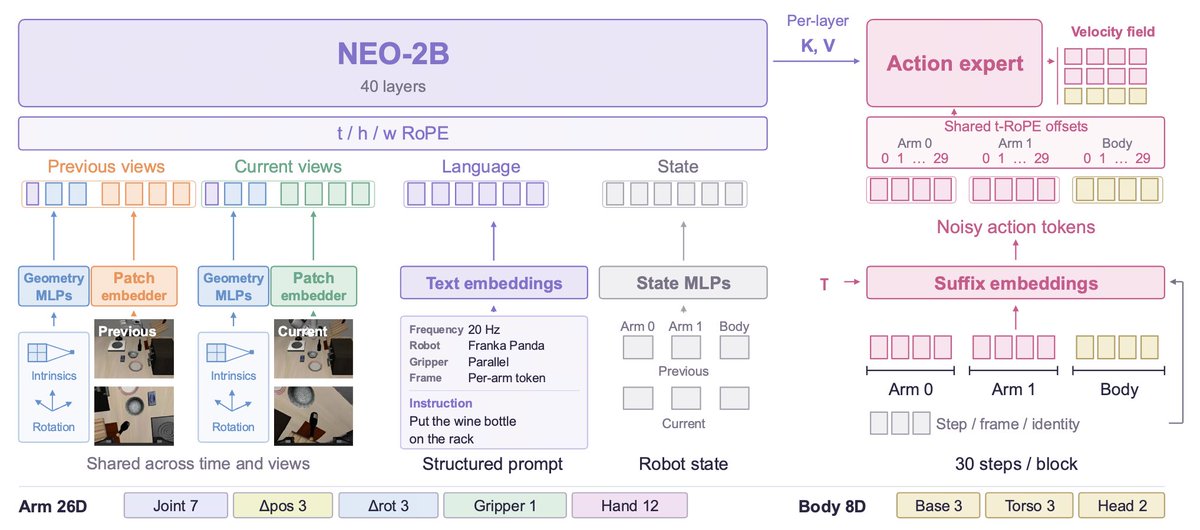
Sharing the 4th NEO-series work: NEO-VLA ✨
🔥 From Pixels to Actions for System-1.
📚 TL;DR
(1) Encoder-free Vision–Language–Action.
(2) Early visual features matter most for action.
(3) Native VLA outperforms encoder-based counterparts in robustness.
Wish you could change focus after taking a photo? 📸
AnyBokeh lets you refocus and adjust background blur from a single image, even when it’s already partly out of focus. Led by my student @itsmag11
Project: https://t.co/QuAO19wQvI
Paper: https://t.co/QBpmBDPZR9
Code: https://t.co/Zv84fabd1K
Wish you could change focus after taking a photo? 📸
AnyBokeh lets you refocus and adjust background blur from a single image, even when it’s already partly out of focus. Led by my student @itsmag11
Project: https://t.co/QuAO19wQvI
Paper: https://t.co/QBpmBDPZR9
Code: https://t.co/Zv84fabd1K
How does MatAnyone-E save GPU memory? By being selective about where to look—and what to look up. 🧠
Dense matching compares every current-frame feature with features stored from past frames. At 4K, those comparisons become expensive.
MatAnyone-E first takes a low-resolution look, then:
• Refines only uncertain regions.
• Searches only the most relevant memory locations.
• Reuses the coarse results elsewhere.
In this demo, just 5.9% of query locations need refinement, using 15% of memory candidates—skipping 99.1% of high-resolution matching pairs.
Meet MatAnyone-E: high-quality video matting, much faster. ✂️
Compared with MatAnyone 2 at 4K:
⚡ ~7.4× faster inference
💾 Just 7.6% of the peak GPU memory
✨ Comparable matting quality
Runs at 73 FPS at 1080p and 29 FPS at 4K on a single NVIDIA H200.
Project: https://t.co/RPqKx7nI2K
Paper: https://t.co/nkqWXVZgkf
Code (coming soon): https://t.co/6IbB89WcsB
@flowersengg The main culprit was dense matching between current-frame features and the past-frame memory bank: the matching tensors grow with current-frame locations × stored memory locations.
Thanks! We already include a 4K RTX 3090 test in Table 9 of our paper: 5.69 FPS at 6.09 GB peak memory, or 9.0 FPS at 3.16 GB with compilation.
Memory savings don’t translate proportionally into speed gains. Sparse matching reduces both computation and memory use, but decoding also matters: our profiling shows the final high-resolution decoder stages are memory-bandwidth-bound, which motivated the lightweight decoder.
@zunnanxu@onelineluo HiP3R works at two levels: first aligning the video chunks into a consistent layout and scale, then refining individual camera poses.
It works with both chunk-based and streaming reconstruction methods, without additional training or fine-tuning.
🎥 A long video. One coherent 3D scene.
Meet HiP3R: piecing together local 3D reconstructions to keep the scene consistent across thousands of frames. Watch the demo and explore the details 👇
Project: https://t.co/BzGoFauLfq
Paper: https://t.co/ttWFBtkbCc
Code: https://t.co/33tRzAGuTp
@zunnanxu@onelineluo Why is reconstructing a long video difficult?
Short sections can look good on their own, yet drift apart when stitched together. Revisiting the same place may produce misaligned geometry.
The challenge is making all these local reconstructions agree.
Has GPT-6-Astra Achieved Embodied Intelligence?
Across 12 benchmarks, access to training demonstrations and up to 10× the execution budget push several tasks close to 100% success.
How does this translate to real robots? Watch our demos across 8 robot configurations to see its capabilities and remaining challenges.
Paper: https://t.co/4HftJmsvHD
Project & demos: https://t.co/2FeddlLygO
GitHub: https://t.co/2SzjThEjJG