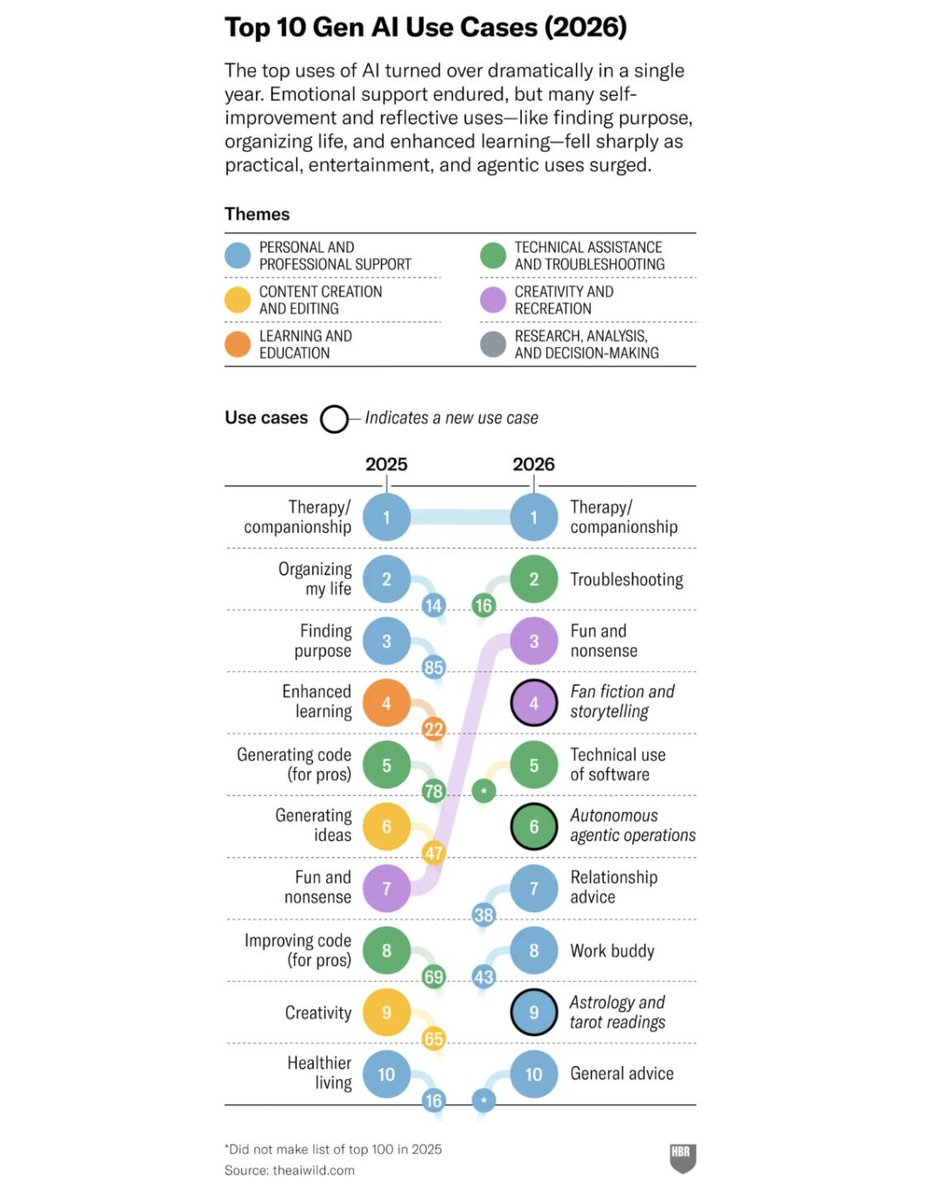
According to the Harvard Business Review, these are the top 10 generative AI use cases in 2026.
And yes, therapy/companionship is the top use case again, regardless of what AI companies say:
Arrivederci Carlo Petrini (1949-2026), fundador de @SlowFoodItaly, Durante varios años enseñé semiótica de la gastronomia en la Università di Scienze Gastronomiche (Pollenzo, 🇮🇹) y conocí de cerca el proyecto y la visión de CP. Nos sirvió de inspiración para el Máster de Comunicación Gastronómica que desarrollamos en la @uvic_ucc hace 20 años. Su lema: "Sembrar utopías para recoger realidad" 💪🥂
https://t.co/IJRSfFwPWg
AI use is already stifling creativity in ways people have not realized yet, and that must change.
Take a look at these studies on college essays published by the New York Times:
"In one study, he and his team examined personal statements from more than 370,000 students, and found that after ChatGPT became available, their essays suddenly used diverse and colorful language, but lacked truly creative ideas. "
-
"In a separate study, the team found that human-written essays offered up to eight times more new ideas than those produced by AI."
-
"Another experiment run by a different research team compared short stories written by humans to those written with AI assistance. (...) AI-assisted works had more interesting vocabulary and were rated more enjoyable to read, but the underlying story lines were more homogeneous. Distinctive and offbeat ideas — with surprising characters or unusual settings — are often shunted to the side when AI is involved."
-
I often hear people saying that they use AI "just to brainstorm" or "just to prepare a first draft."
That "initial suggestion" from the AI system will have a disproportionate influence on the ideas and thought paths that will shape the writing process and the final outcome.
AI-generated ideas do not emerge from the person's lived experience, a feeling, a memory, a recollection, or any specific brain impulse.
As such, they do not have human grounding (or even biological grounding).
Before, many people used a search engine to look for sources and "brainstorm."
Now, search and IA have effectively merged, and the ten blue links have become a fully structured suggestion written in human language.
With a few additional prompts, that suggestion could become a first draft or a final piece.
This change in the digital architecture directly affects how we search and access information online and the product of our creativity, especially if we don't filter it out or make efforts to add friction or to protect our own human insights.
There are also cognitive biases (such as automation bias) that lead people to accept and agree with automated outputs and see them as more accurate or superior to human outputs, which will make people disproportionately embrace AI outputs.
People are absolutely not to blame: everyone is doing their best to survive in the "age of AI,' which is also the age of mass automation, machine idealization, enshittification, the fall of truth and trust, and where fostering ideas of human obsolescence seems to be trending.
Luckily, data is starting to show that embracing our own uniqueness and creative weirdness is a better choice for oneself, society, and the future of creativity.
Cada vez que la IA inventa una cita bibliográfica, la ANECA y otras agencias de evaluación deberían darle puntos a su (no) autor. Eso significa que la persona ha publicado mucho y la IA lo ha tenido en cuenta a la hora de alucinar la referencia 😎💪⚡
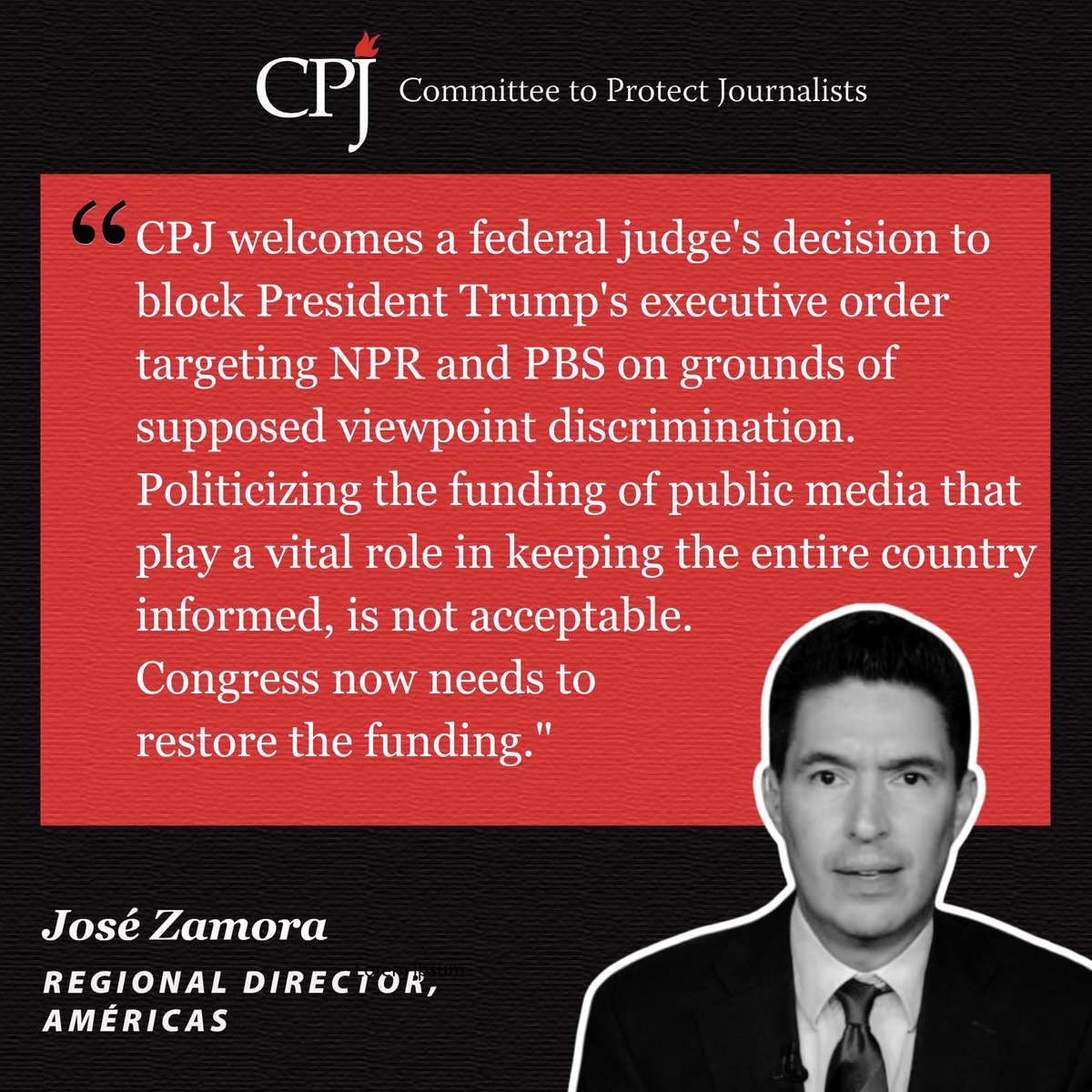
#USA: “CPJ welcomes a federal judge's decision to block President Trump's executive order targeting @NPR and @PBS on grounds of supposed viewpoint discrimination. Politicizing the funding of public media that play a vital role in keeping the entire country informed, is not acceptable. Congress now needs to restore the funding” — @CPJAmericas@pressfreedom | RE: https://t.co/hJCTYbY8ef (via @AP)
La soberanía resucita en los entornos digitales. Contra el credo difundido de que la revolución informacional había sepultado toda la pulsión soberana de las sociedades modernas, la historia se rebela, terca. Escribí para @linterna@lasillavacia ✍️
https://t.co/uDxLF1vX0b
La captura de los medios por las big tech es el tema de este informe de @mediajustice. Recomiendo su lectura no sólo a gente de comunicación y periodismo, también a quienes les interesa el espacio público de información y discusión social y política:
https://t.co/PDIuITF5Fr
🚨 BREAKING: After being designated a "supply chain risk to national security," Anthropic SUES the Trump Administration. Quotes:
"On February 27, 2026, President Trump posted a statement on social media (the Presidential Directive), 'directing EVERY Federal Agency in the United States Government to IMMEDIATELY CEASE all use of Anthropic’s technology.' He derided Anthropic as out-of-control' and a 'RADICAL LEFT, WOKE COMPANY' of 'Leftwing nut jobs.' He also accused Anthropic of 'selfishness' and of making a 'DISASTROUS MISTAKE.' 'Anthropic better get their act together,' the President threatened, or he would 'use the Full Power of the Presidency to make them comply, with major civil and criminal consequences to follow.'"
-
"All of these unprecedented actions—the Presidential Directive, the Secretarial Order and the Secretarial Letter that followed it, and other agency actions taken in response to the Presidential Directive (collectively, the Challenged Actions)—are harming Anthropic irreparably. In Secretary Hegseth’s own words, Anthropic’s status in the eyes of the federal government has been 'permanently altered.' Official designation as a 'Supply-Chain Risk to National Security' carries profound weight, particularly under a President who has threatened both 'criminal consequences' and 'the Full Power of the Presidency' to enforce compliance. Anthropic’s contracts with the federal government are already being canceled. Current and future contracts with private parties are also in doubt, jeopardizing hundreds of millions of dollars in the near-term. On top of those immediate economic harms, Anthropic’s reputation and core First Amendment freedoms are under attack. Absent judicial relief, those harms will only compound in the weeks and months ahead."
-
"The consequences of this case are enormous. The federal government retaliated against a leading frontier AI developer for adhering to its protected viewpoint on a subject of great public significance—AI safety and the limitations of its own AI models—in violation of the Constitution and laws of the United States. Defendants are seeking to destroy the economic value created by one of the world’s fastest-growing private companies, which is a leader in responsibly developing an emergent technology of vital significance to our Nation. The Challenged Actions inflict immediate and irreparable harm on Anthropic; on others whose speech will be chilled; on those benefiting from the economic value the company can continue to create; and on a global public that deserves robust dialogue and debate on what AI means for warfare and surveillance. There is no valid justification for the Challenged Actions. The Court should declare them unlawful and enjoin Defendants from taking any steps to implement them."
-
👉 I'll write more about it in my newsletter. Join 91,700+ subscribers below.
Most people don't know it, but AI systems developed exclusively for military purposes are NOT covered by the EU AI Act.
Countries often avoid public scrutiny of their military use of AI, and the field is mostly unregulated.
The public is demanding transparency and regulation.
#RedDeExpertos
En algunos casos, las plataformas de redes sociales operan editorialmente en la misma dirección que los gobiernos más autoritarios.
✍️Escribe @aracalacana
Lea la columna completa 👇
https://t.co/yPtKlKfaiw
Is your content "SVS-Ready"?. #SVS#DigitalEthics#FactsMatter Check out my latest article: Guía general de EVS: Estrategia de Visibilidad Sintética. Sección 3: Buenas prácticas para la verificación factual (Fact-checking preventivo). LinkedIn. https://t.co/GH7ftFk122
🚨 BREAKING: Sam Altman justifies AI's energy efficiency by comparing it to the FOOD humans need to eat in 20 years of life, plus all our evolutionary history.
That's a strange way to escape from environmental scrutiny.
#𝗭𝗮𝗺𝗼𝗿𝗮𝗟𝗶𝗯𝗿𝗲
Hoy, tras más de 1,295 días de detención arbitraria, mi papá, el periodista #JoseRubénZamora, recupera su libertad. ¡Defensa en libertad!
Gracias a todas y todos por acompañarnos. Su apoyo y solidaridad han sido fundamentales. Gratitud total.
The new humanism is NOT anti-AI.
It just recognizes that AI should not be a goal or a priority.
The focus should always be on the humans behind the work and how they can grow, develop, learn, and thrive, regardless of the tools used.
Full article below.
This passage is from Peter Drucker’s essay in the Atlantic about the crossroads that science stood at during Nazism. Science doesn’t just need funding — it needs the fundamental freedoms that come with democracy.