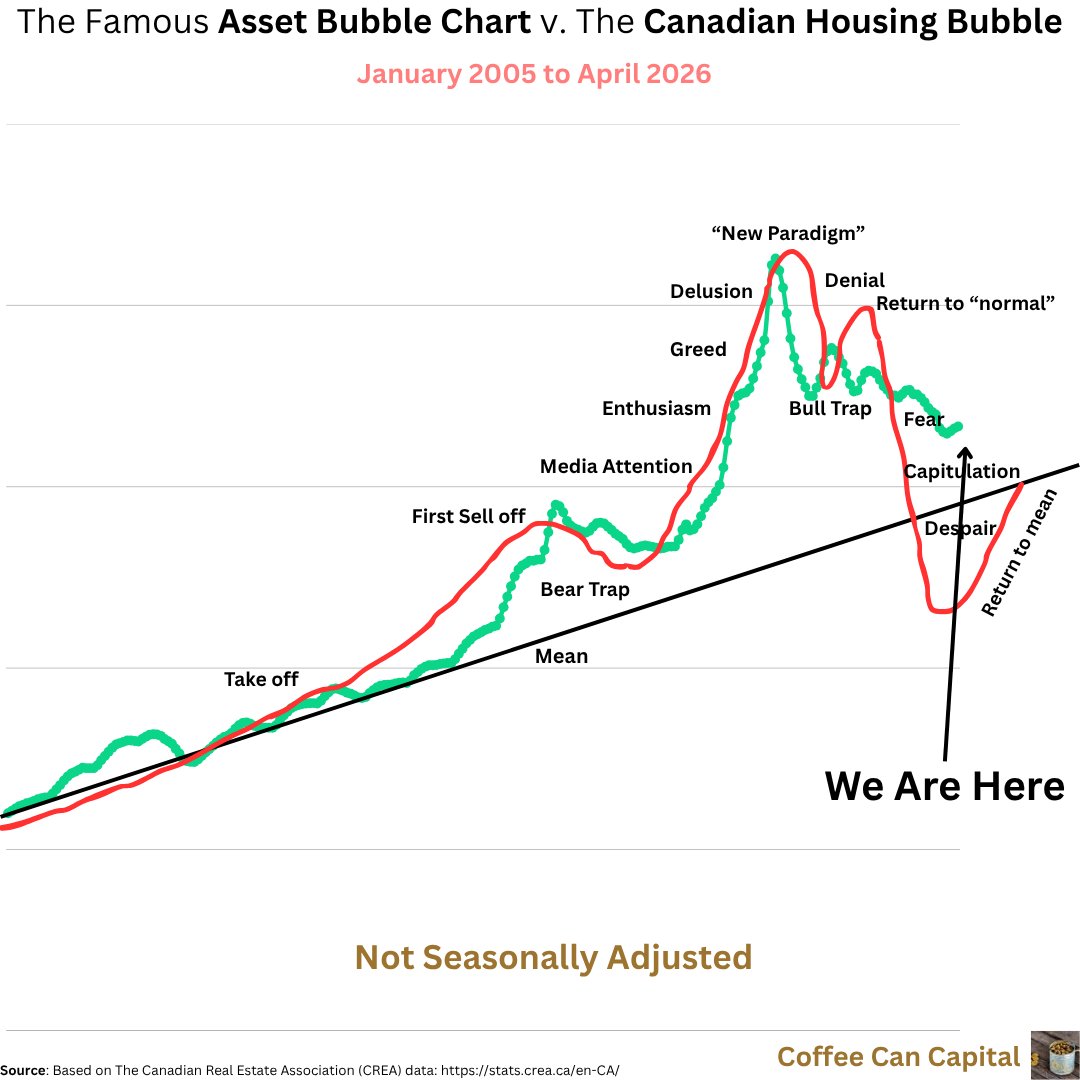
Have you heard of the "Coffee Can" portfolio?
In 1984, Robert Kirby wrote an article stating "You can make more money being passively active than actively passive".
While more people are investing in indexes like the S&P 500, Kirby argued that you can create a superior index.
Canada sits at roughly 12x median income at peak.
The historical mean is 2-4x.
That's not a 20% correction.
That's a 60-70% real-terms reversion.
Housing is ~$7 trillion in Canadian residential real estate.
A 60% decline wipes out ~$4 trillion in collateral.
If you don't believe that will happen, you have not studied history.
If you find value in posts like this, please:
1. Like, subscribe, and repost.
2. Follow "Coffee Can Capital" here and on Facebook & Instagram.
3. Join my substack (https://t.co/GGtqjsrFh3), where I post free content on investment philosophy and business analyses.
If you find value in posts like this, please:
1. Like, subscribe, and repost.
2. Follow "Coffee Can Capital" here and on Facebook & Instagram.
3. Join my substack (https://t.co/GGtqjsrFh3), where I post free content on investment philosophy and business analyses.
For years, the Canadian Real Estate Association, the big six banks, and every other real estate association said that Canadian housing wasn't in a bubble. Yeah...sure 🤣.
@BenRabidoux Well, it's still building. You just stated there were +897 completions. Also, active resale listings and months of supply have been increasing since 2022 (especially in Ontario). Are you presupposing that supply will not build from here? Is there evidence for this?
@BenRabidoux What's more, what is being built in 2026 is irrelevant in the short term, since active listings are at multi decade highs and there is very little buying. This inventory needs to be absorbed before we need to worry about a shortage.
@BenRabidoux Why? Many builders adjusted almost immediately, delaying projects as prices fell and inventory started to build. I know builders in London, ON, who stopped building single family houses 3 years ago because it was not economically viable at 2023 prices.
@BenRabidoux You may be correct in the long term -- however, in a typical housing cycle, housing starts and completions bottom PRIOR to house prices. For instance, during the Great Financial Crisis, single family starts bottomed in Q1 2009, completions in Q1 2011, and house prices in Q1 2012.
@danielfoch Thanks for the video! Obviously, this is highly sensitive to the inputs. In Canada, for instance, there is simply NOWHERE I know of where you can purchase a property for $333,334 while the equivalent rent is $2,500/month. Here is the reality in Canada:
@Camp4 Thanks for the calculator! Obviously, this is highly sensitive to the inputs. In Canada, for instance, there is simply NOWHERE you can purchase a property for $333,334 while the equivalent rent is $2,500/month. Here is the reality in Canada:
If you find value in posts like this, please:
1. Like, subscribe, and repost.
2. Follow "Coffee Can Capital" here and on Facebook & Instagram.
3. Join my substack (https://t.co/GGtqjsrFh3), where I post free content on investment philosophy and business analyses.
In 2020, Deutsche Bank did a study of the best performing assets historically. From 1900-2020, real estate (house prices) went up on average 3.53% per year. This implies that the average house price in Ontario should be ~$536,000 (v. $795,300 today and $1.05 million at the peak).