ChatGPT + Laptop + Internet + 1 Hour a Day = $250 Daily
Normally, I charge $157 for this guide.
𝐖𝐨𝐫𝐭𝐡 $157, 𝐛𝐮𝐭 𝐟𝐫𝐞𝐞 𝐭𝐨𝐝𝐚𝐲!
To get it:
1. Follow me (So I can DM you )
2. Retweet
3. Reply " Need"
Must follow me to get DM. Free for 48 hours only.
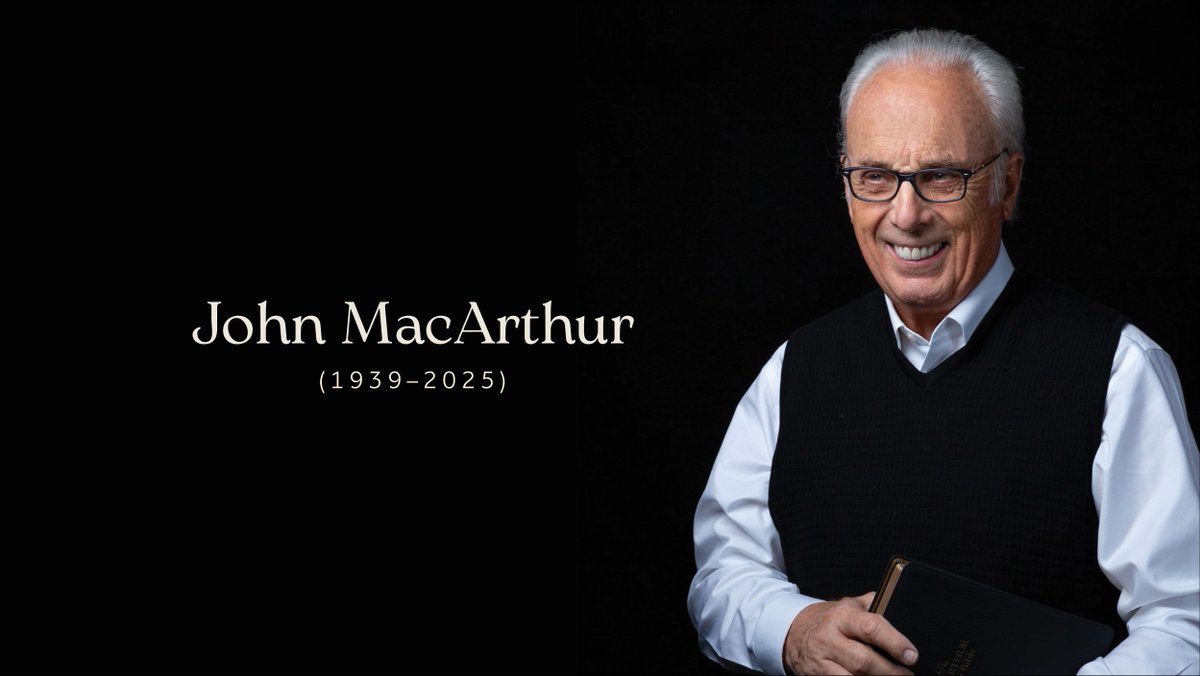
Today, John MacArthur entered into the presence of the Lord, whom he faithfully served for over half a century.
There aren’t enough words to describe the impact he’s had on my life—his unwavering commitment to the truth, bold expository preaching, and love for the church shaped not only my theology but my very walk with Christ. Through his sermons, books, and steadfast shepherding, he taught us to treasure the Word of God and stand firm in grace.
Please pray for his dear wife Patricia and the entire MacArthur family, for Grace Community Church, and for all of us mourning such a profound loss.
Though our hearts ache, we do not grieve as those without hope (1 Thess. 4:13). Pastor John is now beholding the glory of Christ, the One he preached with such conviction and joy.
“Well done, good and faithful servant… Enter into the joy of your master” (Matthew 25:21).
Thank you, John. Soli Deo Gloria.
The discussion of this issue requires some humility. IMHO, the main issues are: the citizenship question - and the rights thereof - for Kinyarwanda-speaking Congolese, territorial integrity of the DRC, security guarantee for Rwanda, governance of minerals exploitation, and the limitation of international community to resolve conflict and keep peace. At the end of it all, the tragedy is the suffering of innocent civilians.
There are three types of Kinyarwanda-speaking people in DRC: the nationals, who were already in the current DRC territory when it was demarcated as Congo in 19th century; migrants, who, either voluntarily or through compulsion, crossed the border during colonial time; and refugees, who moved during post-independence era. Vis-à-vis Rwanda, the nationals and migrants became simply a cultural diapora and refugees formed a political diaspora, each with attendant initiatives.
It is now settled, as elucidated eloquently by Mwalimu Nyerere, that at least the nationals are Congolese whose civic rights can’t be tentative or uncertain. These rights, and the space for their pursuit, reside in the political domain within the Congolese polity. There’s also a case to be made for migrants, especially labourers who were transplanted into the DRC through cynical Belgian machinations (e.g manufactured famine as push factor to achieve labourers requirements).
In 1960, just before independence, the Belgians organised a roundtable in Brussels which was attended by Congolese political leaders. (I love the beautiful tune about the roundtable, “Table Ronde”, by Grand Kalle who performed at the roundtable where the young Dr. Nico’s genius at the solo guitar shone).
Two things about the roundtable are important as we try to make sense of what’s currently going on: first, the Kinyarwanda-speakers were present at the roundtable as Congolese. Secondly, the issue of citizenship was tabled but not resolved. Therefore, Congo received independence without resolution of this critical matter.
Since then, there has been several attempts to resolve it - with varying motivations, outcomes and implications.
In the end, the question remains: what does belonging to a polity, and securing protections through it, means - and how far are people willing to go to achieve that. And what does civic participation - through civic, not ethnic, citizenship - means.
Also, in the end, it’s all about sovereignty and territorial integrity, which must partly include state capacity to govern and administer it - and manage the resources therein for peoples’ benefit.
It’s about African solidarity when we encounter threats to peace and security within our countries.
It’s about holding each other to account - impartiality and impactfully - when we violate peace.
It’s about the effectiveness of our mechanisms for conflict resolution and peace-building - and the political will to make peace.
The joint EAC-SADC Summit is a great opportunity. H.E @SuluhuSamia consistently insists on getting to the “root cause”. There’s hope that the Summit will not just bandage the boil. The Congolese civilians have suffered for far too long.
Scanning past negotiations/agreements, the contours of the permanent solution exist:-
1. Durable ceasefire with muscular enforcement and verification capabilities to protect civilian lives and livelihoods.
2. Complete, permanent and verifiable disarmament and demobilisation of ALL armed groups.
3. Sorting out the citizenship question and the civic rights of Kinyarwanda-speaking Congolese.
4. A regionally-guaranteed and enforced compact on non-violability of sovereignty and territorial integrity - and security guarantees - for both Rwanda and DRC.
5. A globally-enforced, Kimberly Process-type agreement on governing the ethical sourcing, processing and sale of minerals from DRC.
6. Deepened regional integration, with focus on joint regional economic initiatives, where the political and economic cost of conflict is severe.