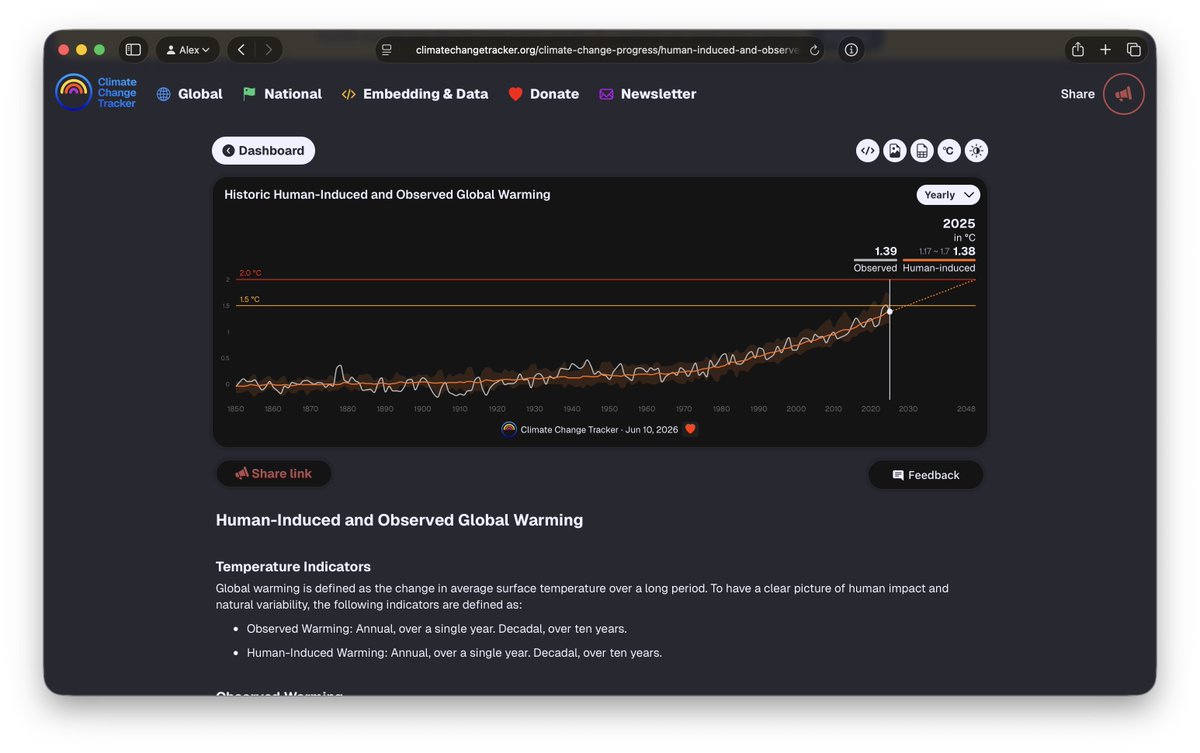
The carbon budget for holding 1.5 °C is almost gone, yet the path is known: emissions must fall to net zero by 2032 to limit warming to 1.5 °C, or by 2050 to limit it to 1.7 °C. The hard part is whether a species clever enough to measure the danger is wise enough to answer it.
The carbon budget for holding 1.5 °C is almost gone, yet the path is known: emissions must fall to net zero by 2032 to limit warming to 1.5 °C, or by 2050 to limit it to 1.7 °C. The hard part is whether a species clever enough to measure the danger is wise enough to answer it.
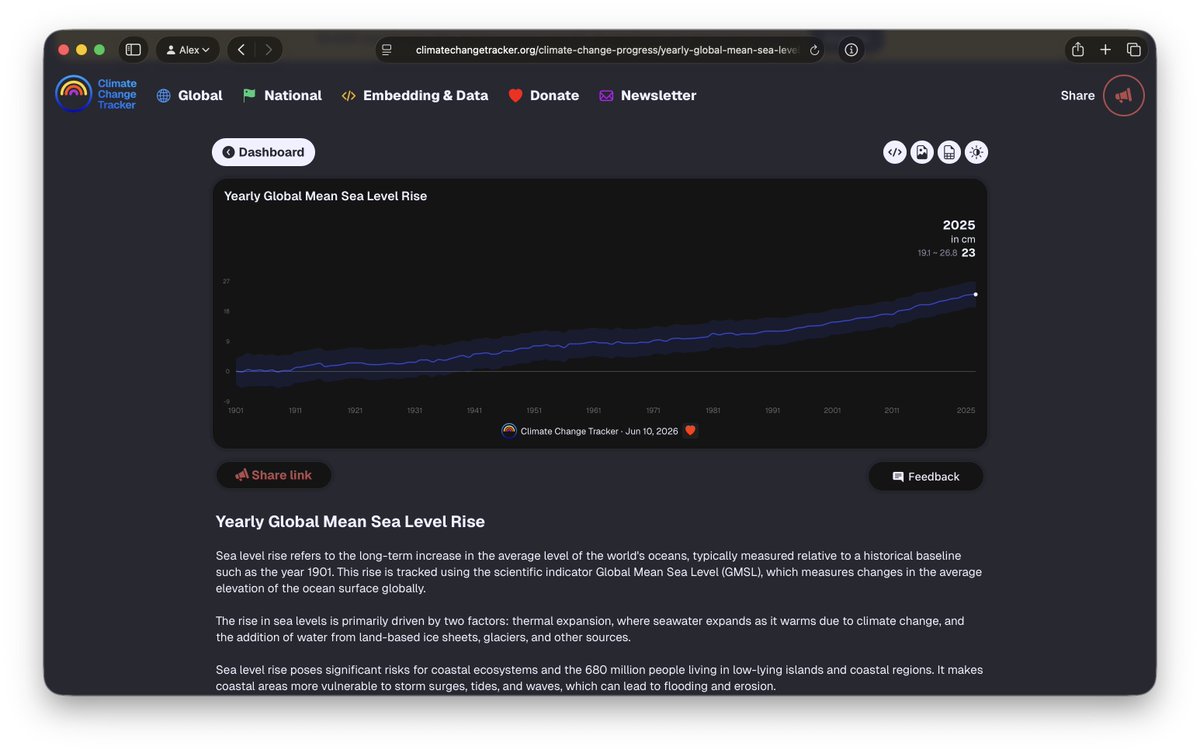
The whole picture in one place: human-caused and observed warming, the gases driving it, the carbon budget still left, and the seas already rising. Measured against the Paris Agreement, consistent with IPCC AR6, updated each year.
https://t.co/FgO7gV1ITS
The carbon budget for holding 1.5 °C is almost gone, yet the path is known: emissions must fall to net zero by 2032 to limit warming to 1.5 °C, or by 2050 to limit it to 1.7 °C. The hard part is whether a species clever enough to measure the danger is wise enough to answer it.
You can download data on Climate Change Tracker as CSV or PNG files:
+ free
+ up-to-date
+ simple
+ Creative Commons
🤫Climate Change Tracker provides over 1,200 downloadable or embeddable, global and national climate indicators.
https://t.co/9xhXqWdgAa
🌏Human-Induced CO₂ Emissions and Atmospheric Levels: Human-induced CO2 (Carbon Dioxide) emissions are the primary driver of rising atmospheric CO2 levels, leading to climate change, with CO2 remaining in the atmosphere for an average of over 400 years.
https://t.co/sRXMAmWp0y
Track the progress of human-induced and observed global warming, greenhouse gas emissions, the remaining carbon budget, sea levels, radiative forcing, emissions of nations.
Up-to-date:
✓ 5 critical dashboards
✓ 40 critical indicators
✓ 190 national dashboards, 1140 insights
🌍 Progress of Global Climate Change: Progress of human-induced and observed global warming, greenhouse gas emissions, sea levels, and the remaining carbon budget. Relevant to the Paris Agreement, IPCC AR6 consistent.
https://t.co/FgO7gV1ITS
🇺🇳National Greenhouse Gas Emissions: Crucial indicators of 190 nations. Progress, recent and recent impact, per capita emissions, contribution to global warming, and sources of human-induced CO2, CH4, and N2O emissions.
https://t.co/CtLgyFT1v9
🌏Human-Induced CO₂ Emissions and Atmospheric Levels: Human-induced CO2 (Carbon Dioxide) emissions are the primary driver of rising atmospheric CO2 levels, leading to climate change, with CO2 remaining in the atmosphere for an average of over 400 years.
https://t.co/sRXMAmWp0y
🌎 Observed Global Warming: Latest progress of observed warming, average temperature anomaly, rate of change, average temperature, geographical breakdowns, energy imbalance, radiative forcing.
https://t.co/CuruDLXWB9
🌍 Progress of Global Climate Change: Progress of human-induced and observed global warming, greenhouse gas emissions, sea levels, and the remaining carbon budget. Relevant to the Paris Agreement, IPCC AR6 consistent.
https://t.co/FgO7gV1ITS
Small data card showing earth's energy imbalance over the last 4 years - made with data from https://t.co/WEH6iMZhu3
You can download all data from @cct_earth and make your own charts.
Track the progress of human-induced and observed global warming, greenhouse gas emissions, the remaining carbon budget, sea levels, radiative forcing, emissions of nations.
Up-to-date:
✓ 5 critical dashboards
✓ 40 critical indicators
✓ 190 national dashboards, 1140 insights
Monday’s #WorldStatisticsDay highlights the crucial role reliable data plays in driving global progress.
Statistics are not only central to the UN’s work but also essential for addressing the world’s most pressing challenges.
Learn more: https://t.co/roNqsa8hFe
Climate change is accelerating, scientists find in ‘grim’ report. They warn that humanity is just three years from overshooting the Paris Agreement’s 1.5°C target, with seas rising faster than ever. by Dana Nuccitelli @CC_Yale
https://t.co/bW7FmkwwIM