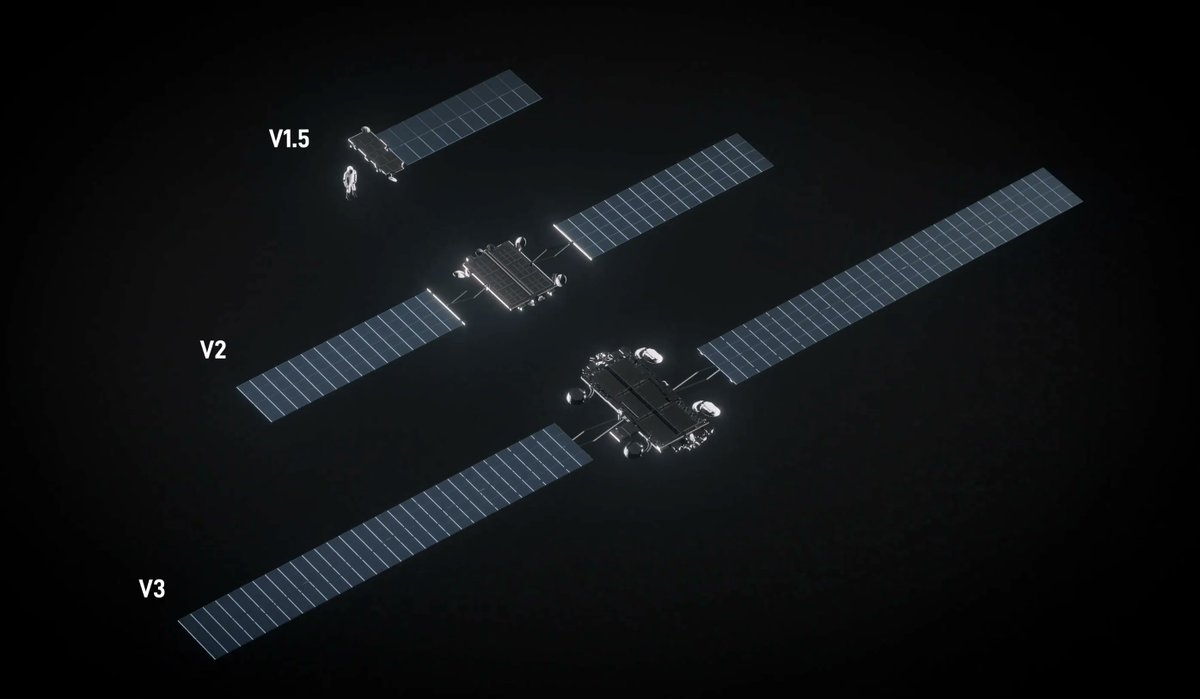
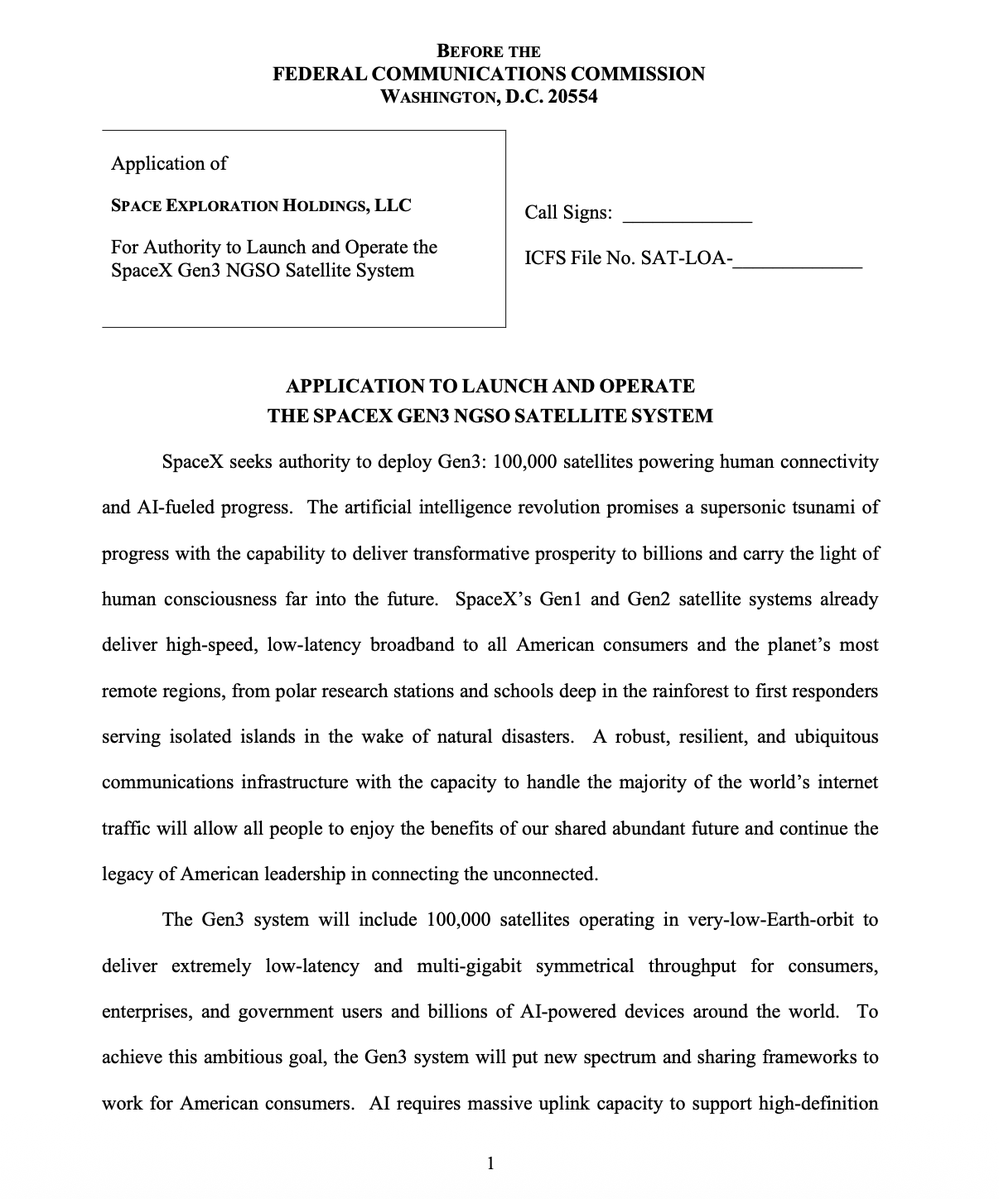
SpaceX has officially requested FCC approval to launch and operate a third-generation satellite constellation of 100,000 satellites, designed to power human connectivity and AI-fueled progress.
"The artificial intelligence revolution promises a supersonic tsunami of progress with the capability to deliver transformative prosperity to billions and carry the light of human consciousness far into the future. The Gen3 system will include 100,000 satellites operating in very-low-Earth-orbit to deliver extremely low-latency and multi-gigabit symmetrical throughput for consumers, enterprises, and government users and billions of Al-powered devices around the world. To achieve this ambitious goal, the Gen3 system will put new spectrum and sharing frameworks to work for American consumers. Al requires massive uplink capacity to support high-definition."
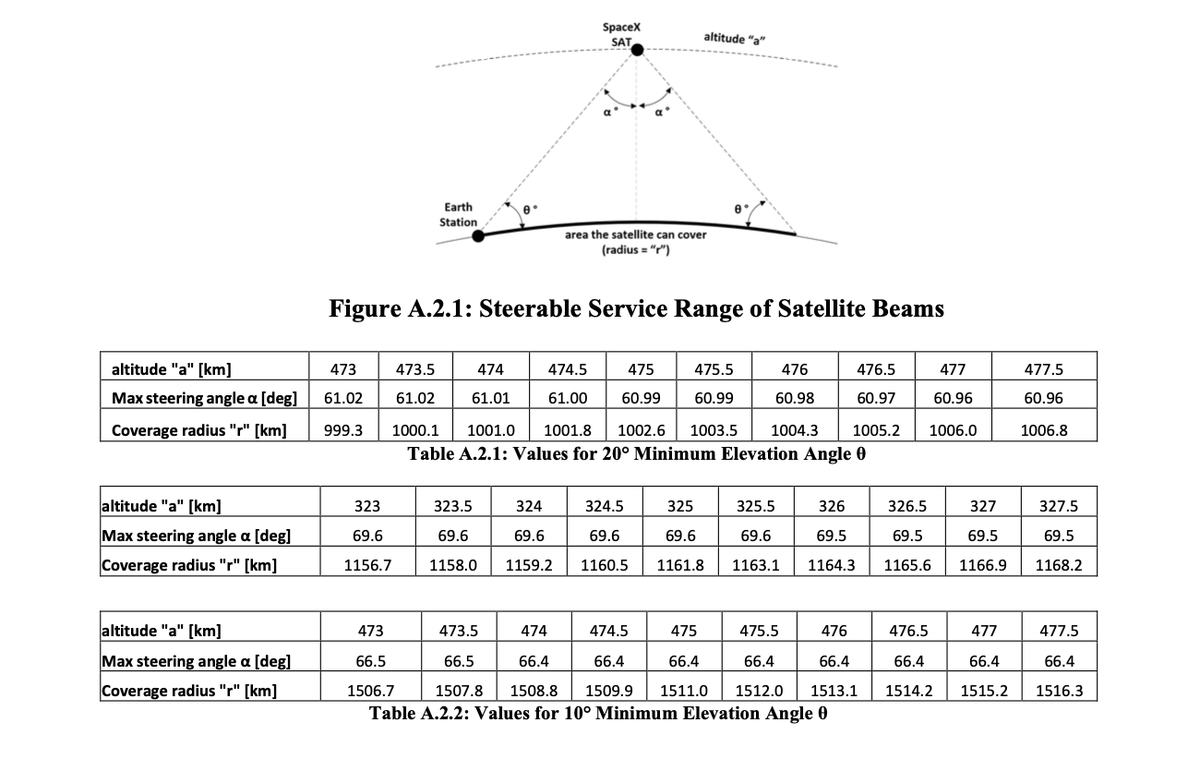
The Gen3 system will consist of 100,000 satellites, configured in two bands of thin, closely stacked operational shells with nominal altitudes between 323 and 327.5 kilometers and 473 and 477.5 kilometers. SpaceX seeks flexibility to operate its Gen3 system with inclinations ranging from 26 degrees to 96.9 degrees (sun-synchronous orbit) to optimize coverage consistent with evolving demand.
This new filing is separate from SpaceX's previous application to operate a constellation of up to 1 million AI satellites. They are two distinct constellations.
Over the past 6 weeks, more than $9 billion of new @Tesla Megapack projects have been announced, totaling more than 43 GWh of battery energy storage.
That amount of energy storage combined could help power 5.9 million homes.
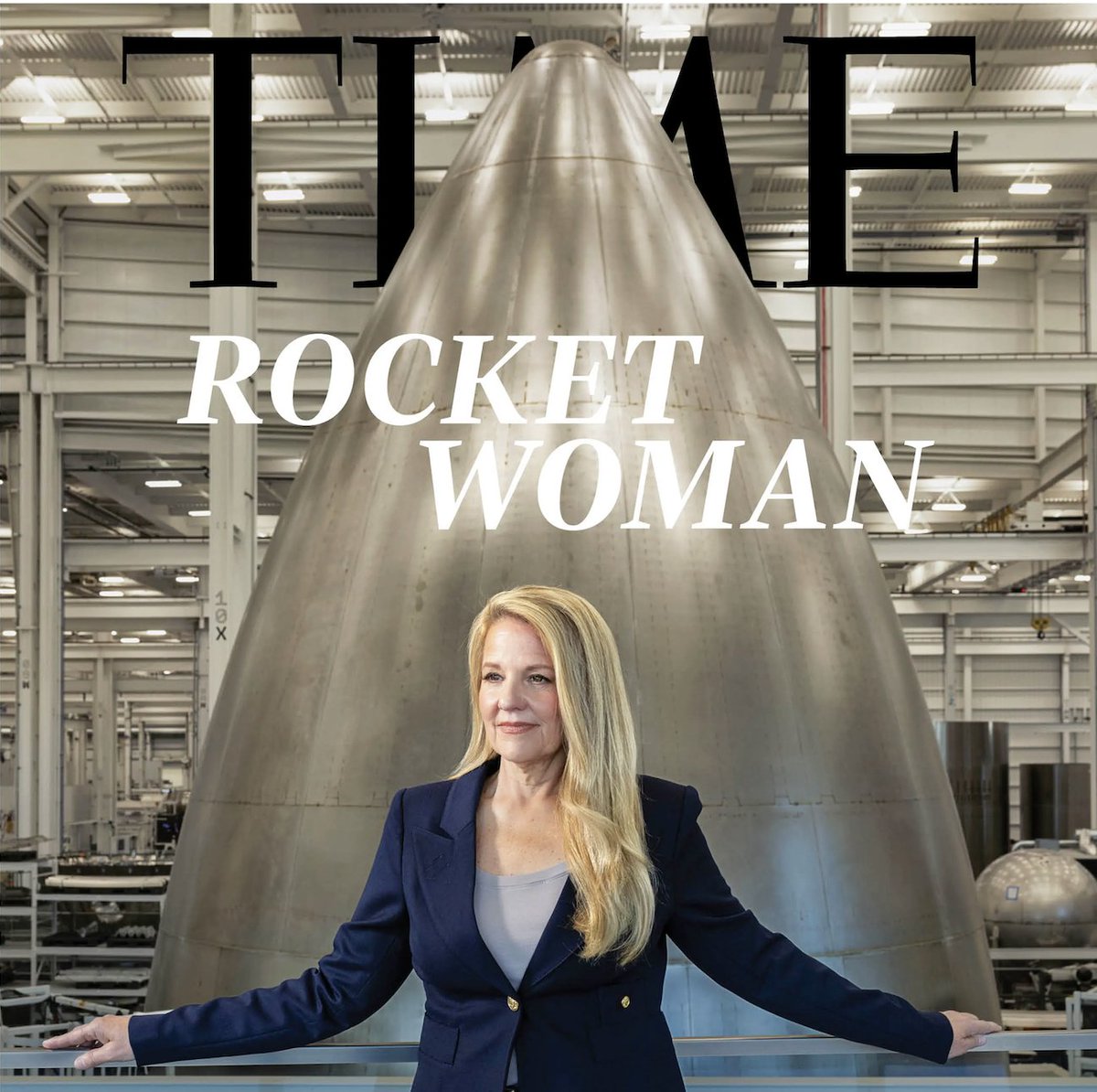
SpaceX President and COO Gwynne Shotwell and her husband have announced that they are donating ~$325 million of SpaceX stock to Trump Accounts for more than two million children across the U.S.
Every one of those kids will now have a direct stake in a company whose mission is the most ambitious in human history: to make life multi-plantary 🚀
I actually am a doctor. I’m not cherry picking any data. All this data is out there for the public to see. It’s common sense. Populations with least melanin and most sun exposure, get the most skin cancer. One of the reasons it is more prevalent now is that we are diagnosing it more. Other reasons are increased sun exposure due to fashion/clothing and sun tanning beds. There weren’t any sun tanning beds pre 1980’s and people covered up more.
It’s not anecdotal. Look at skin cancer rates of Asians in the US. Asians use the same sunscreen everyone else does and more of it. Asian women will not leave the house without sunscreen. After African Americans, Asian women have the lowest skin cancer rate in the US. 0.2 per 100,000. If you look at the BCC rates, they are even lower. White men have a skin cancer rate of 35 per 100,000. One group never leaves the house without sunscreen and one doesn’t believe in it. White men have a 175x greater chance of getting skin cancer.
People need to stop spreading false science. Asians have the lowest skin cancer and use the most sunscreen. The only skin cancer Asians get is on their palms and sole of their feet. It is quite rare. Ever notice Asian ladies always have sunscreen on and are covered up? This study proves people that are out in the sun a lot get skin cancer.
One of Elon Musk’s companies, Tesla, is making cars for blind people.
Another one of his companies, Neuralink, is working on restoring sight to the blind.
Guys, $TSLA launched their Robotaxi service in Miami with NO ONE in the vehicle to supervise. That’s one of first cities to do this so far.
I don’t think you understand how big of a deal that is.
If they can go unsupervised from the get go, that decreases time to market and increase margins as no driver is needed.
Texas has over 102 fully autonomous unsupervised Robotaxis and that number will continue.
We should see Arizona, Nevada, Washington and a few other states come online very soon.
The fleet should also be expanding with more unsupervised vehicles in existing cities across Texas and Florida.
The flood gates are about to open in a big way with the recent launch of the Tesla Cybercab.
Teslas vs legacy ICE vehicle fleets:
• Most American-made
• Cheaper to operate
• Faster & more powerful
• Safer
• Better tech
• Better for environment
• Can drive themselves
It's a no-brainer.
The Model Y L is the most aerodynamic efficient vehicle Tesla makes. It has a drag coefficient of 0.216.
For a comparison, a Kia EV9 has a 0.287 Cd, which is 27% higher than the Model Y L.
A low coefficient of drag mixed with high efficiency motors and other practices allows the Model Y to have competitive range numbers with generally smaller battery packs.
• Kia EV9 AWD: 99.8 kWh battery - 283 miles of range
• Tesla Model Y L: 83 kWh battery - 325 miles of range
Tesla is all about efficiency.