I built Shorteefy after trying every AI clipper out there.
They are fast. But they decide everything for you. The clip starts mid sentence and you cannot fix it. And you pay every month whether you clip or not.
Paste a long video → get short captioned clips. You pick how involved you want to be:
→ Quick Mode: AI does the whole thing. Finds the moments, crops to 9:16, adds captions, hands you finished clips.
→ Advanced Mode: AI drafts the clips. You move the start and end word by word so nothing cuts mid sentence, fix any wrong caption, then render.
The pricing part:
→ No subscription
→ ₹2.50 a minute in India, $0.03 a minute everywhere else
→ Start with ₹150 or $6
→ Full HD, landscape and portrait
https://t.co/tl8O5fzkwx
Hi Jake.
Just started seeing your tweets in my feed.
As I am actively trying to learn about SEO.
I am a solo builder.
Here is my product: https://t.co/tl8O5fzkwx
Would be glad for your feedback.
There are few things I have learnt in last few days.
A new SAAS cannot compete with Big Ones for the same keywords.
But then how to choose right KWs and invest time upon?
The second part is to have the GSC report to understand how are we getting impressions now and make pages more rich around it.
Other than this, nothing much.
Will be grateful for your suggestions here.
Actually I thought it made sense to move to a local transcription model-based platform like Handy but the point of Wispr Flow is the flow.
The transcription happens immediately and we do not notice the amount of time wasted when we use Handy. It breaks the flow for someone who is trying to achieve that.
The other part is, if you have a good laptop maybe try with the different models.
The only place I use opensource models on everyday basis is local transcription. I don't use any subscription of products like wispr flow. I use this opensource app called handy.
I am curious, are you using any opensource models on day to day basis, if yes - what's the use case?
Thanks Hridoy.
I have been following your work on X to figure out SEO.
I am yet to devise a strategy.
What I understood: a new SAAS cannot compete with Big Ones for the same keywords.
But then how to choose right KWs and invest time upon?
The second part is to have the GSC report to understand how are we getting impressions now and make pages more rich around it.
Other than this, nothing much.
Will be grateful for your suggestions here.
Figuring out the SEO for a SAAS: Post 1
I’m figuring out SEO for Shorteefy, and the first lesson was humbling: most keywords in my space aren’t mine to win.
Every keyword falls into two piles.
Pile one: terms the big players have owned for years. A new site fighting there doesn’t land on page 5; it doesn’t land at all.
Pile two: terms they don’t care about. That’s where a small product can actually show up.
So how do you find pile two? I’m using three filters.
Does it describe what makes us different?
Opus Clip can’t rank for “AI clipper without subscription,” because they’re a subscription. We’re pay-as-you-go from ₹150. Our differences are our keywords.
Does it lead to the product?
A blog post that ranks but never sends anyone to clip a video is vanity traffic. Every keyword has to map to a feature, a free tool, or a comparison.
Will an AI Overview eat the click? Google’s AI summaries now sit above results, and studies show clicks drop sharply when one appears, mostly on “what is” questions. Searches where someone has to do something (convert, trim, compare, buy) still get clicked. That’s where I want to be.
The test I now run before writing anything: Google the keyword myself. If page one is all giant brands, I skip it. If it’s Reddit threads and outdated listicles, Google is telling me it has no good answer yet.
If you’ve cracked SEO for a small SaaS, I’d love to hear what worked.
I’ve been working on Shorteefy for a while now and kept running into the same thing. AI clipping tools are fast, but the clips they make often don’t make sense to someone who hasn’t seen the full video.
Stuff like: the clip starts with the answer but the question was two minutes earlier. Or it cuts off mid-sentence because the “score” dropped. Or it spells the guest’s name wrong in the captions, which is the one word people need to find you.
After looking at a lot of clips, most good ones have 4 parts:
Hook: Does the first line make someone stop scrolling?
Setup: What’s the smallest bit of context a new viewer needs?
Payoff: Does it deliver what the hook promised?
Ending: Does it end cleanly, or loop back so people rewatch?
AI can find candidate moments well. It can’t really judge these four. So in Shorteefy’s Advance Mode, the AI shows you its picks as text before anything gets rendered. You pick the ones you want, move the start/end, fix captions, and only then the clips are made.
If you just want speed, Quick Mode still lets the AI do everything.
Also no subscription, you just pay per minute of video you use.
Wrote the whole thing up here, including a short checklist you can use with any tool: https://t.co/Bz86CZBfnW
Curious how you all handle this right now. Do you check every clip before posting, or just trust the AI and post?
Update from a solo built product.
This morning I had 6 speed fixes from a Lighthouse report.
Browser waited for:
> 283 KB of JavaScript started before the first paint
> My error tracker and analytics only loaded after 6 s
> The one stylesheet finished last, at 3.2 s
> Nothing could paint until it arrived
Few things I tried:
> 2 of the 6 fixes would not have helped. One would have made it slower
> New fix: each page now carries the CSS it needs inside its HTML
Lets see.
Do not miss watching this.
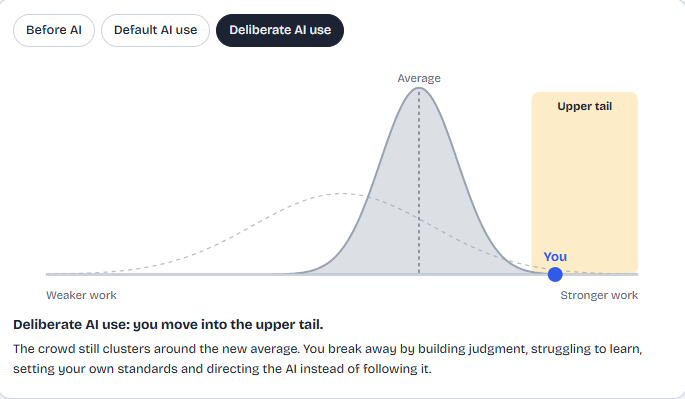
As AI becomes accessible to everyone, there is less chance to stand out.
Also, we are all moving towards the average (a better average), and there is nothing to distinguish us.
Prof shared a funny observation: all the recent presentations looked the same.
So what is the way?
Old school method. Take a problem. Struggle.
Where does AI come in then?
To make the process smoother, by coming in when you’re stuck.
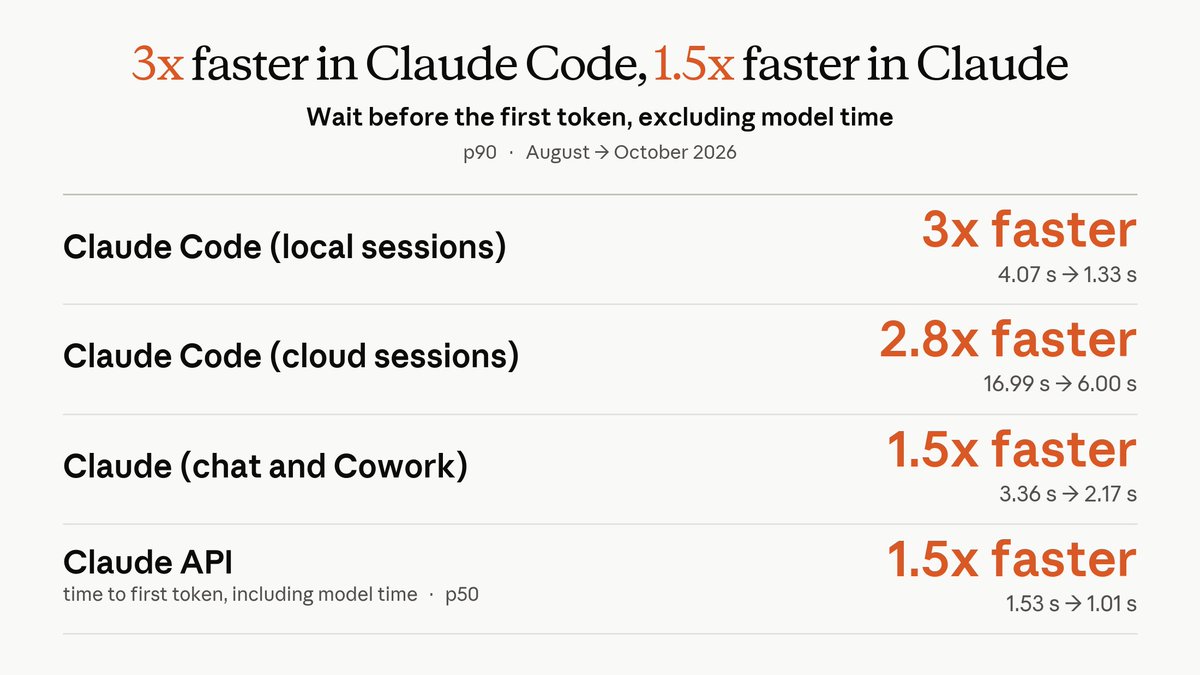
We keep improving performance across Claude, and you may have noticed it starts responding sooner!
Claude Code now gzips the conversation it sends on every turn, so it reaches the model faster. Cloud sessions also start up as soon as you start typing.