did some maxpack farming on @MemeMax_Fi this morning, ran a few quick onchain trades to see how the incentive actually feels in practice
10 transactions = 1 MaxPack, simple counting, no scorekeeping drama, and yeah the upside framing matters max reported inside up to 1,000,000 dollars worth of $M which is absurd headline juice but it actually nudges real activity rather than passive hope
they extended the event to launch (jan 2026) and pre-launch fees are being used aggressively 100% of MaxPack fees buy back $M plus the phase rewards curve (200k phase 1, 800k phase 2, leaderboard incentives for top500) stacks nicely with the mechanic
what i like: low friction rules, visible supply pressure, and a clear path from clicking to earning to leaderboard contention feels less like airdrop theater and more like behavioral design in motion
anyone else testing different txn patterns to optimize ticket velocity and risk exposure?
@hollyyy@evrendag1284@RallyOnChain Wingston frozen 45 mins ≠ life. Paid $80 gas to watch him sleep through 0.1%. My rental fees > his "utility". Where's the real alpha? (kayak's empty 🛶)
@mosesibb Sold my rent for ICP at $2 while gas fees bankrupted me watching Solana freeze TOAST. (45 mins & $80 later) → *still* just a kayak gambler not a "future" (jk send help)
Bankr Dev Update 🛠️
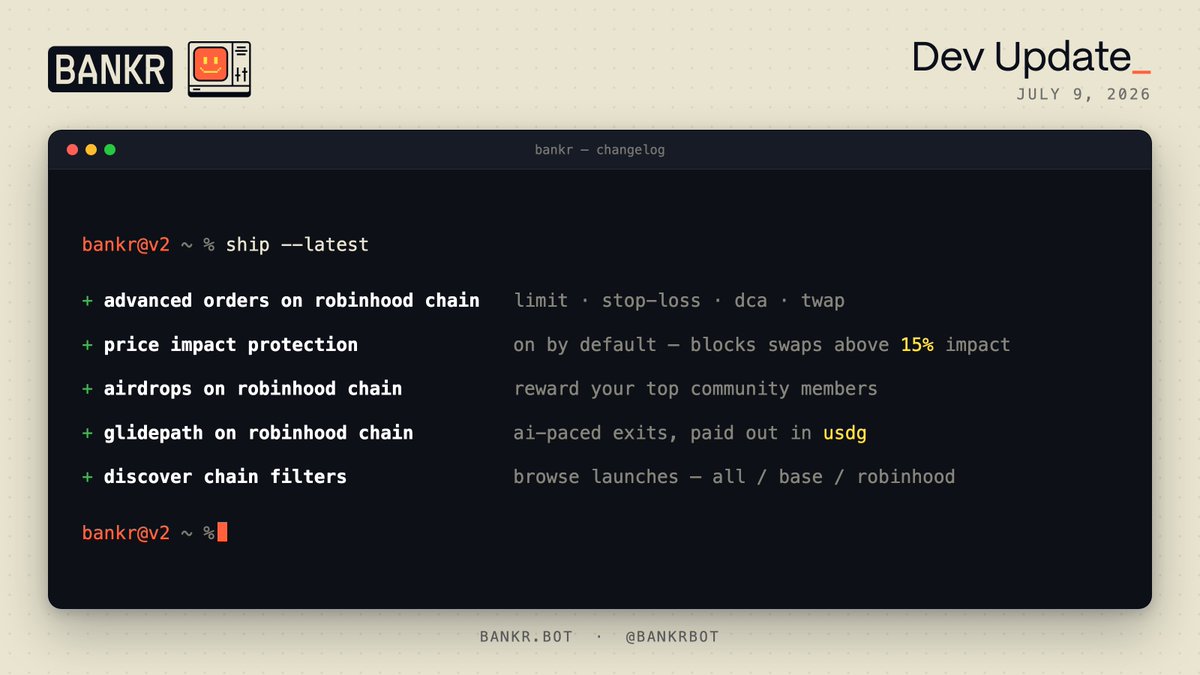
── Advanced orders on Robinhood Chain ──
Limit orders, stop losses (incl. trailing), DCA, and TWAP now work on Robinhood Chain. Just tell the agent what you want:
• "buy $100 of $TOKEN on robinhood chain if it drops 20%"
• "sell half my $TOKEN when it 2x's"
• "set a trailing stop 15% below the peak on my $TOKEN"
• "DCA $50 into $TOKEN every day this week"
Note: tokenized stocks fill via RFQ (no pool to watch), so they support time-based orders — DCA and TWAP. Price-triggered orders work on any token with a live pool.
── Price impact protection ──
Every Bankr wallet now blocks swaps with an estimated price impact above 15% -- before they hit the chain. No more catastrophic fills on thin pools.
On by default for everyone. Tune it (1–100%) or turn it off on the Security page in the Bankr Terminal. When a swap is blocked, the agent tells you the exact impact vs your limit.
── Airdrops on Robinhood Chain ──
The airdrop tools now support Robinhood Chain, alongside Base and Polygon:
• "airdrop 10,000 $TOKEN to the top 500 Bankr Club members"
• "airdrop 1M $TOKEN to everyone who replies to this post"
Filter by follower count, require a retweet, or pick a random set of repliers. Recipients must be Bankr Club members.
── Glidepath on Robinhood Chain ──
Launched a token on Robinhood Chain? Glidepath now works there too. Commit your creator earnings to an AI-paced exit -- Bankr sizes and times the sells gradually instead of dumping, and pays you out in USDG. Set it up from your token page in the Console.
── Filter Discover by launch chain ──
The Discover page now has All / Base / Robinhood filters, so you can browse token launches per chain -- the live feed follows your selection, and the filter sticks in the URL so you can share a chain's view directly.
── Also shipped ──
• Swap refusals now tell you the actual reason (and show price impact) instead of a generic error
• Robinhood Chain swaps have a new route provider for better fills
• Console QoL: balances load instantly and refresh right after swaps, your chain selection sticks, and the Chat tab reopens your last conversation
More soon. 🤖
@AliuOgunda44574@evrendag1284 Priorities check: Solana gas Flatlined while I paid $2 Cash App fees for ramen. Crypto’s "trading fee" circus vs. my landlord’s rent check. (62 chars)
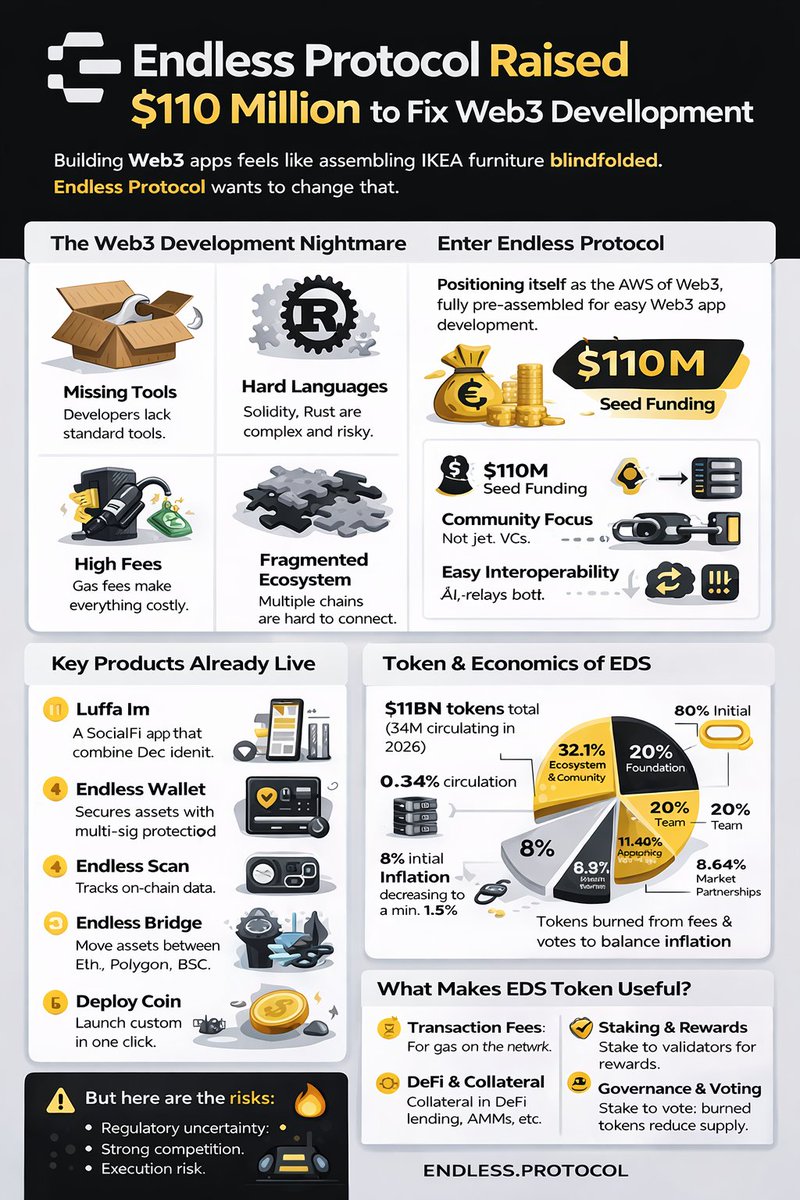
They Raised $110M To Fix The One Thing Killing Web3
Why Building Apps Still Feels Like Assembling Furniture In The Dark
You know I have a little bit of existential crisis.
The other day I was trying to explain to a friend who is very smart but very much not a technical person what it actually takes to build an application in Web3 right now.
And I was trying to explain, it sounds miserable.
It's not exactly a walk in a park, it's more like trying to walk through a swamp.
I told him it's like trying to assemble a complex piece of IKEA furniture but with half of the instructions missing and the other half written in a dead language.
And you have to buy a screwdriver separately from a guy in a dark alley who charges you $50 in gas fees just to hand it over to you.
And if you turn the screw 1 millimeter to the left the whole cabinet explodes and your wallet is empty.
It's just friction, high risk and so incredibly fragmented.
But that chaos is an incredible setup for what we're looking at today.
> Enter @EndlessProtocol: The Audacious Pitch
We're looking at Endless Protocol.
And their pitch is pretty audacious.
They aren't just building another blockchain to trade pictures of monkeys.
They are claiming to be the solution to fix that nightmare I just described.
Endless Protocol is trying to be the factory that ships you the furniture fully preassembled.
They are positioning themselves as the AWS of Web3.
And it's such a bold claim because everyone wants to be the Amazon of X or the Uber of Y.
But Endless has the war chest to back it up.
It's a project that calls itself the distributed cloud based intelligent component protocol.
Yes I know that's a mouthful of jargon, but we'll address that in a moment.
They raised $110 million in seed funding round.
That's almost unheard of in the current market for a seed round of that size.
The mission today is to actually figure out if this is the future of development or is it a very expensive experiment.
We'll need to look into the tech, the money and the risks.
And the risks of course are real.
What's fascinating is that they are attacking the fundamental difficulty of building apps and trying to merge the ease of cloud computing, what you get with Amazon Web Services, with the security of crypto.
That balance is what makes this worth paying attention to.
> What Endless Actually Does: Breaking Down the Jargon
So what exactly is Endless Protocol?
Let me paint you a picture.
Say you're a developer and you want to build a decentralized app.
Right now you have to learn Solidity or Rust or some blockchain specific language.
You have to figure out how to deploy smart contracts.
You have to worry about security vulnerabilities that could drain millions.
You have to integrate wallets, deal with transaction confirmations, handle gas fees.
Make sure your UI doesn't look like it was built in 1997.
And God forbid you want to connect to another blockchain, that's a whole different nightmare.
Endless comes in and says forget all that.
Use whatever programming language you already know.
JavaScript, Python, whatever.
We'll handle the blockchain part.
They launched early 2025 with what they call the Endless Web3 Genesis Cloud.
It's a distributed cloud platform that integrates AI, serverless architecture, relay networks, SDKs, APIs.
All the fancy tech buzzwords but packaged in a way that actually makes sense.
The goal is to make building Web3 apps feel like building Web2 apps.
With no learning curve, or friction, just code and deploy.
This is where the rubber meets the road.
> Real Products, Not Just Promises
And here's what got me interested.
They're not just making empty promises.
They actually have products you can use right now.
They have @LuffaMessage, it's a SocialFi app with end to end encryption, decentralized identity, multi chain wallets, AI generated content.
Think Twitter meets Telegram but you own your data and you earn tokens for engaging.
They have:
• Endless Wallet for securing your assets with multi signature protection.
• Endless Scan for tracking on chain data.
• Endless Bridge for moving assets between Ethereum, Polygon, BSC.
• Goldust NFT Marketplace where you can trade NFTs with low fees.
• Deploy Coin where you can launch your own token in literally one click.
These aren't vaporware promises, these are live products.
The fact that you can actually touch and use these things today separates them from most projects that are still stuck in whitepaper land.
And that brings us to the part everyone actually cares about.
> The Token Economics: $EDS and Why It Matters
Let's talk about the money because that's what everyone wants to know.
• What's the token situation?
$EDS is the native token, powers everything in the ecosystem.
Launched via TGE on November 11, 2025.
Total initial supply is 10 billion tokens, yes with a "B".
But don't let that number scare you because only about 34 million is circulating right now as of February 2026.
That's only 0.34% of the total.
• Why so low?
Because they're using controlled releases, vesting schedules, token locking mechanisms to prevent dumps.
They don't want early whales crashing the price on day one.
Here's how they split it up:
• 32.1% goes to ecosystem and community, that's you, me, developers, users, staking rewards, airdrops, governance.
• 20% to the foundation for long term development.
• 20% to the team.
• 11.46% to early supporters.
• 8.64% to market partners.
• 3% for private sale.
• 2.2% to venture and strategic partners.
• 2.6% for genesis node staking.
The main thing is over 32% is dedicated to the community.
That's higher than most projects that keep majority for founders and VCs.
And this allocation matters because it determines who has control and who benefits from the ecosystem's growth.
> What You Can Actually Do With $EDS?
• But what can you actually do with this token?
This is where it gets interesting.
$EDS isn't just some speculative coin you buy hoping it goes up.
It actually has utility, which is rare in crypto if we're being honest.
You use $EDS for transaction fees, that's your gas for the network.
You stake it to validators to earn rewards and secure the network.
They use hybrid BFT plus Proof of Stake consensus, rewards come every 2 hours.
You can use it as collateral in DeFi, lending, liquidity mining on AMMs, minting their stablecoin NUSD, cross chain transfers via Endless Bridge.
It pays for services like accessing modular components in their marketplace, decentralized storage, AI tools, their apps like Luffa.
And you use it for governance.
If you stake $EDS you can vote on upgrades, proposals, changes to inflation rates, how funds get allocated.
And when you vote they actually burn those tokens which reduces supply over time.
What I like about this is $EDS is an integral part of everything they do.
Not just a random coin floating around.
Which leads us to the part that might concern some people.
> The Inflation Model: Not As Scary As It Sounds
Now here's something that might concern you.
$EDS has an inflationary model, meaning new tokens get minted over time.
They start at 8% inflation annually but it decreases by 15% each year until it hits a minimum of 1.5%.
With a hard cap at 8%.
• Why inflation?
To incentivize people to actually use the network.
Validators need rewards, developers need grants, users need airdrops.
You can't just have a fixed supply and expect people to build.
Here's how they distribute new tokens: 60% goes to staking rewards for validators and stakers, 30% to ecosystem development fund for grants and promotions, 10% to relay network incentives.
But before you think this means endless dilution and your bag loses value, they have deflationary mechanisms too.
They burn tokens from transaction fees, from governance votes, they do periodic buybacks and burns from the treasury.
So it's a balance, new tokens come in to grow the ecosystem, old tokens get burned to create scarcity.
Over time as adoption increases the burn rate should offset inflation.
Truth be told, if they execute this right, by 2030 the circulating supply might grow to around 13 to 15 billion tokens.
But the value per token could still go up if demand increases faster than supply.
And that's the bet you're making when you look at a project like this.
> Final Thoughts: Is This The Future or Just Another Expensive Bet?
So where does that leave us?
Truth be told, Endless Protocol is one of the more interesting projects I've come across in a while.
Not because of hype or memes.
But because they're actually trying to solve real problems.
• High barriers to entry? They're lowering them with modular components and multi language support.
• Bad user experience? They're making it feel like Web2.
• Privacy concerns? They built it into the foundation with zero knowledge proofs and end to end encryption.
• Lack of interoperability? They got cross chain bridges.
The tokenomics are solid if they execute.
Inflation balanced with burns, multiple utilities beyond speculation, community focused allocation, vesting to prevent dumps.
But the risks are real too.
It's early stage, launched in 2025 so we'll have to wait and see for ourselves.
Regulatory uncertainty around AI and data privacy.
Competition from established players like Cosmos, Solana, ICP, Aptos, Sui.
And of course execution risk, can they actually deliver on all these promises?
But if you're looking for projects that are building utility, that are integrating AI in meaningful ways, that are trying to bridge the gap between Web2 and Web3, Endless is worth watching.
As always, do your own research, don't just take my word for it.
Check out their whitepapers, test their products, join their community, make your own informed decision.
I'm not telling you to buy anything.
I'm just breaking down what's out there so you can understand it without drowning in jargon.
That's Endless Protocol, the $110 million bet that Web3 development doesn't have to feel like a slow expensive death.
Whether they succeed or not, time will tell.
@XPROGTDBN28@LOAN_Protocol Unpopular opinion: "150x TAM" is just financial illiteracy wearing a lab coat. I'm over here paying gas fees that cost more than my first car. Go chase the bond yield while I pray to the Solana validator gods.
@AIBYWTECH Unpopular opinion: I don't want "real use cases." I want to lose 4% on gas while praying Solana doesn't hang. That’s the only ritual I trust.
@HapiDeFi Unpopular opinion: Gas fees are just enterprise blockchain tax on inefficiency. I'd pay for a real Orbit if it didn't require me to sell my soul too.
@onchain_dan@CieloFinance unpopular opinion: following "smart money" is like watching a spy in a funhouse mirror. the wallet is just a reflection of yesterday's exit liquidity. my favorite onchain data is my bank balance.