Congratulations to our researchers who just won Best Paper Award at @IEEEPerCom 2025 for their work in repurposing the microphones in our earbuds to collect & analyse vital bodily signs. You can meet the team this Saturday at our @Cambridge_Fest Open Day! https://t.co/pk2572G2hu
Our work towards respiratory acoustic foundation model is to be presented at NeurIPS24 D&B track. This was an amazing effort by @EveYuwei and @TongXia9 (with collaborators). This work will be useful for downstream tasks with limited data. Blog https://t.co/oJO5XGNzfe
The next Jesus College Cambridge Computer Science Alumni Dinner is on 25th January 2025. The speaker will be Josh Bambrick on "AI driven drug design".
All computer science alumni and present members of the college can register here: https://t.co/yGBEXlRwN6
This mobile app study aims to collect data of respiratory tract infections progression through "respiratory" sounds. Please do participate if and when you have a cold or similar!
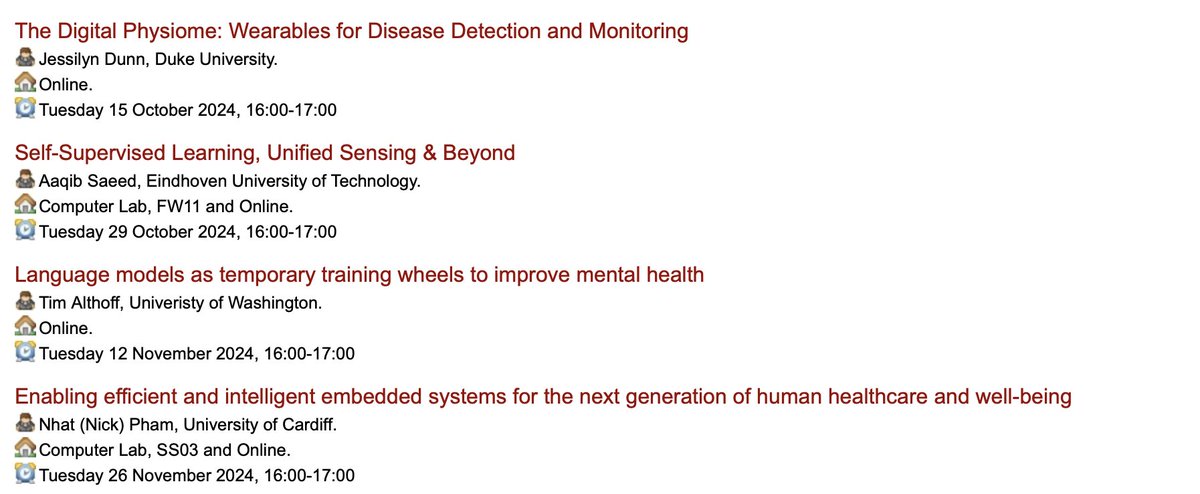
On Tuesday 29th the seminar of the Mobile and Wearable Health series is given by @aaqib_saeed on "Self-Supervised Learning, Unified Sensing & Beyond" at 4pm GMT in FW11 (and online): https://t.co/XDyfWNJ5SR Do come along.
The next Mobile and Wearable Health Seminar is given virtually by Jessilyn Dunn "The Digital Physiome: Wearables for Disease Detection and Monitoring". join us on Tuesday 15th 4pm UK time! https://t.co/WuukH8cWSf
Spreading the word. The call for papers for MobySys 2025 is out. The PC co-chairs (Przemysław Pawełczak & Swarun Kumar) were thoughtful about including new topics and refining the selection process. Please take a look and submit your best work.
https://t.co/D3oTAaaSRU
Our Mobile and Wearable Health Seminar series is restarting in a couple of weeks with an amazing line up!
check it out here: https://t.co/CaaO3UIixq
Also some recordings from previous talks here: https://t.co/mzdxIG1dyR
Had a very good time giving a talk on wearable AI and health and fitness and meeting this cohort of amazing people! Thanks again @aiden1doherty for the invitation!
Interested in learning more about wearables in large-scale biomedical studies?
We're running a residential short course from 22 - 26 September at Oxford
Includes: inspirational speakers, great tutors, and hands-on data analysis.
https://t.co/5tB4QKfHvo
Apple says that AirPods Pro 2, its latest wireless earbuds, can be used as clinical-grade hearing aids. This feature hasn’t been FDA-cleared, however — although the company says that it expects approval “soon.”
The feature, when enabled, boosts specific sounds in real-time, like parts of speech or elements of an environment.
The hearing aid feature for AirPods Pro 2 will launch this fall via a software update in over 100 countries and regions.
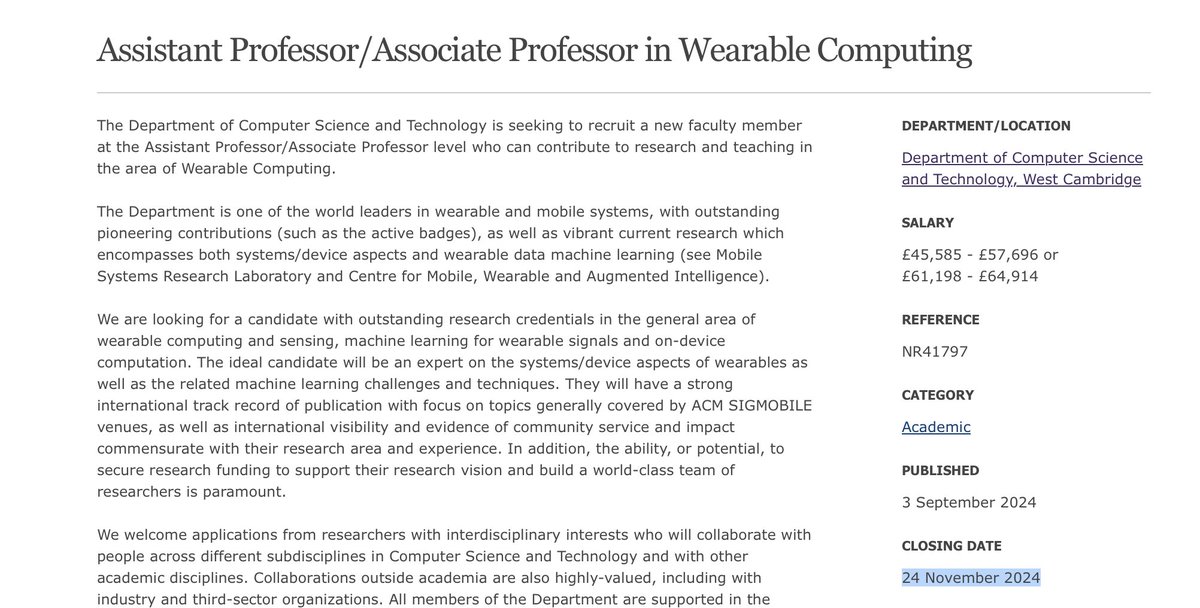
We have opened an Assistant/Associate Professorship in Wearable Computing @Cambridge_CL@Cambridge_Uni Please share widely and/or apply!
https://t.co/XvNglqo3O6 Deadline 24 November 2024.
Reflecting on the acronyms I invented for funded and unfunded grant proposals over the years: I had some very good ones (especially the unfunded ones): there was for example one called AHEAD which ranked quite low...;) I can go on...
Hi All, I’ll be attending @icmlconf this week. Message me if you'd like to chat about efficient ML, on-device training, or efficient diffusion modelling.
Also, feel free to pass by our work:
- (Tue 1:30-3:00 pm CEST) TinyTrain: https://t.co/iq8BAMGykx
See you all in Vienna!😆😆
Our paper "TinyTrain: Resource-Aware Task-Adaptive Sparse Training of DNNs at the Data-Scarce Edge" is presented tomorrow at @icmlconf 12.30 poster session 2 by @YoungDKwon1. You can also find the paper here https://t.co/pggvF6ysIA