this might be the craziest thing humans have ever tried lol
a startup called Real Ice is literally trying to refreeze the Arctic
and on a small patch in northern Canada, it's actually working!
> in winter, they drill through the ice and pump seawater up on top
> the freezing air turns it into a fresh layer, so the ice goes into summer thicker
> their test patch came out about 50 cm thicker than the ice around it
this is huge because right now the Arctic is on track to lose almost all its summer ice as soon as the 2030s
and that ice helps keep the whole planet cool
it's like wearing a white t-shirt vs a black sweater on a hot day
right now the ice is the white t-shirt, bouncing the sun's heat back into space
once it melts, the dark ocean underneath becomes the black sweater, soaking all that heat up
and that extra heat speeds up global warming, which means rising seas, stronger hurricanes and deadlier heatwaves all around the planet
the company says thickening an area twice the size of California would cost about $5-6B a year
we're officially in the business of refreezing the planet
Remarks from Anthropic CEO @DarioAmodei on our initial public offering:
My co-founders and I started Anthropic because we believe that the most powerful technology of our time should be built for the benefit of humankind.
Daniela and I lost our father to a disease that, just a few years later, became curable. I started my career in biology, hoping to help future cures come sooner. In the lab, I saw the vast thicket of complexity that scientists face when they’re trying to understand disease and develop new treatments.
So many of the scientific tools that can cut through that thicket��tools for gene editing, gene synthesis, controlling brain cells with light—started as pure ideas. In other words, they came from thinking. From intelligence.
Human intelligence has already made diseases like plague, smallpox, and polio history for most of the world. But progress on other diseases has been too slow for so many patients and their families. Going from a great idea to a treatment can take decades: it took many years from the first discovery of a strange repeating pattern in DNA to the approval of the first treatment for a disease using CRISPR.
Nature is full of these patterns. But we’ve had too little intelligence to decipher most of them; too few scientists, with too little time. Now we can build that intelligence. Whether it’s protein folding, drug design, cancer genetics, or clinical trial administration, scientists across many areas of biology and medicine are finding Claude can help them do their research in a fraction of the time it would’ve taken just a couple of years ago. I believe sufficiently powerful AI, working in concert with humans, could compress a century of scientific and medical progress into a decade.
I don’t want to get ahead of myself. At this point all we have are early results. Experiments and clinical trials will still take time. And although they involve slow and ponderous processes, I believe those processes can be substantially accelerated by AI. We hope that in the future fewer families miss a cure by just a few years.
Medicine is just a particularly vivid example, but there are many others. Our customers—the world’s most ambitious companies, nonprofits, and individual people—are already applying the intelligence we’ve built to stimulate economic growth; lift people out of poverty; protect democracy and free societies; even make everyday services like the DMV work better. We’re proud to work alongside them. And I’m extremely optimistic about what we can do together in the future.
At the same time, we have always been honest that this technology has very real risks. These range from misuse of the technology by individuals or nation-states, to economic disruption, to losing control of AI systems. We discuss these risks not because we think they are inevitable, but because we think they are avoidable.
Avoiding them depends on the choices made by the people building AI. There is a gigantic difference between how AI will go if we pay little attention to safety, versus how it will go if we are obsessed with safety. And an obsession with safety and with public benefit has been woven into Anthropic’s DNA from the start. From safeguards against biological and cyber risks, to alignment training and testing, to looking inside our models like an X-ray, Anthropic has pioneered methods for understanding and steering the behavior of AI systems.
There is much work still to be done, and the most difficult safety work lies ahead of us. The incredible talent of the company that has enabled us to build the most capable AI systems will need to be directed, even more so than it has already, towards double- and triple-checking that those AI systems are safe and secure.
And to state it unequivocally, we will pace the training and deployment of AI systems, taking as long as is necessary to have confidence that they are safe and will remain under human control. We will not bend to either business or political pressure. Today puts the company in a stronger financial position, and in doing so only strengthens our resolve to do the right thing.
If we can show it’s possible to make the right choices on safety and still build an incredibly successful company, others in our industry will be inspired to do the same. We call this a race to the top. When the race to the top is working properly, it doesn’t matter which company has the best models—everyone wins because everyone is building safely. The race to the top works best when driven from the front of the pack, and we fully hope and expect to do so, but the goal is to make the whole industry better, regardless of whether Anthropic is winning or losing at any given time.
The advent of machine intelligence is one of the seminal moments in human history, and we have a rare opportunity to shape it for the better.
This moment is bigger than any one company, or any one country. It will take all of us, working together, to ensure this technology goes well for us and the many generations to come. Starting today, we hope that you’ll join us on this mission.
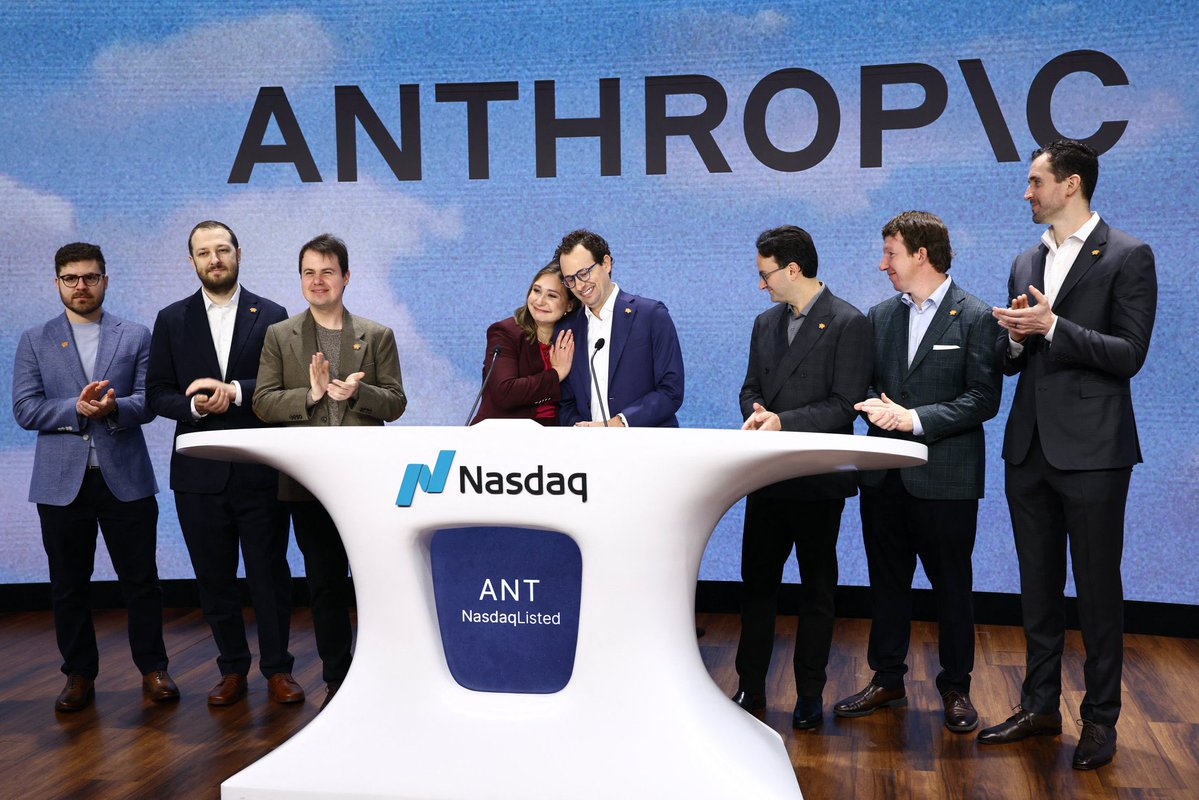
aujourd’hui vient de se jouer un moment historique à wall street avec l’entrée en bourse d’anthropic sur le Nasdaq sous le ticker $ant
c’est la plus grosse IPO de toute l’histoire de l’humanité devant SpaceX il y a quelques mois
le plus fou c’est que cette boîte a été bâtie en à peine 5 ans depuis janvier 2021 par une poignée d’anciens chercheurs d’openAI partis d une feuille blanche
voilà, quelques chiffres qui vont vous donner l’ampleur du caractère historique de cette entrée en bourse … et qui donnent très largement le vertige:
>107,3 milliards de dollars levés au total pour cette opération (dont plus de 26 milliards injectés en placement privé simultané par google, microsoft, nvidia, amd et tsmc)pulvérisant le record absolu de SpaceX en juin dernier
> 2000 milliards de dollars de capitalisation franchis dès l’ouverture à 115 $ par action (+39 % par rapport au prix d’ipo et +57 % au-dessus du bas de la fourchette initiale de la semaine) propulsant la boîte directement à la 6e place des plus grosses entreprises cotées de la planète
> 500 milliards de dollars de demande globale enregistrée auprès des investisseurs, soit 6 fois plus d’ordres d’achat que d’actions disponibles c’est juste TERRIFIANT >une valo multipliée par plus de 2 400 en 5 ans, passant de 623 millions de dollars lors de sa première levée en mai 2021 à + de 1 500 milliards dès sa cotation
>150 milliards de dollars de fortune cumulée pour les 7 cofondateurs qui vont peser environ 20 milliards chacun AUJOURDHUI grâce à cette IPO et qui ont tous vendu 280 millions de dollars d’actions il y a quelques heures
la suite est encore plus dingue donc TENEZ VOUS BIEN:
>plusieurs employés recrutés dès les premiers mois de 2021 qui franchissent la barre du milliard de dollars de fortune et qui intègrent directement le classement FORBES, jamais vu dans l’histoire de l’humanité parmi toutes les IPO
>près de 600 employés (je dis bien 600 EMPLOYÉS) dont les parts pèsent désormais plus de 100 millions de dollars chacun JE DIS BIEN PLUS DE 100 MILLIONS
>environ 2500 salariés qui détiennent plus de 10 millions de dollars et 2 800 employés qui deviennent millionnaires dès ce soir sur un effectif total de 5 300 personnes, soit plus d’1 salarié sur 2 qui est aujourd’hui millionnaire ou multimillionnaire ou carrément MILLIARDAIRE
> un autre truc qui pourrait prêter à rire mais qui ne l’est pas vraiment mais il faut noter qu’il y a maintenant +29 % de hausse sur le prix médian d’une maison à San Francisco (les prix étaient déjà horribles) qui grimpe à plus de 2,30 millions de dollars sous la pression directe de cette nouvelle vague de multimillionnaires
les amis on est en train d’assister en direct à la plus grande création de richesse collective jamais vue dans l’histoire du capitalisme
la preuve vivante que la science fondamentale, l’obstination technique et le partage du capital avec les bâtisseurs peuvent réécrire les règles de l’économie mondiale en 5 ans chrono
Responding in my personal capacity, but wanted to share my perspective..
We are in a great-power competition with so much at stake in the years ahead. There is no one in America who has lived during a time when the United States wasn't the preeminent superpower and, despite our imperfections, a force for good in the world. A nation that fought and helped end wars on behalf of those who couldn't, pioneered powered flight, put humanity on the Moon, led revolutions in medicine and technology that improved billions of lives and distributed hundreds of billions in aid around the world.
I don't know how handicapping this nation by going after one of its largest employers, a company that has created wealth for millions, ushered in electric cars, rockets that don't need to be thrown away, satellites that connect the disconnected and have unquestionably saved lives, not to mention access to information that is pretty foundational to solving many of the world's problems, biotech to restore function to those with disabilities, and so much more, serves America's interests. Without the contributions of these companies, there is little question America would be behind in a competition where the outcome is far from certain and the consequence so great.
Now, maybe I am just a bit new to this, but from the billboards, TV and digital ads, spam texts, and fundraising calls, it would seem both parties have no issue raising money, including from billionaires, with the aim of influencing and buying votes. And if that means campaign reform, maybe include dialing back the spam calls and texts..But with all that is going on in the world, and so much at stake for our country, I question the priorities reflected in the post below.