Keizer and Sasunkevich show that structural factors, social status, the degree of integration, and the sense of (non)belonging are crucial in understanding how migrants navigate differences in gender values and norms between home and host societies. Link: https://t.co/8D3hz4qBRe
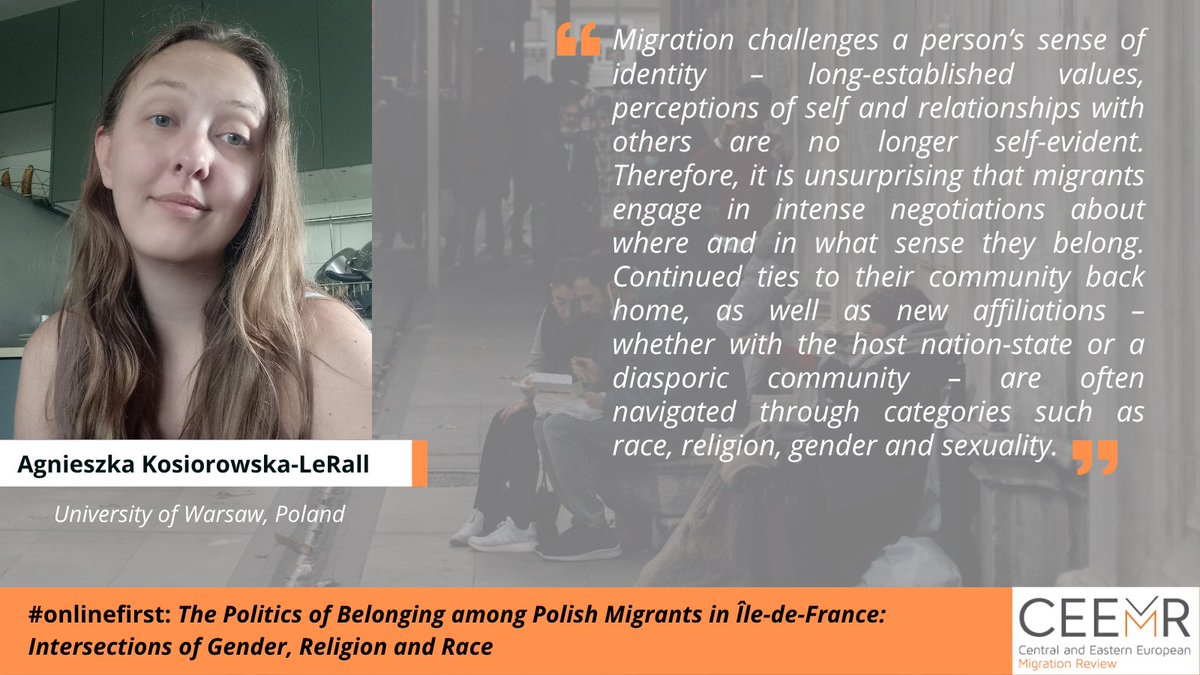
In her newly published paper, Agnieszka Kosiorowska-Le Rall argues that Polish migrants in France negotiate their identity through embracing or distancing themselves from various discourses on race, sexuality and religion. Link: https://t.co/zMXohh3MUD
Dorian Jano argues that Albanian 'irregular' migration to the UK should not be viewed solely as a criminal act. Rather, it emerges from governance-produced statuses and is shaped by sociocultural practices. Link: https://t.co/ltdqiwOmgv
Olga Wanicka’s article explores how a vlogger blurs formal and informal roles by playing with the expectations and needs via ‘performance authenticity’, achieved thanks to the mediated presence and intimacy. Link: https://t.co/IMlkoL9N9K
@ikozache examines diasporic engagements with the homeland and the effect of conflict on diaspora-homeland relationships, showing that despite the Russian existential threat to Ukraine, the Ukrainian World Congress hasn't resorted to radical or ‘transgressive’ rhetoric or actions
Ráchel Surányi and Endre Sik compare Hungary and Poland in terms of xenophobia, showing that its level is, and likely to remain, higher in Hungary due to the continuous anti-refugee government propaganda campaign and a mix of political, historical and cultural effects.
Analysis of Tamás Varga, Zsófia Rakovics and Endre Sik indicates that Hungarian pro-government media altered the emotional framing of refugees directly after the Russian–Ukrainian war outbreak; however, longitudinal patterns reveal reversion to pre-existing framing practices.
Endre Sik and Péter Krekó explain the role of the moral panic button (MPB) in creating crisis- and fear-mongering campaigns, arguing that it is crucial in building the Hungarian version of informational autocracy (IA). Link: https://t.co/qGXjxtrdEf
Dumitru Sandu examines the relationship between the return migration of Romanians and re-emigration abroad. Returnees who plan to go abroad again are more dissatisfied with public institutions in Romania than those who have not and do not plan to emigrate. https://t.co/zAYoEgLRVW
In her article, @nevaozturk warns that excessive flexibility in temporary protection erodes legal certainty, expands discretion, and threatens protection standards. Link: https://t.co/3SMzXnAqw8
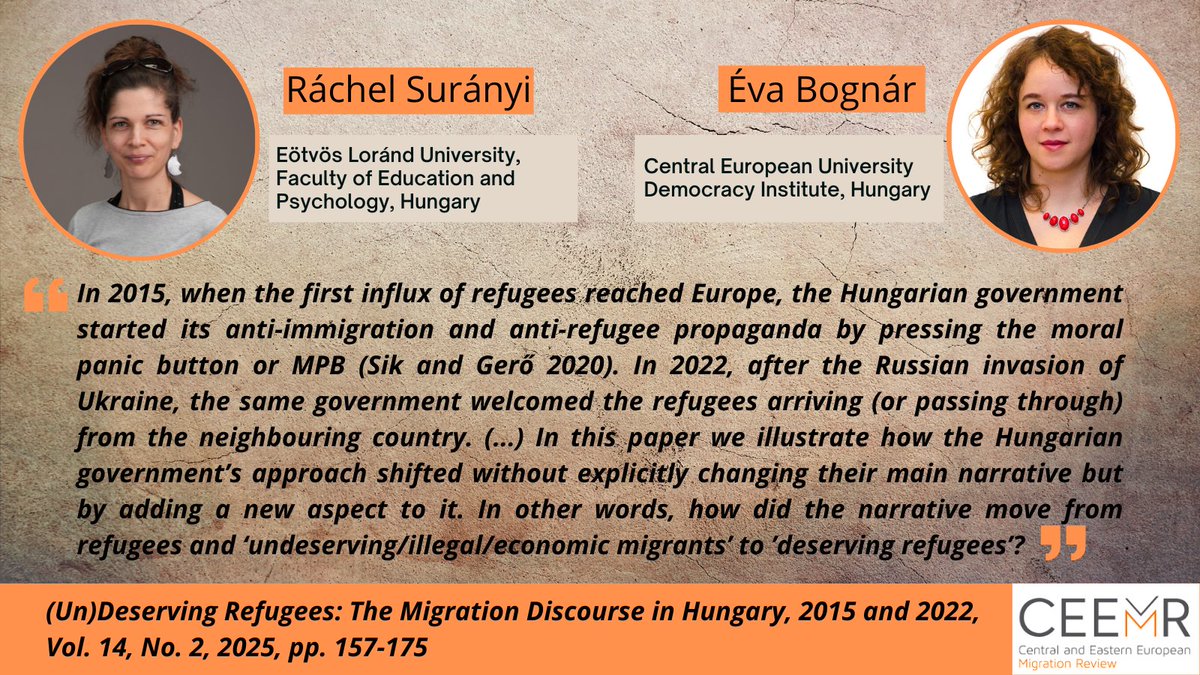
Ráchel Surányi and Éva Bognár illustrate how the Hungarian government’s approach towards refugees shifted between 2015 and 2022, not altering the main narrative, but introducing a new aspect of deservingness. Link: https://t.co/uqD08EutJe
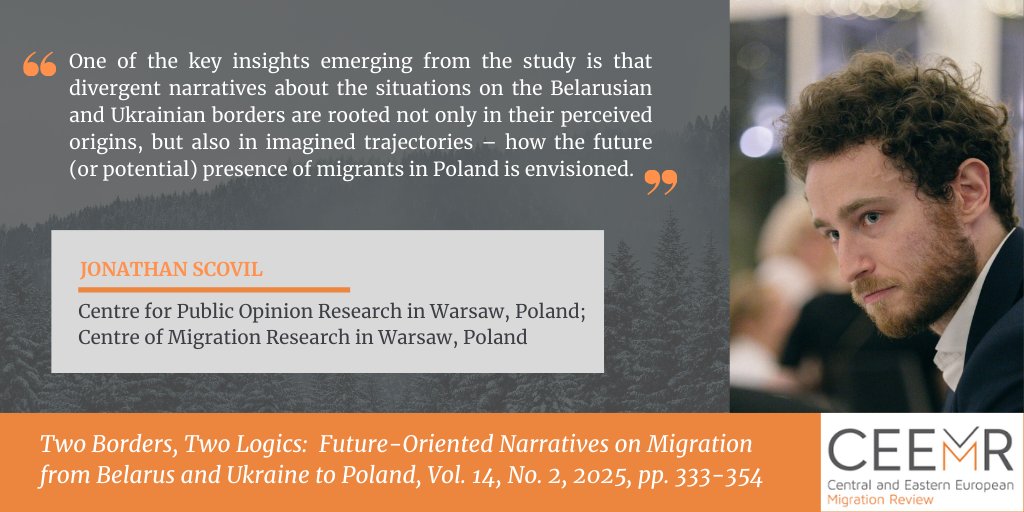
In his newly published paper, Jonathan Scovil demonstrates that future-oriented narratives explain contrasting Polish views on migrants from Belarus and Ukraine. Link: https://t.co/hvG1OqzEoM
Marilena Nicula shows in her new paper that flexible residency rules and higher wages drive Romanian medical graduates to migrate, mainly to Germany, the UK, France, Sweden, and Belgium. Link: https://t.co/tpIse91NV3
Dushi reveals how first-generation of #Kosovo Albanian migrants rather engaged in passive or survival-based strategies while younger generations (children of the first generation but also migrants who came after 1989) tend to integrate more proactively: https://t.co/f1UmHwji2r
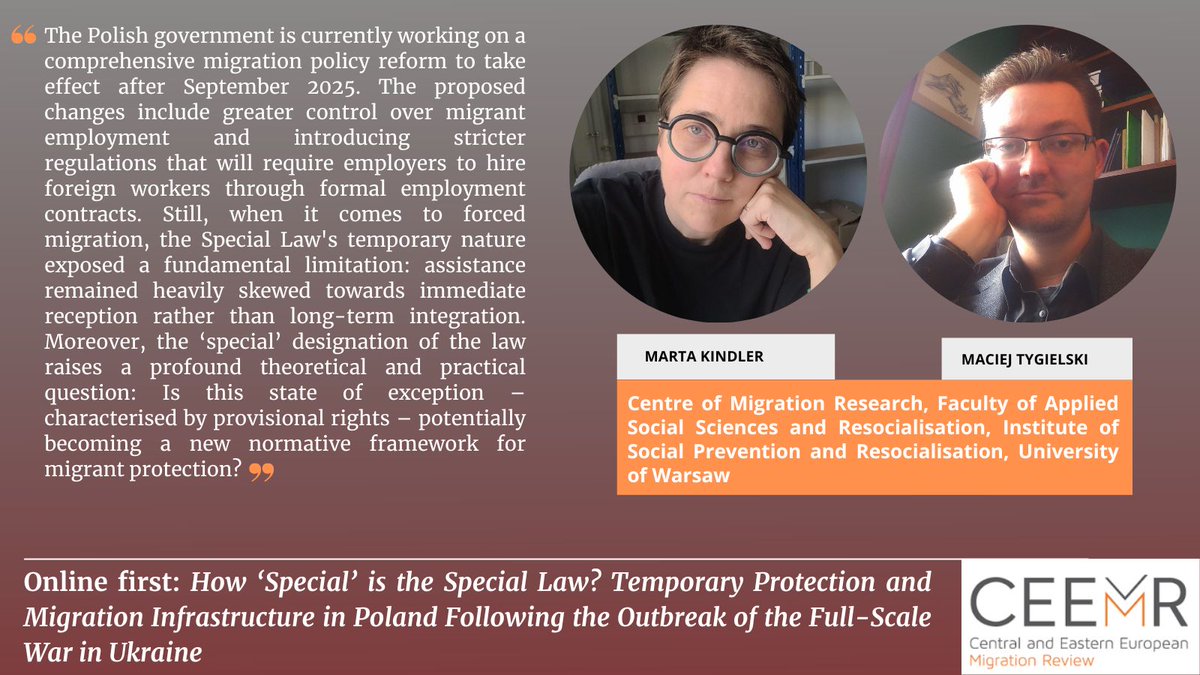
New: @MartaKindler & Maciej Tygielski present how migrant organisations and social-media platforms emerged to fill in the gaps of operational uncertainty regarding implementation of temporary protection for Ukrainians in Poland: https://t.co/HyJudNgZU2
Have a look at temporary protection in the #US. Inlender sees the US schemes such as Uniting for Ukraine (U4U) to be a crucial mechanism in the face of a declining Refugee Convention, however, with the risk of subjectivity, solitariness and instability: https://t.co/uUOo4bJURU
Amna Shafqat: the access to higher education for refugees is constrained by lack of contacts and integrative activities with society in #Czechia while the state has no measures, schemes or strategies to support the asylum beneficiaries in that matter. Link https://t.co/eANd3ZDeRw