Javier Milei One Year Assessment
Everyone excited about an Argentina economic miracle is basing it on all sorts of government statistics except the most important statistics: money supply measures and public debt growth.
Under its new supposedly free-market Rothbardian president, Argentina's money supply in 2024 has increased at these astonishing rates:
M0: 209%
M1: 133%
M2: 93%
M3: 123%
To put these numbers in perspective, note that they dwarf the rates during the preceding years, during which Argentina thoroughly earned its reputation as one of the most dysfunctional fiat monetary basket cases in the world.
In the four years of 2020-2023, Argentina’s money supply measures grew at a compound annual growth rate of:
M0: 50%
M1: 77%
M2: 90%
M3: 86%
In Milei’s first six months in office, public debt grew from $370 billion to $442 billion, a staggering increase of 19.4%. Borrowing $72 billion in 6 months can make any economic statistics look good, but the problem of course is in the long-term consequences. It is possible to make short-term growth, poverty, unemployment, or inflation numbers look good by printing and borrowing money, thus transferring the cost of a short-term glow up to the future, where they are paid with exorbitant interest. Those of us who thought things could not possibly get worse might need to reconsider.
Remember that in his election campaign, Milei specifically campaigned on a platform of abolishing the central bank, even saying that that was non-negotiable. Yet as soon as he went into office, all such talk was ignored, and replaced with elaborate stories about how shutting down the central bank would be very politically unpopular. In this, Milei has fully adopted the same statist rhetoric that is always used to justify inflation by governments: the short-term pain of stopping inflation would be so bad, that it's better to continue down the path of inflation and ignore the long-term consequences. The reality is that the Argentine central bank is bankrupt, and the sooner this reality is acknowledged, the quicker it can be overcome. Trying to save the central bank can only be done by piling up debt obligations that will make the future problems even worse. In this, Milei is no different from all his predecessors who sought short-term relief at the expense of the future.
Milei has also refused to default on the public debt, which would have been the Rothbardian solution to finally free his countrymen from eternal debt slavery to pay for the consumption binges of their previous presidents. A default on foreign debt, and a shuttering of the central bank would have caused a few months of painful adjustment, after which the Argentine economy would recover on a solid footing, without even the possibility of a government being able to create inflation or saddle the population with debt. Foreign currency and bitcoin would likely dominate such an economy, and the state would necessarily be limited by the fact that it cannot print money.
By not shutting down the central bank and letting it ramp up its money printing, Milei is sowing the seeds for currency crises in Argentina’s future. By not defaulting and hiring the same bankers who brought calamity to the country in the previous administrations, it seems Milei is eager to get another IMF bailout, which will saddle Argentinians with generational debt slavery and more fiscal crises in the future. Unsurprisingly, he is raising taxes significantly, illustrating that his understanding of Austrian economics is no deeper than the regurgitation of cliches on TV. To increase taxes in order to facilitate more government borrowing is a crime against the people of Argentina to benefit the international banking cartels and the IMF criminals. It is a tyrannical recipe advanced by the Keynesians at the IMF, and has no relation whatsoever to what any real economist worth his salt would advocate.
A lot has been made about Milei reducing the budget deficit, but this is not that important. Argentina’s problem was not that it had a big budget deficit, as its budget deficit has usually been pretty low, under 4% of GDP, the same range as European countries with no major inflation and fiscal problems. The problems have always been in money supply increase and in public debt, both of which have accelerated under Milei in an unprecedented way.
The cherry on top is that Milei has shipped off the little remaining gold Argentina has to London, in search of some yield. Pawning off a politically neutral monetary asset free of counterparty risk in search of a few quick bucks does not inspire confidence. In his book The Ascent of Money, historian Niall Ferguson details how Argentina’s economic problems began when president General Juan Domingo Peron visited the central bank in 1946 and was astonished at how much gold was sitting there. Argentina had more than 1,000 tons of gold at that time, and Peron and his successors would not resist the temptation to finance their spending by running down the gold reserves that should have been backing the people’s money. The past 8 decades of calamity were the predictable consequence. After billions of percentage points in inflation and countless defaults, Argentina’s gold reserves today are no more than 61 tons. By shipping off the last monetary reserve of the future in exchange for a quick buck to allow him to keep paying off debt so he can get another IMF loan, Milei has completed Peron’s inflationary legacy to its logical end. Argentina now has no money of its own, only an ever-growing pile of liabilities from foreign banks replete with political and economic risks. Rothbard must be turning in his grave every time this Peronist invokes him to justify his actions.
This data is astonishing and flies in the face of the hype. But unless someone can show me why this data is wrong, then, for all of his libertarian and free market rhetoric, Milei is a vintage Latin American populist inflationist, buying short-term popularity with long-term inflation and debt, essentially no different from every Argentine leader since Peron. All that his free market rhetoric seems to have achieved is to trick poor Argentines into trusting their broken central bank again instead of trying to find a working alternative like Bitcoin. His anti-socialist rhetoric is nice to listen to, and his hysterical antics, relentless emotional crying, and triumphant theatrics may be amusing to some, but fate usually serves its cruelest dishes to those who celebrate before victory.
Recien conversé con un psiquiatra experto en adicciones.
Me explicó que las drogas hacen que el organismo produzca dopamina. La dopamina da placer y produce adicción. Cada vez el cuerpo pide más dopamina, o sea más droga. La droga va destruyendo el organismo y la mente del usuario, que cada vez pide más para mantener el mismo estímulo.
Eventualmente el requerimiento de dopamina y droga es tan grande que la droga hace colapsar al organismo del individuo, y debe abandonarla o morir.
El dolor de abandonar un nivel de acostumbramiento de dopamina se llama "withdrawal". El sufrimiento del withdrawal es mayor cuanto mayor sea el nivel de acostumbramiento de dopamina que se debe abandonar.
Dice el experto que el dolor del withdrawal es mayor que la felicidad obtenida al construir la adicción. Y dura mucho tiempo.
No pude dejar de pensar en el paralelo entre el proceso de felicidad de adquirir la adicción y el dolor del withdrawal, con
el proceso de bajar artificialmente la inflación a traves de bajar el tipo de cambio usando endeudamiento(carry trade) y controles de cambio (Cepo).
La economía es un organismo. El carry trade y el Cepo son una droga que permiten la felicidad transitoria de tener una inflación descendente a costa de un deterioro gradual y creciente en el Tipo Real de Cambio, llamado "atraso cambiario".
El atraso cambiario eventualmente hace colapsar la economía, se debe abandonar la droga del carry trade y el Cepo y llega la etapa del "ajuste", o sea del "withdrawal". La economía paga con creces el costo de haberse drogado con el carry trade y el Cepo.
Una vez empezada la adicción solo hay dos caminos posibles:
-Continuar con la droga hasta el inevitable colapso.
-Dejar la droga y sufrir el costo del withrawal.
Hay muchos paralelos a la drogadicción en economía. El control de precios que lleva al Rodrigazo es otro caso. Los servicios sociales de reparto que demandan cada vez más prestaciones y financiados con impuestos al empleo que llevan al colapso de la Seguridad Social también.
No hay salida gratis.
🚨 ESTE EL MOTIVO POR EL CUAL LLORA LA CASTA DE LA AFIP: EL GOBIERNO DE MILEI TERMINA CON EL "BONO DE ORO" 🪙
⚠️- Los 21.410 empleados de AFIP se quedan con el 0,65% DEL TOTAL de la recaudación
💸- Durante enero a septiembre se quedaron con $66.831.000.000 POR MES
🫰- Se repartieron en promedio $3.100.000 POR EMPLEADO por mes. @JonatanViale@ceciliaboufflet
1) Vendo dólares para pagar la tarjeta
2) Vendo dólares para pagar expensas
3) No vendo más dólares porque son mis ahorros.
4) Me enojo y me ajusto todos los meses
5) Recesión perpetua
Para los que dicen que está todo auditado, acá tienen el link a la AGN (Auditoría general de la Nación)
Un gran ejemplo es la UBA. No les quiero arruinar la sorpresa poniendo la captura de pantalla (pero la tengo). No se lo pierdan.
Es un escándalo.
https://t.co/xZOJVgkriR
Con el patoterismo y las macanas económicas que está haciendo, Milei está trabajando intensamente para que vuelvan.
Por eso nos atacan a los liberales.
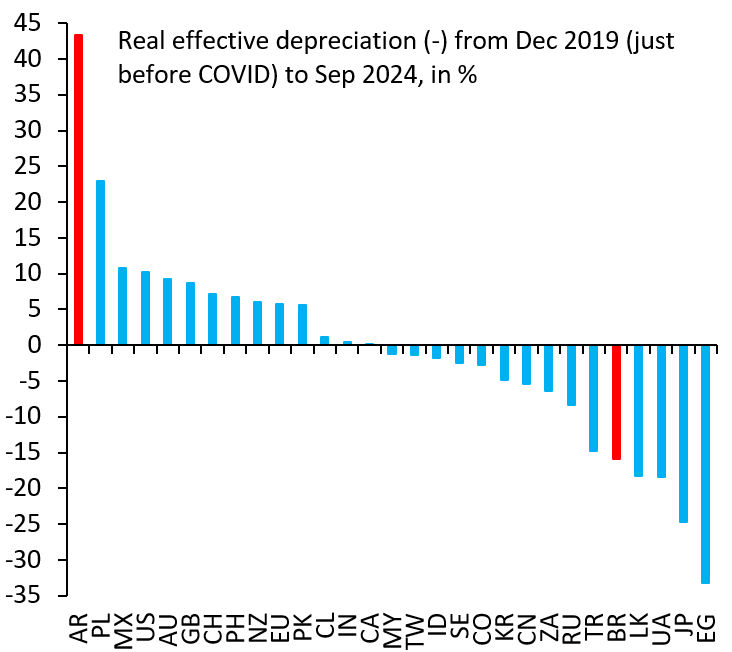
In real effective terms, Argentina's Peso is the strongest currency globally since COVID, while the Brazilian Real - right next door - is one of the weakest. This divergence is unsustainable and obviously has to end with another large devaluation for the Argentinian Peso...
El QQQ tocó 500 redondo hoy. Puede seguir impunemente al alza sin una corrección aunque sea leve? No me dan las estructuras, ni las magnitudes, ni el tiempo como para negar la posibilidad. Si cae, caerá todo lo que existe en el mundo con excepción de los bonos yankees. Hoy es de esos días en que invoco dos clásicos: 1) nadie se fundió por realizar ganancias; 2) lo que queda, que se lo gane otro. Si falla la caída, no hay drama en entrar más arriba.
La estafa de campaña fue grave porque no solo que se la creyó la mitad de los votantes de Milei sino los propios propagandistas de las redes que tienen normalmente un poco más de información. Pero no hubo caso, no pudieron entender que la desmonetización del peso costaba 150.000 millones de dólares que los debía conseguir Milei endeudando todavía más al estado argentino, o sea a nosotros. Y que por más de que fueras como cipayo a pedirle a Washington no te iban a ayudar porque ellos son los primeros contrarios a que un país dolarice. Y sobre Ocampo, yo les avisé que no tenía ni puta idea de lo que decía y que el libro ese era una joda.
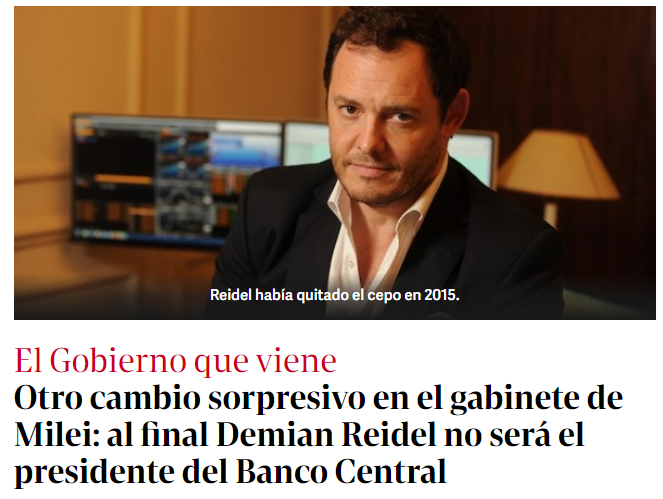
Reventado antes de asumir. Este sujeto, Reidel, es un econometrista de ideología comunista que en el gobierno fracasado de Macri se dedicaba a calcular la tasa de interés del BCRA para que dólar e inflación no se "escaparan". A este delirante quiso llevar Milei, tras Ocampo.