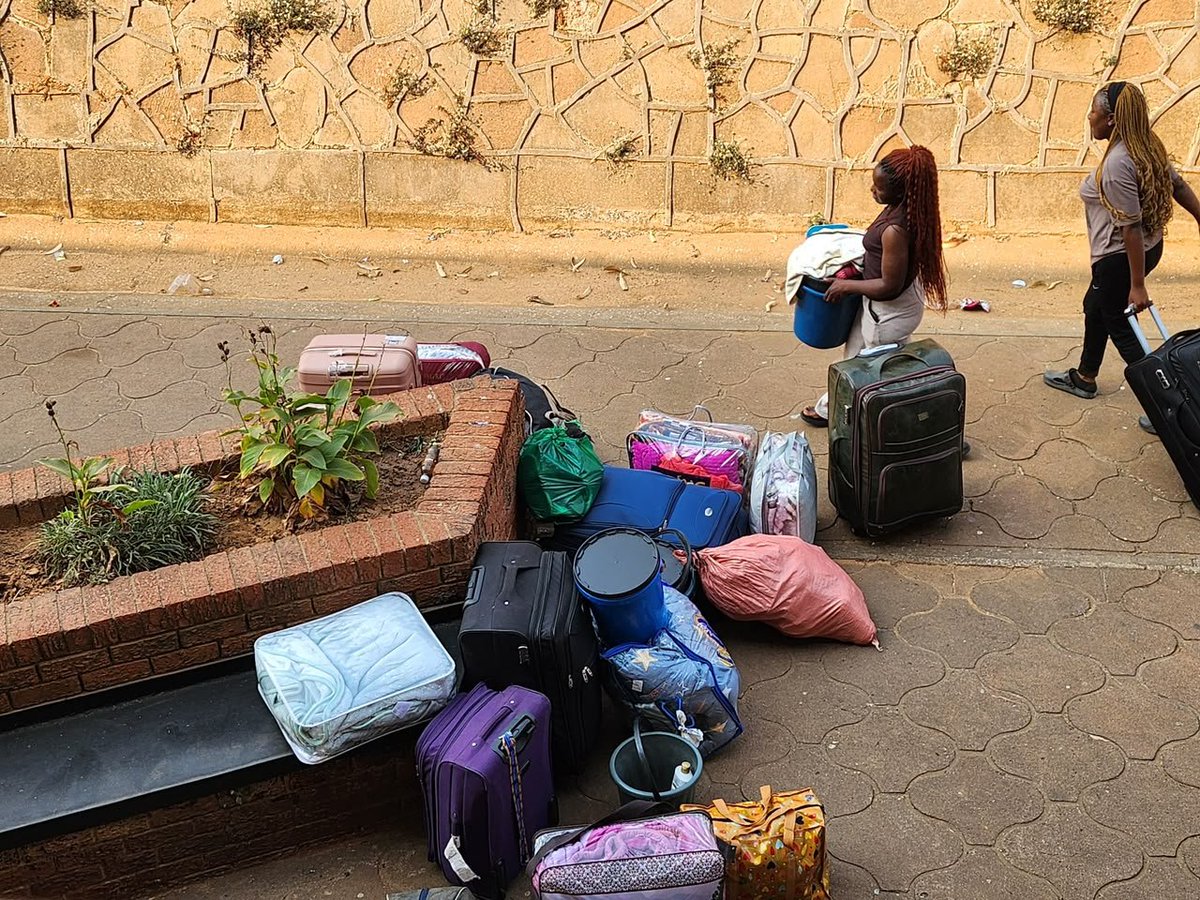
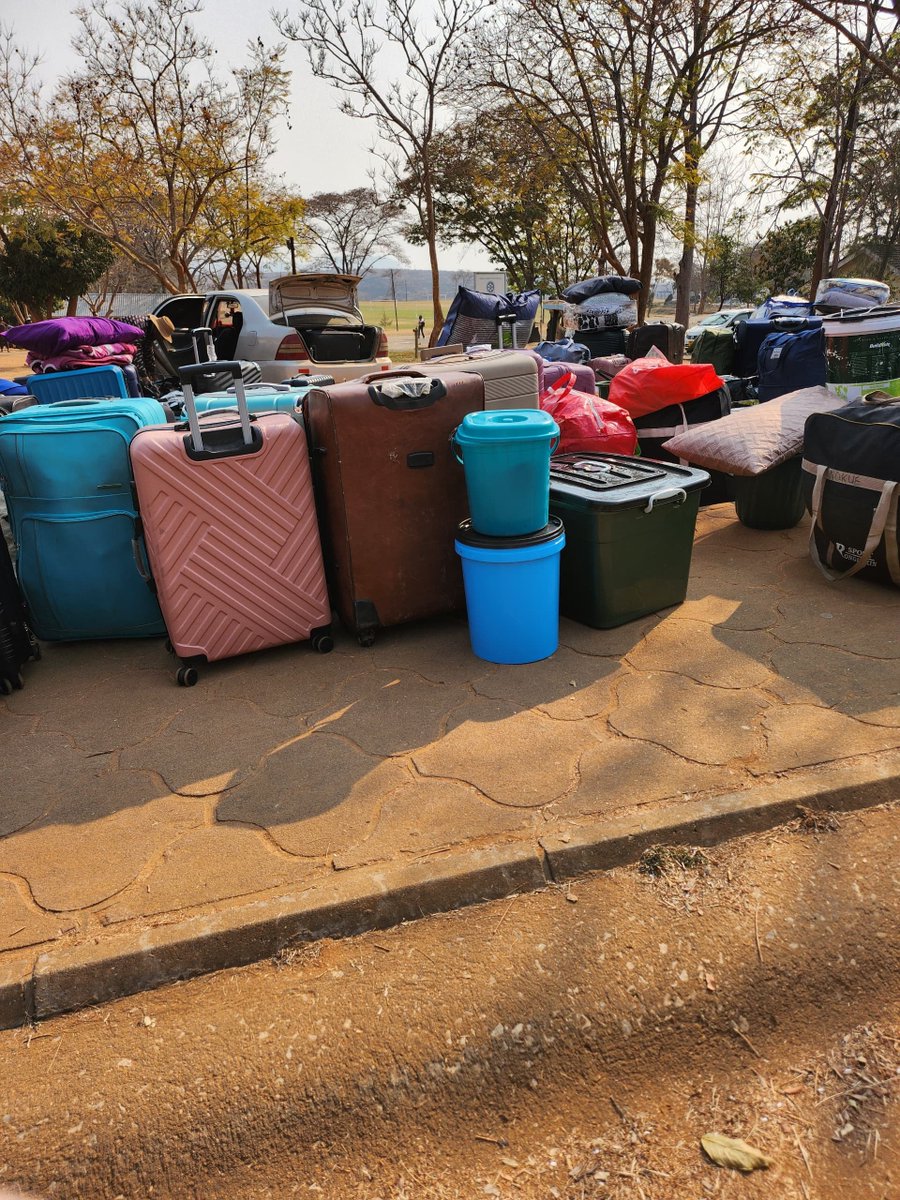
1/2. When we speak out against the university administration's bad decisions, people accuse us of just being against everything. But this video proves our point: students are truly suffering. Look at this stampede just to catch a bus for supper from CUT campus to Chinhoyi High.
These questions do not weaken institutions or politics.
They make them more democratic.
Conclusion
Strong institutions are not institutions that make people feel powerless.
Strong institutions are capable of exercising authority while remaining accountable to the people they serve.
Strong political leadership is not leadership that simply commands crowds or collects votes.
It is leadership that recognises citizens as human beings with dignity, voices, rights and agency.
People are not procedures.
People are not files.
People are not numbers.
People are not political currency.
People are not votes.
Behind every procedure is a human being.
Behind every political statistic is a human life.
Behind every vote is a citizen.
Let us enforce the law. Let us follow proper procedures. Let us exercise political responsibility. Let us demand accountability. But above all, let us never forget the person standing before us.
Enforce the law. Protect dignity. Respect the citizen. Serve the human being.
— Civic Engagement Forum of Zimbabwe (CEFZ)
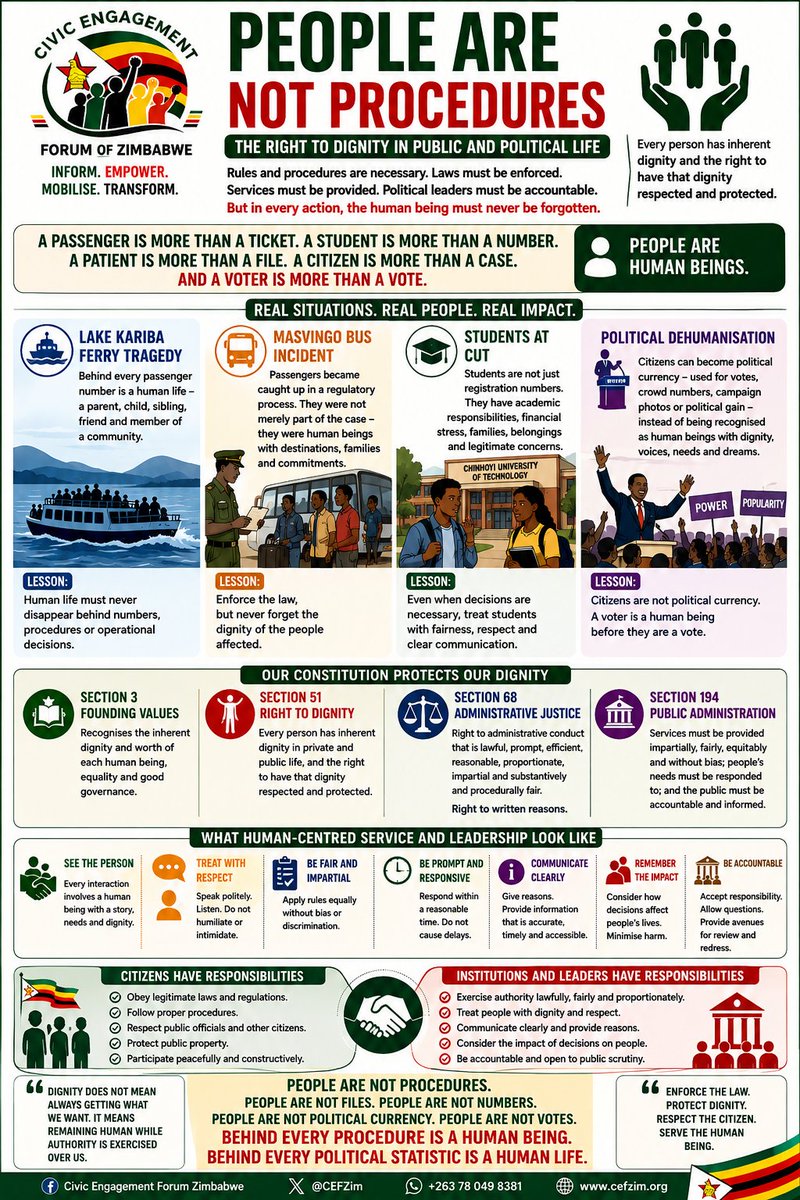
PEOPLE ARE NOT PROCEDURES
The Right to Dignity in Public and Political Life
The Civic Engagement Forum of Zimbabwe (CEFZ) calls for renewed attention to the way institutions and political actors interact with the people they are supposed to serve.
Rules and procedures are necessary for a functioning society. Institutions must enforce laws, maintain standards and protect the public. Political leaders have legitimate roles in mobilising citizens and seeking political mandates. But in exercising authority or seeking power, there is a danger that the human being can disappear behind the system.
A passenger becomes a ticket.
A student becomes a registration number.
A patient becomes a file.
A citizen becomes a case.
And a voter becomes a vote.
People are more than these labels.
The Right to Dignity
This is not merely a question of courtesy. Human dignity is a constitutional value and a constitutional right in Zimbabwe.
Section 3 of the Constitution recognises the inherent dignity and worth of each human being as a founding value. Section 51 provides that every person has inherent dignity in both private and public life and the right to have that dignity respected and protected.
Section 68 further provides a right to administrative justice, including lawful, prompt, efficient, reasonable, proportionate, impartial and substantively and procedurally fair administrative conduct. Section 194 establishes principles for public administration, including fairness, impartiality, responsiveness to people's needs, accountability and the provision of accessible and accurate information.
These principles matter because institutional decisions have human consequences.
When Institutions Forget the Person
The Lake Kariba ferry tragedy is a painful reminder of the importance of placing human life at the centre of institutional responsibility. Behind every passenger number is a human life—a parent, child, sibling, friend and member of a community.
The circumstances surrounding the disaster raise serious questions about safety, oversight and responsibility. Those questions must be properly investigated. But the broader civic lesson is clear:
Human life must never disappear behind numbers, procedures or operational decisions.
The same principle applies when regulatory authorities intervene in the movement of people. In the reported Masvingo incident involving a bus travelling from South Africa, passengers became caught up in a regulatory and customs process concerning the vehicle and goods being transported.
Authorities have legitimate responsibilities to enforce the law. But the passengers were not simply extensions of the vehicle or the matter under investigation. They were human beings with destinations, families, commitments and individual circumstances.
Enforcement of the law should never require forgetting the dignity of the people affected by it.
The experience of students affected by institutional decisions at Chinhoyi University of Technology raises another dimension of the same question. Students are not merely numbers within an administrative system. They are young people with academic responsibilities, financial circumstances, transport arrangements, personal belongings and legitimate concerns about their wellbeing.
Even where an institution has legitimate reasons for making a decision, the human consequences should be considered and communicated fairly.
The same principle applies across our institutions.
A patient entering a hospital may become a file number, yet behind that file is a person who may be frightened, vulnerable or in pain.
A citizen entering a government office may become an application number, yet behind that application is someone trying to access a service or exercise a right.
A person interacting with law enforcement may be a suspect, complainant or witness, but their legal status does not erase their humanity.
The issue is therefore not whether institutions should have rules.
They should.
The issue is whether those rules are applied in a manner that respects the dignity and rights of the people affected.
A person can be told "no" without being humiliated.
A vehicle can be lawfully detained without treating innocent passengers as objects.
A student can be required to comply with an institutional decision while still being heard and treated fairly.
A citizen can be denied an application while still receiving a reasonable explanation.
Dignity does not mean always getting what we want. It means remaining human while authority is being exercised over us.
Political Dehumanisation
But dehumanisation is not limited to bureaucracy or public administration.
It can also occur in politics.
Citizens can become political currency when politicians value people primarily for what they can provide to political power—votes, numbers at rallies, campaign support, public legitimacy, financial contributions or political mobilisation—rather than recognising them as human beings with their own dignity, aspirations and agency.
A struggling community can become a campaign opportunity.
A grieving family can become a political photograph.
A crowd can become a statistic demonstrating popularity.
A young person can become a vote to be mobilised rather than a citizen whose future deserves investment.
This is another way of reducing people to objects.
Political mobilisation is an important part of democracy. Citizens have every right to organise, campaign and support political movements. The problem arises when the person disappears behind the political purpose.
Political leaders may speak for people without listening to them, mobilise communities without empowering them, and seek votes without creating meaningful opportunities for citizens to hold them accountable afterwards.
A citizen should never be valued only because they can provide a vote.
A voter is a human being before they are a vote.
Citizens are not political currency. They are participants in the political life of their country.
Hunhu/Ubuntu
This is where Hunhu/Ubuntu becomes more than a cultural expression.
Our philosophy reminds us to recognise the humanity of others. Our Constitution gives that principle legal expression through dignity, equality, fair administration and responsible public administration.
Whether we are dealing with a government official, a university administrator, a police officer, a politician, a student, a passenger or an ordinary citizen, the fundamental principle remains the same:
The other person is human.
That recognition should influence how power is exercised.
Responsibility Must Operate on Both Sides
As Zimbabwe moves into a new phase of civic education focused on Civic Discipline and Responsible Participation, CEFZ believes responsibility must operate on both sides.
Citizens have responsibilities: to obey legitimate laws, follow proper procedures, respect public officials, protect public property and participate peacefully.
Institutions also have responsibilities: to exercise authority lawfully, fairly, proportionately and transparently; to communicate with the people they serve; to consider the consequences of their decisions; and to respect human dignity.
Political leaders have responsibilities too: to treat citizens as participants rather than instruments, to listen to communities, to respect their agency and to remain accountable beyond election campaigns.
Civic discipline cannot be a one-way demand placed upon citizens.
The Four Questions
CEFZ therefore calls for a culture of human-centred public service and responsible political engagement.
Before an institution or political actor makes a decision that significantly affects people, four questions should be considered:
What is the rule or responsibility?
Why is the action necessary?
Who will be affected?
How can it be done while protecting human dignity and respecting the agency of the people involved?
URGENT ALERT 🚨
We are receiving reports that students are being evicted from university residences at Chinhoyi University of Technology.
This directly disrupts the right to education.
Beyond the academic impact, it imposes an undue financial burden on affected students who have now been reportedly relocated several kilometers away from campus.
The AVAILABILITY of adequate accomodation in tertiary institutions remains a key challenge and the government must prioritize ensuring accommodation for all students.
We call on the Chinhoyi University of Technology to immediately officially engage all affected students, put in place mechanisms to assure their access to campus facilities and services and make clear when they are to resolve this inconvenience.
#TransformEducation
#IkuguqulaImfundo
#KushanduraDzidzo
🇿🇼 CEFZ DEFENCE FORCES DAY MESSAGE
Honouring Those Who Serve and Protect Zimbabwe
Today, the Civic Engagement Forum of Zimbabwe (CEFZ) joins Zimbabweans at home and abroad in honouring the men and women of the Zimbabwe Defence Forces.
We remember the sacrifices of those who came before us during the Liberation Struggle and recognise those who continue to serve Zimbabwe today.
Our Defence Forces are a national institution entrusted with protecting Zimbabwe, its people, national security, sovereignty and territorial integrity.
We also recognise the many ways in which members of the Defence Forces contribute to our communities and national life—from disaster response and humanitarian assistance to health interventions, environmental protection, infrastructure development and supporting communities during times of national need.
These contributions remind us that national security is ultimately about the security and wellbeing of the people.
Zimbabwe needs its Defence Forces more than ever—not as an instrument of political interests, but as a professional, disciplined and national institution serving the people of Zimbabwe.
CEFZ believes that protecting the constitutional and professional character of our Defence Forces helps ensure that they remain focused on their national responsibilities and continue to be a source of security, stability and confidence for our communities.
Today, we honour those who served before us, those serving today, and the families who support them.
To the men and women who serve Zimbabwe: thank you for your service, your sacrifice and your commitment to our nation.
🇿🇼 Happy Defence Forces Day, Zimbabwe.
Civic Engagement Forum of Zimbabwe (CEFZ)
Inform. Empower. Mobilise. Transform.