Did you know strategy works on multiple levels?
Corporate, business, functional, and operational.
Every leader needs to understand them.
Strategies can be simple or complex - just like your business.
But whether you run a startup or a giant company,
The basic principles of strategy always apply.
The 4 Levels of Strategy:
1. Corporate Level
Sets the overall direction and long-term vision.
Created by top leadership.
Plans where the organization should operate over 3–5 years.
2. Business Level
Focuses on individual business units.
Aims to gain competitive advantage in target markets.
Decisions include differentiation or cost leadership.
3. Functional Level
Tailors strategy for departments.
Aligns departmental work with overall goals.
Solves unique challenges in each area.
4. Operational Level
Deals with daily execution.
Turns plans into actions and measurable results.
Focuses on short-term goals, resource allocation, and projects.
Good strategy doesn’t guarantee success.
But it’s where everything begins.
Understand all levels.
Pay attention to each one.
P.S. Are you focusing enough on every level of strategy?
♻️ Repost to help your network strengthen their strategy at all levels!
----
📌 Get my top 100 infographics for free:
1) Follow me.
2) Subscribe to my free newsletter at https://t.co/jTnaNRbsRL.
You’ll receive them directly in your welcome email.
360 years.
That is collective Excel experience of my team of 30 people, in one room.
I have personally used Excel for 20 years. Since the very beginning.
We’ve spent decades "crushing it" when it comes to financial modeling.
We knew every shortcut. Every nested formula. We thought we had reached the peak of efficiency. (They are better then me, just to admit)
But I have something to tell you.
The game just changed.
In my opinion, we are witnessing the biggest innovation since Excel was first released. It’s not a new function or a Power BI update.
It’s Claude.
Specifically, Claude’s ability to build and manipulate Excel models.
For 40 years, the "manual labor" was the tax we paid.
Hardcoding formulas.
Spending hours formatting cells.
Manually linking sheets and building tables from scratch.
That era is over.
Claude can now handle the heavy lifting of building the structure, the logic, and the formatting in minutes.
But here is the part that really surprised me: It actually understands accounting.
It understands the relationship between a Balance Sheet and a Cash Flow statement. It understands how operating drivers flow into a P&L.
We aren't replacing our expertise. We are finally liberating it.
Instead of spending 80% of our time building the model, we spend 100% of our time analyzing the results.
If you want this Prompt and Excel model, just drop a comment and I’ll send it to you.
(Important: follow me so I can DM you!)
AI skills will be crucial for years to come.
Knowing how to use ChatGPT isn’t enough.
Learn these AI skills to future-proof your career:
1. Prompt Engineering:
Write better instructions to help AI tools give you exactly what you need.
2. AI Workflow Automation:
Link different apps together to help you complete tasks automatically.
3. AI Agents:
Use AI systems that act like teammates to handle tasks together.
4. Retrieval Augmented Generation (RAG):
Link AI chatbots to your private files for accurate answers.
5. Multimodal AI:
Use AI that understands pictures, sounds, and text all at once.
6. Fine-Tuning and AI Assistants:
Build custom AI models or assistants tailored to your needs.
7. Voice AI and Avatars:
Make realistic AI voices and avatars for videos and presentations.
8. AI Tool Stacking:
Use tools like Notion, Zapier, and ChatGPT together to work faster.
9. AI Video Content Generation:
Turn your ideas or blog posts into professional videos using AI.
10. SaaS Development:
Build small AI-powered apps using no-code tools.
11. LLM Management:
Keep track of how well your AI tools are working and their costs.
12. Stay Updated:
Follow top AI news sites to keep up with trends and new tools.
AI won’t replace you.
But someone with AI skills might.
How aligned is your leadership team on the North Star?
Sharing great insight from Timothy Tiryaki:
I often use a simple 2×2 model to explain how organizations stay aligned.
Four elements must work together:
Strategy. Culture. People. Operations.
Here is how they connect.
1. Strategy and operations
Without strategy, operations become chaotic.
Without operations, strategy stays on paper.
2. Strategy and culture
Strategy gives direction.
Culture gives energy.
One without the other does not work.
3. Culture and people
Culture connects people.
But without people, culture does not exist.
4. People and operations
People turn plans into execution.
Operations depend on them.
So what aligns all four?
Leadership.
The leadership team connects strategy, culture, people, and operations.
But many leadership teams are not truly aligned"
They operate in silos.
They represent departments instead of the whole organization.
That approach no longer works.
In the AI era, transformation affects the entire system:
Every team.
Business model.
Operating model.
That is why the North Star matters.
A clear North Star creates alignment.
Alignment builds trust.
Trust enables collaboration.
But many leaders make one mistake.
They confuse their personal North Star with the organization’s North Star.
That creates risk.
Strong leaders know the difference.
Personal values matter.
But they must serve the organization.
One part cannot act as the whole system.
Real leadership means seeing the full picture.
Individuals. Teams. Business units.
And the entire organization.
P.S. What is your North Star?
♻️ Share this so more people get it right!
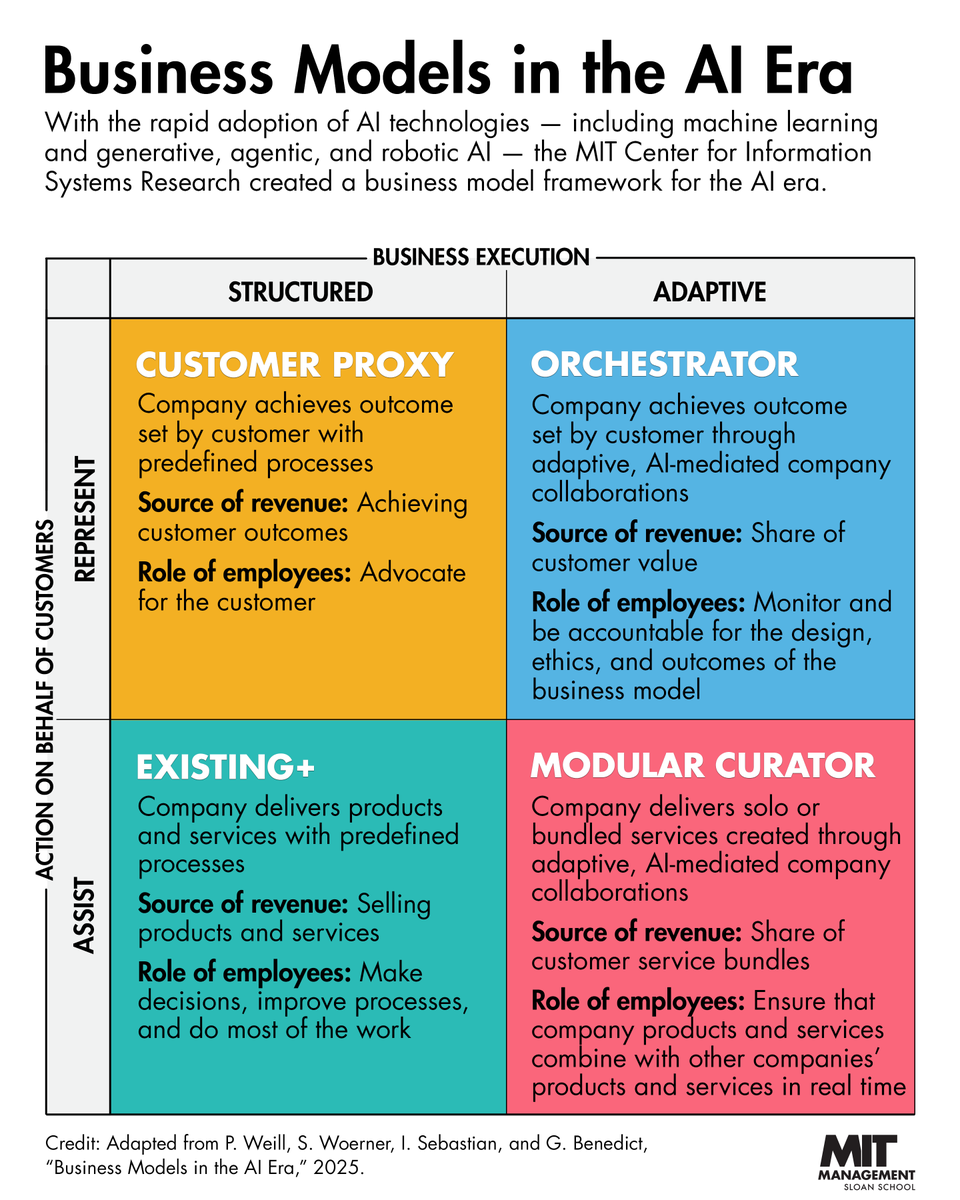
With the rapid adoption of AI technologies, the MIT Center for Information Systems Research created a business model framework for the AI era that shows businesses evolving to become increasingly outcome oriented and enabled by autonomous AI.
Learn more: https://t.co/53myL2gdSA