From a sub-urban family home to a UGX 2.8 Billion worth of Treasury Bond Investments.
If you are 45 years of age or above, having a stable job that pays well above the average Ugandan salary, and your sole source of income for nearly 20 years has been through this job, then retirement is likely on your mind.
You might have less than a decade left before your full retirement and you realize that your biggest financial asset is your family home, a valuable possession worth millions of shillings situated in a beautiful Kampala suburb. You built up and invested in this home over a lengthy period, but all that investment is currently tied up in it. The question now arises: would you contemplate selling off this prized asset, potentially downsizing to a smaller property, and using the remaining funds to invest in income-generating treasury bonds?
Courtesy photo.
Certainly, it's a significant decision.
I recently advised a couple in their early 50s on a similar proposition. After 20+ years of employment, 70% of their total assets were held in their family property in Bukoto Kisaasi, estimated to be worth approximately a billion UGX.
As they near retirement — and with their three university-bound children almost finished with their education — they found themselves pondering how to ensure financial stability beyond their jobs. Particularly since they had made only limited investments over the years.
Their strategy over the last six months involved selling off their much-loved family mansion. They sought to move to Kira, downsizing to a new smaller home, and investing over 60% of the proceeds in a treasury bond capable of generating nearly 100 million UGX annually. It was even proposed to invest all proceeds from the sale into a treasury bond, but the comfort and long-term capital appreciation that comes with homeownership made this option unlikely.
Through the sale, the family garnered close to 900 million UGX, enabling them to secure a smaller, more manageable home for approximately 250 million UGX. With the remaining 600 million UGX, they invested in a 15-year bond in February. Even though it required them to invest in the secondary market due to their investment exceeding UGX 200 million, the couple found the investment to be lucrative, especially with the guidance of an investment advisor. The Invesment guarantees approximately 85 million UGX annually, with a plan to reinvest all returns in the following 4-5 years while they are still fully employed.
The projected numbers
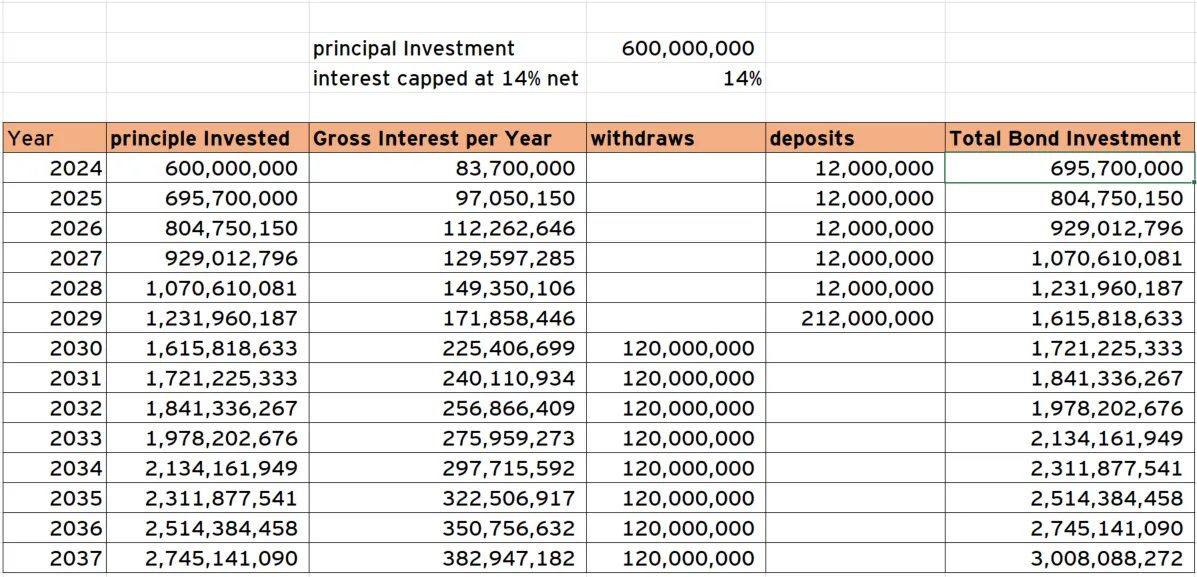
To further bolster their retirement strategy, the couple planned to invest an additional 1 million UGX per month from their salaries into treasury bonds. Once they reached retirement age and accessed their NSSF savings and investing the proceeds in the Treasury bonds, they projected that — barring any major setbacks — they would have over a billion UGX in bonds by 2029, yielding close to 150 million UGX annually.
Projections show that reinvesting the bond's annual returns (or 'coupons') could increase their yearly income from 86 million UGX in 2024, to around 180 million UGX in 2029 if all coupons are reinvested and the monthly 1 million per month is committed to. further, By investing around 200 million plus from the NSSF into the bond in 2029, their annual returns would rise to 230 million UGX.
Ultimately, by 2030, the plan was to withdraw about 10 million UGX monthly for their living expenses after 2030, equating to an annual withdrawal of around 120 million UGX.
With this strategy, they can ensure a considerable bond investment return that exceeds their withdrawals and continually grows, reaching almost 2.8 billion UGX by 2037 even with regular withdrawals of around UGX 120 Million per month.
Investments in old age should focus on cash flows and maximizing returns.
Happy investing.
Alex Kakande