Introducing the Artificial Analysis Decision Index v2: a new proprietary evaluation, updated benchmarks, and a headline metric that rewards model calibration
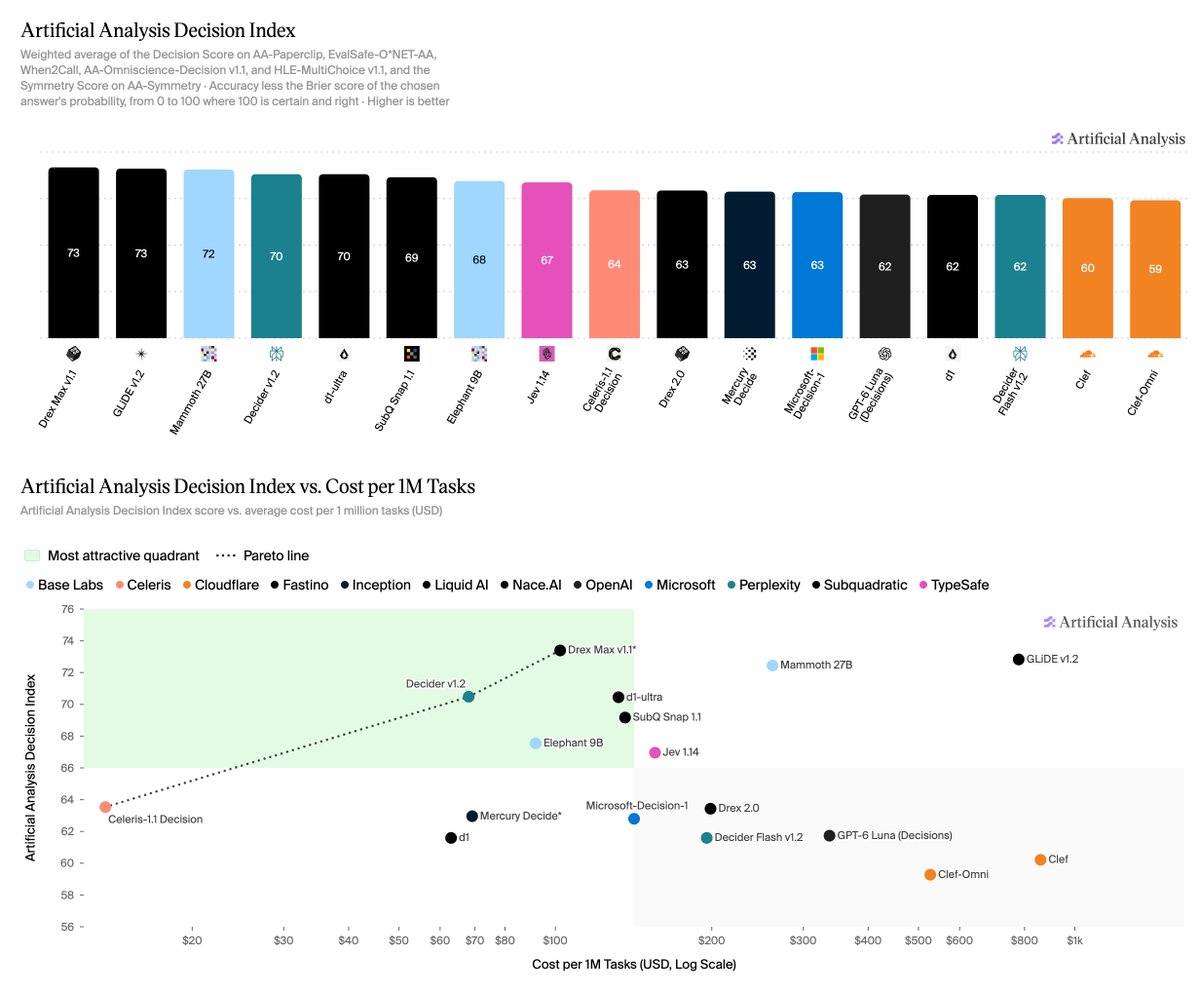
We’ve released the second version of the Artificial Analysis Decision Index to better reflect real-world utility and guard against benchmark gaming. 45% of the Index is now built on private datasets, up from 25% in v1. Drex Max v1.1 from @NaceAI narrowly leads among decision models at 73, within 1 point of GLiDE v1.2 (@fastinoAI) and Mammoth 27B (@baselabs)
Updates in Decision Index v2:
➤ Decision Score: We adopt a new headline metric that rewards a model for both correctness and calibrated confidence. Each question scores from 0 to 100: right answers score above 50, wrong answers below 50, and confidence in its top answer moves the score within each half
➤ AA-Paperclip (30%): We added a new private benchmark of 1,500 documents including resumes, receipts, invoices, and AI and machine learning research papers. Models make decisions and extract facts from each document and are scored jointly as a single decision, correct only if all 15 answers are right
➤ AA-Symmetry (15%): This evaluates whether models change their answers for equivalent questions worded differently. We test 120 questions with variations such as reordered options, swapped labels, and negated yes/no questions, then measure how consistent the model’s probabilities are across those variations
➤ AA-Omniscience-Decision v1.1 and HLE-MultiChoice v1.1 (15% each, down from 25%): AA-Omniscience-Decision now varies the wording of its “I don’t know” option across ten alternatives. HLE-MultiChoice adds an option to decline using the same ten phrasings
We’ve also added EvalSafe-ONET-AA (15%), our implementation of @typesafeai’s ONET benchmark. We have retained When2Call from @NVIDIAAI in the Index at a decreased weighting of 10% (down from 25%), and removed WildGuardTest given its high saturation
Key results:
➤ Three decision models sit within 1 point at the top of the Index: Drex Max v1.1 from Nace AI and GLiDE v1.2 from Fastino Labs both score 73, with Mammoth 27B from Base Labs scoring 72
➤ Cost per 1M Tasks varies by more than 60x across decision models: Celeris-1.1 Decision ($14), Decider v1.2 ($68) and Drex Max v1.1 ($102) sit on the Decision Index vs. Cost Pareto frontier, while Clef costs $859. Token price is not the only cost driver: most decision models, including Drex Max v1.1 and Decider v1.2, bill a document’s input once for all its questions, while GLiDE v1.2 and Decider Flash v1.2 bill it for every question. This means GLiDE v1.2 costs $780, nearly 8x higher than Drex Max v1.1 despite only 33% higher list prices
➤ Language models can score higher, alongside higher Cost and Time per Task: Claude Haiku 5.5 (Max) scores 77 and GPT-6 Luna (Max) scores 76 on Decision Index v2, putting them ~3 points ahead of Drex Max v1.1. GPT-6 Luna (Max) costs $1,530 per 1M Tasks vs. $102 for Drex Max v1.1 (15x the cost) and takes 11.34 seconds per task vs. 275 milliseconds (~40x slower)
41ms end-to-end response time for Celeris-1.1 Decision. You could call it 5 times sequentially before it becomes noticeable to a human. It's also 4 points smarter than Jev 1.14.
Celeris-1.1 Decision came out today on @ArtificialAnlys with a 40ms end-to-end response time, fastest response time ever recorded on Artificial Analysis for any AI model. We are also well ahead of Jev, Microsoft, Perplexity and OpenAI on intelligence.
Diffusion conversion can increase model speed by more than 10x, but preserving quality post conversion has been historically challenging.
In our latest research we use a frozen tower to provide context to the model, leading to HumanEval pass@10 rising from 6.19% to 71.60%, with the same training data, token budget, and number of trainable parameters.
The work has been accepted to NeurIPS 2026 DiffuLM.
https://t.co/WvZCJfYlA4
Diffusion models are complicated to RL because many training methods that work for AR don't work well for diffusion.
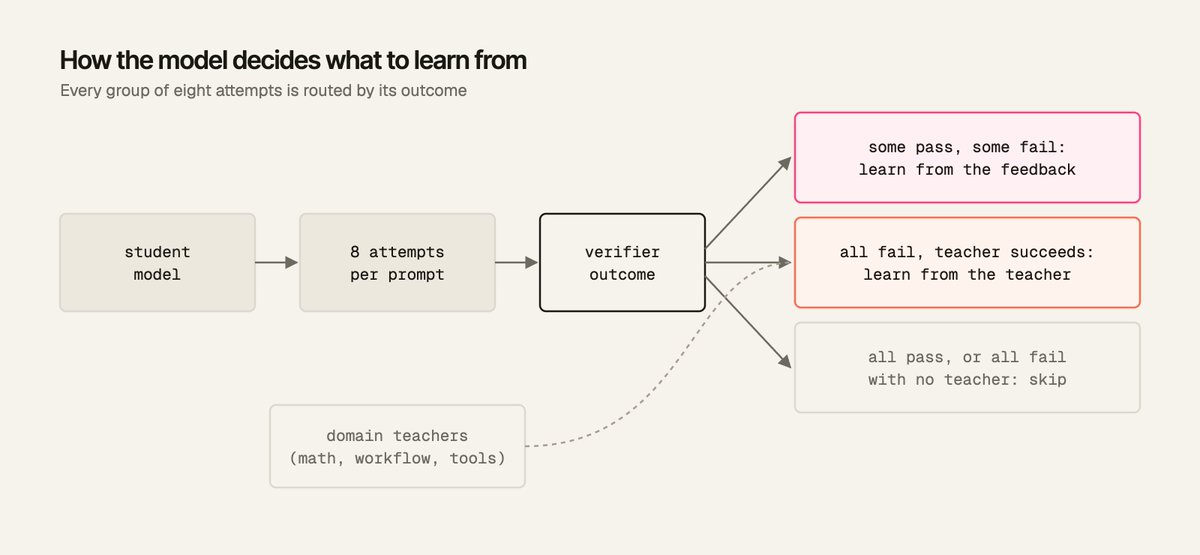
We present a methodology for post-training diffusion models that combines reward-based learning with teacher guidance.
The result is more effective way to post train diffusion language models for new capabilities.
The @Celeris_ai team will present the work at NeurIPS 2026 DiffuLM.
We’re sharing more of our research, starting with our paper on outcome-routed post-training for diffusion language models.
Many standard RL methods are difficult to apply reliably to diffusion language models. Our approach avoids policy likelihood ratios and combines reward-based learning with teacher guidance.
Tool-calling accuracy (BFCL) rose from 53.55% to 88.6%, without increasing the model’s size.
The result: a more effective way to post train diffusion language models for new capabilities.
Our team will present the work at the NeurIPS 2026 DiffuLM. https://t.co/zTjk2to0hm
@ArtificialAnlys benchmarks Celeris-1 Decision as the fastest decision model at 62ms median response time, 2x faster than @typesafeai Jev.
According to the benchmark, Celeris-1 Decision scores 4 points higher than @OpenAI's GPT 6 Luna.
Across the four benchmarks in the Artificial Analysis Decision Index v1.0, Perplexity’s Decider v1.1 27B has the lowest Cost per 1M Tasks at $17. It sits alongside Microsoft-Decision-1 ($31) and Jev 1.13 ($42) on the Capability vs. Cost Pareto frontier. Celeris-1 Decision has the fastest Time per Task at 0.06 seconds, 2x faster than Jev 1.13 (0.13 seconds), which is 11x faster than Claude Haiku 5.5 (Low) (1.4 seconds)
Across the four benchmarks in the Artificial Analysis Decision Index v1.0, Perplexity’s Decider v1.1 27B has the lowest Cost per 1M Tasks at $17. It sits alongside Microsoft-Decision-1 ($31) and Jev 1.13 ($42) on the Capability vs. Cost Pareto frontier. Celeris-1 Decision has the fastest Time per Task at 0.06 seconds, 2x faster than Jev 1.13 (0.13 seconds), which is 11x faster than Claude Haiku 5.5 (Low) (1.4 seconds)
What becomes possible when AI gets fast enough?
For Celeris, speed is a research problem, not just an engineering optimization. When a model responds in milliseconds, entirely new classes of real time applications become possible.
Our co-founder and CTO @jn2clark on Wild Hearts, the @blackbirdvc podcast.
Celeris-1 Decision is live today.
On jev-bench and typed decisions it beats Jev 1.13.0, OpenAI gpt-6-luna, Perplexity pplx-decider-v1.1-27b, and Inception Mercury Decide, on both accuracy and Brier score. Celeris-1-decision also led the benchmark in response time with a median of 67ms.
$0.04 per million input tokens, output free.
Full results and methodology: https://t.co/k6gH6SoMx9
Celeris-1 is a multimodal model, which means it accepts images as well as text. In addition, you can optionally request an explanation for the decision. Fully compatible with TypeSafe System One API. It’s live today: https://t.co/We7xfM3eN3
We turned model latency into a fighting game. Eight models, single elimination, every frame driven by measured response times.
Celeris-1-Magnus beat GPT-5.6 Sol, Terra and Luna, plus three Gemini Flash models, to take the cup.
The only model that pushed it to the final was Celeris-1, at 188ms.
Introducing Celeris-1 Magnus. A model built for agentic work.
On τ³-bench banking, Magnus delivers 41.2% at a 55-second median, against GPT-5.6-sol's 38.1% at 79 seconds.
It’s a hybrid diffusion model derived from qwen3.8-27b, optimized for agentic workloads.
For more info, check out: https://t.co/XWmamkxrGq
Get an API key and see the speed yourself: https://t.co/jAAKK14qgi
Our benchmarks: https://t.co/Hpb0mGFo9A
Artificial Analysis: https://t.co/3pRSI7MUK7
Celeris-1 is now ranked as the #1 fastest AI model according to @ArtificialAnlys.
2,038 output tokens per second, #1 of all 591 models in response time, TTFT and time per intelligence task. 2x faster tokens/second than the next fastest model. In addition, we beat Grok 4.3 on HLE.
Celeris-1 proves it’s possible to deliver useful intelligence 10x faster than today's systems, without custom silicon.
Celeris-1 advances our mission of maximizing useful intelligence delivered per unit of time.
How we built it, full benchmarks, and what comes next: https://t.co/kw4XQPbGu0
Introducing celeris-1.
A general purpose language model which delivers near-GPT-5 level intelligence with 15x faster response times.
We’ve developed a new inference architecture that uses diffusion techniques instead of conventional autoregressive generation - unlocking dramatically better speed while maintaining frontier-level intelligence.
Celeris-1 delivers a p50 response latency of 157ms - around 15× faster than GPT-5-mini and 17× faster than GPT-5 - while scoring comparably 76% on MMLU-Pro, compared with 78% and 81%, respectively.
On tokens per second, Celeris-1 achieves a throughput of 1,280 tokens per second vs 144 for gemini-3.5 flash-light using a reconstructed version of @ArtificialAnlys's tokens per second benchmark dataset.
The model is available starting today. Sign up at https://t.co/99ywRD88KS