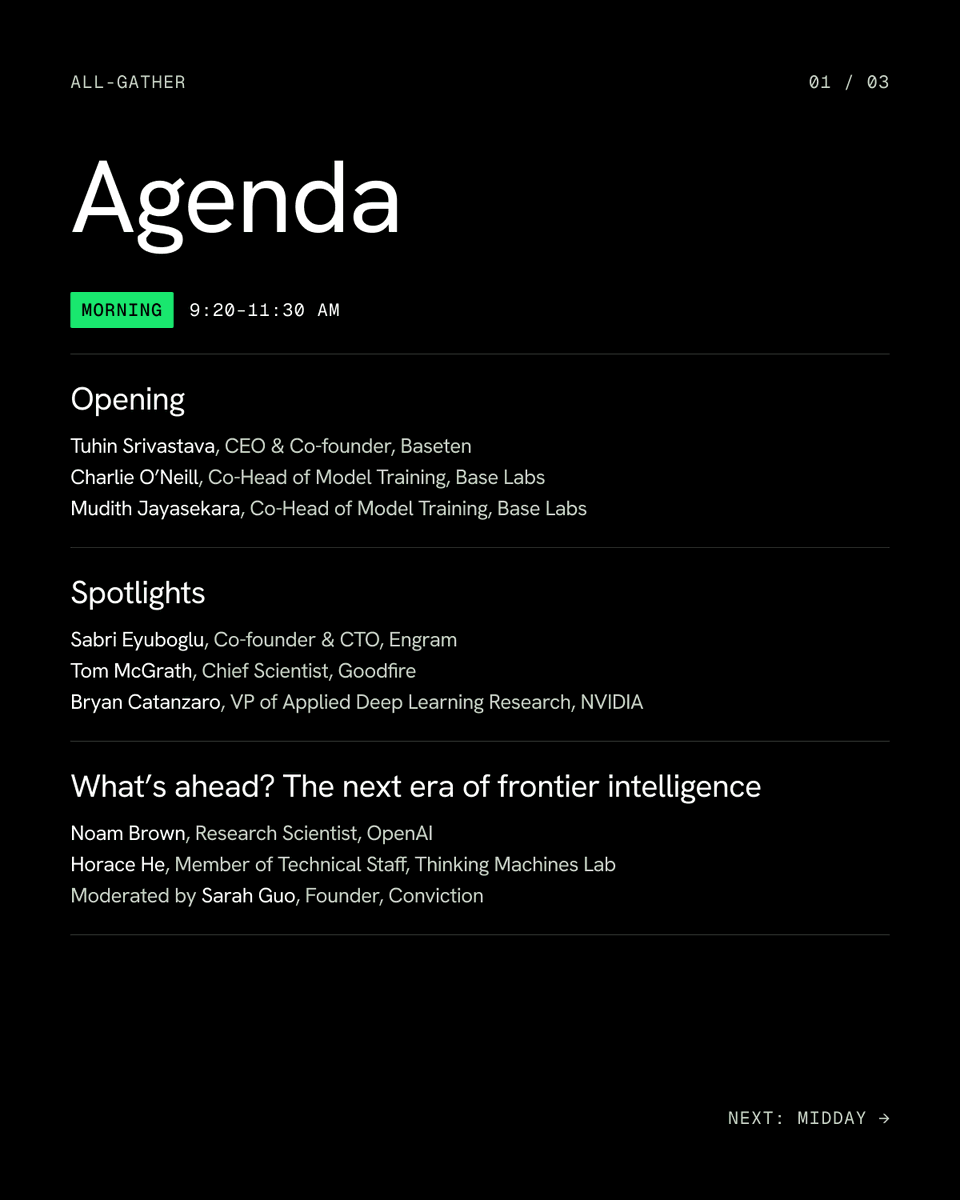
We're excited to share the agenda for our first research conference, All-Gather, taking place next Wednesday November 18 at the Exploratorium.
The age of research is here and we will hear from the scientists shaping the field across frontier labs of all sizes in @markchen90@polynoamial@bneyshabur@OriolVinyalsML@MillionInt@cHHillee@silasalberti@chrmanning
See here for more: https://t.co/KF0s4TsH8v
The full All-Gather agenda is live.
One day at the Exploratorium with Noam Brown, Oriol Vinyals, Chris Manning, Mark Chen, and more, across research spotlights, chalk talks, firesides, and a panel on building research labs today.
Nov 18 in San Francisco. See the full speaker list: https://t.co/xaJ2d1EGez
Baseten runs 9B and 27B - our secrets:
- we trained the models to only need a single inference pass per state, and not one prefill-step per question (e.g. perplexity flash v1.2 can be 30x more expensive)
- we politely asked codex to make the inference faster, make no mistakes. Worked quite well, acoording to AA. https://t.co/ildij4OztX
OPSD and related variants have been popular areas of post-training research in 2026.
Whilst the original papers were commendable work with respect to on-policy learning and the dense feedback they provided, we should treat the bias that a hinted teacher injects as incongruent with long-horizon continual learning.
This week we unpack some of the literature, alongside our own attempted fixes and observations to understand why this is the case.
For this week's Rollout, we dig deeper into a resurging question: is it computationally worth it to learn a value function in RL, or is it better to use that compute on more rollouts?
We found it fun to dig into the literature (including of some recent ICLR submissions...) to write this up.
Overall, we find that learned value functions remain hard to justify computationally over pure group reward-based methods, although they can provide some uplift in cheaper, targeted value prediction tasks.
We're releasing joey-1, our smallest and fastest decision model and the best 2B model in its class.
We trained joey-1 using the same data mixture and approach used to train elephant-1 and mammoth-1 and are, as always, open sourcing the weights on Hugging Face.
On @baseten Model APIs, we're serving joey-1 at $0.01 per million tokens, a tenth of the mammoth-1 price.
Today we’re releasing our third open-source decision model, joey-1 (2B), the fastest decision model available and among the most intelligent decision models of its size.
joey-1 is trained by the @baselabs team, and is available on our Model APIs, as a dedicated deployment, and with a cookbook to fine-tune on our Training Jobs.
joey-1 is built to maximize speed and minimize cost without sacrificing intelligence for those workloads where TTFT really matters.
Jump on it: https://t.co/eraAN1PC3B
If we wish to train frontier open-source models, we need to aggregate data as well as compute. This aggregation relies on high quality RL environments.
Building good RL environments is a science, and at @baseten our Applied Research team has been developing them hand in hand with customers.
Today we're partnering with 12 vetted environment companies to accelerate this work.
Very soon, we'll open-source a set of frontier environments for everyone to use and train on, and show you all our early plans for building this out.
Today we’re announcing the Baseten Environment Network, a group of the best RL environment companies that will help our customers build custom environments for post-training.
The Network extends our applied research capacity, helping more customers build environments around their own tasks, data, and feedback.
Partners work directly with customers to create the environments, while we continue to handle model training and production deployment.
Learn more: https://t.co/Brqd2eXgOh
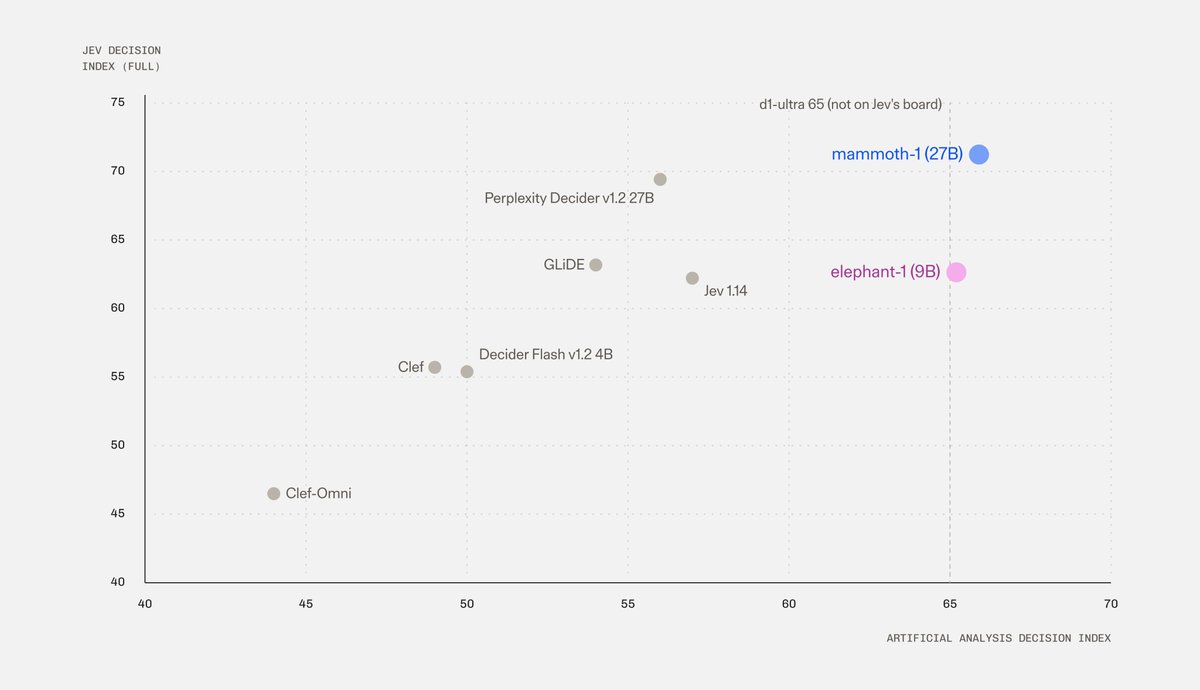
Today we’re releasing two decision models, elephant-1 (9B) and mammoth-1 (27B), trained by the @baselabs team, available for free for one week on our Model APIs.
mammoth-1 is #1 on the Jev Decision Index and elephant-1 is tied for #1 on the Artificial Analysis Decision Index.
It’s a new model, but more importantly, this is an open-source model you can access, deploy, and post-train on Baseten (or wherever you do your best work).
The free week ends 10/27/26 at 11:59 PM PT. Try it and let us know what you think.
Try mammoth-1 here: https://t.co/x8oDALMuyZ
Try elephant-1 here:
https://t.co/fmCGb3eGth
Today we release mammoth-1 and elephant-1!
We post-trained mammoth-1, the #1 ranked best decision model in the world, and elephant-1, which is the best model under 15B (and beats Jev).
We're open-sourcing all model weights and provide a technical report detailing all our training and data methods.