Köçek Dance: The Dance of Boys in the Ottoman Court
The Turks arrived in Anatolia in significant numbers from the eleventh century onwards, gradually establishing their rule over territories that today form part of Turkey.
Among the cultural practices that flourished in Ottoman society was the Köçek dance. It involved young boys, often recruited from non-Muslim communities, who dressed in women's clothing and danced to entertain the Ottoman court and predominantly male audiences.
These boys were not simply entertainers. Historical accounts also document their sexual exploitation by wealthy patrons and members of the Ottoman elite.
The practice flourished particularly between the seventeenth and nineteenth centuries. In 1837, Sultan Mahmud II prohibited Köçek performances, reportedly because of disorder and violent rivalries among Janissaries and spectators. However, this prohibition also formed part of a wider transformation of Ottoman society. European influence and Westernising reforms increasingly reshaped attitudes towards gender, sexuality and public entertainment, contributing to the eventual decline of the tradition.
Yet the dance did not disappear entirely. Today, adult Turkish men still perform Köçek dances, although the performers and social context differ from the historical institution of dancing boys.
The image on the right depicts Köçek dancers during the 1720 celebrations organised by Sultan Ahmed III for his son's circumcision, as recorded in the illustrated Surname-i Vehbi.
A contemporary example of the dance, performed by adult men in Turkey:
https://t.co/w832Mpk8jZ
More videos below.
🎭 The dark history behind Turkey’s Köçek dance.
The word Köçek comes from a Turkish word meaning “young” or “small,” referring to the young male dancers who performed for the Ottoman elite. Dressed in elaborate costumes, they entertained audiences with expressive dances—but some also suffered sexual exploitation by powerful patrons.
The tradition declined in the 19th century amid changing social attitudes and growing European influence. Today, it survives as a cultural legacy, though its history reveals a darker side behind the spectacle.
#Köçek #OttomanHistory #TurkishCulture #TurkishDance #HiddenHistory
Europas ledare har lyckats med ett otroligt geopolitiskt hattrick: Man gjorde sig beroende av Ryssland för energi, Kina för handel och USA för sin säkerhet, och har på något vänster lyckats bli ovän med alla tre samtidigt.
Ett rent mästerverk i självskadebeteende.
TURKEY’S IDENTITY PARADOX: A TURKISH LOOK LABELLED “FOREIGN”
Poor girl. In Turkey, she is called a “foreigner” because of her eyes and appearance—even though the very features that set her apart reflect a historical Turkic look far more closely than the idealised, white European image promoted by modern Turkish nationalism.
As she explains in the video, people tell her: “You look foreign. Your dad is Turkish, but you look like your mother, so you’re a foreigner.”
Let that sink in: she has a Turkish father, yet people call her foreign because of the very features associated with Turkic ancestry.
And this is the same delusion imposed on Kurds and other ethnic groups: they are expected to conform to an artificial national identity that denies their distinct histories, identities and indigenous roots.
#Turkey #Kurdistan #TurkicHistory #Identity #IndigenousPeoples #Nationalism #History
TURKEY’S CLIMATE SUMMIT OR ECOLOGICAL WAR CRIME?
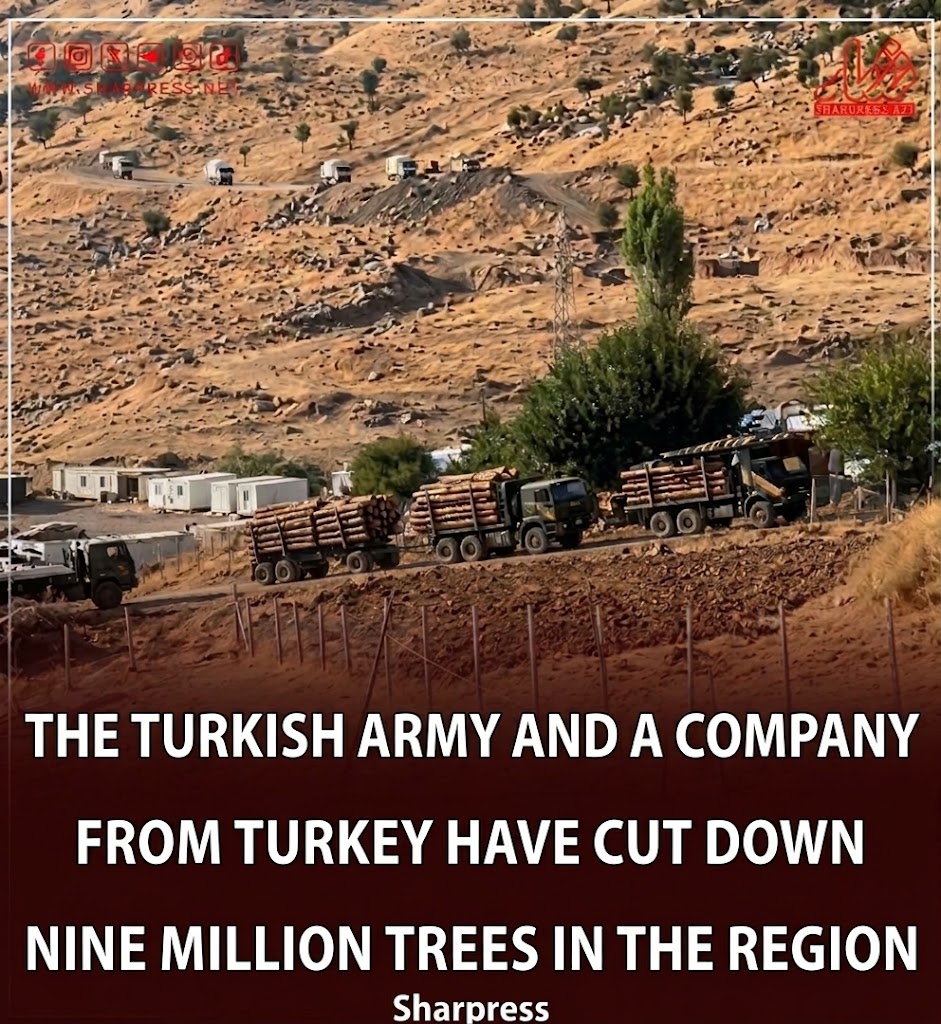
While Turkey prepares to host the UN Climate Change Conference (COP31) in 2026, its army is destroying the woodlands of Kurdistan.
This is not climate leadership—it is greenwashing. The world must not allow a climate conference to become a shield for ecological destruction and war crimes.
The scale of the devastation is visible in this video.
#Duhok #Turkey #Ecocide #Deforestation #ClimateChange #WarCrimes #COP31 #COP31Turkey #COP31Antalya #ClimateJustice #StopEcocide #Greenwashing #Kurdistan #ClimateAction #UNFCCC
The Turkish army, together with a company, has reportedly cut down nearly one million trees in the Duhok area of Southern Kurdistan, according to Sharpress.
While armies elsewhere plant forests, a NATO member’s military is reportedly contributing to the destruction of Kurdistan’s forests and environment.
#Duhok #KRG #Kurdistan #Ecology #Deforestation #Environment #TreeFelling #Iraq #Sharpress #BreakingNews #MiddleEast