In the Brazilian Amazon, large landholders strategically donate to local politicians, who promote agriculture in return – with negative environmental consequences. https://t.co/SyRnXkiLZI
How does international trade shape firms’ CO₂ emissions? 🌍⚙️
I’m on the #econjobmarket 25/26.
PhD candidate in Econ @ KU Leuven (IO group).
Environmental IO & trade.
JMP: https://t.co/17q95z4jtR
Site: https://t.co/oLSifP2hwO
#EJME#EconTwitter
Economics Journals as Tennis Tournaments
🧵(for an extremely niche audience)
Quarterly Journal of Economics = Wimbledon
The oldest and most influential event, but also clubby, snobby, and elitist. To win it you must train on a very particular surface/ZIP code.
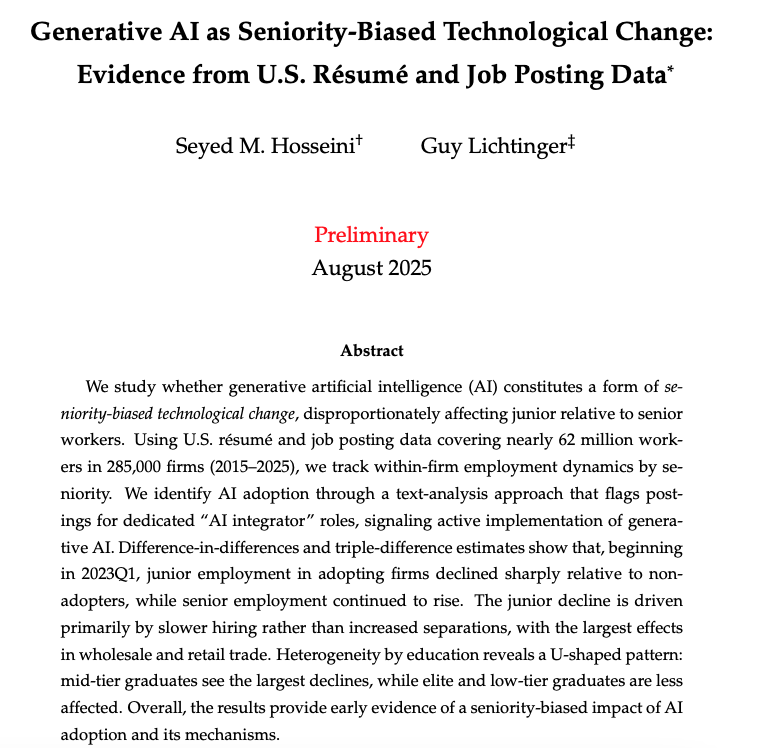
🚨1/9 In a new WP, @LichtingerGuy and I use detailed LinkedIn résumé + job-posting data on ~285k U.S. firms (2015–2025) to study a debated question: how does generative AI adoption affect entry-level employment?
(3/X) Now, my coauthors teamed up with the great @T_Giommoni to measure the economic impact of these badly designed laws with a novel measure of legal uncertainty: how often higher and lower courts disagree on law interpretation. Brilliant!
https://t.co/9urTeSwkzi
How is regional loss of manufacturing jobs linked to populism? In a new paper @PVS_journal, Michael Bayerlein, Anne Metten & I find that industrial decline in Germany shapes electoral support for left-wing rather than far-right populist parties. Thread🧵https://t.co/TlYhoImteE
What effect do ideologically extreme candidates have on voters?
"We show that in-party voters, out-party voters, and independent voters are more likely to turnout to vote and partisans are more likely to support their party’s candidate in elections with ideologically extreme candidates."
Our working paper on the impact of heat pumps on energy demand was featured in the @nberpubs’s monthly digest for February!
In our study @CentreNetZero, we found that heat pump adoption in the UK results in:
🌍 70% reduction in carbon dioxide emissions
⚡ 40% reduction in overall energy demand
This highlights the incredible potential of heat pumps to decarbonize the grid.
@a_r_schein@ColumbiaSIPA@ColumbiaUEnergy@ColumbiaCEEP@ColumbiaIGP@janrosenow@JasonBordoff
https://t.co/wgbUR80r1R
It's insanely tough to estimate 𝙝𝙪𝙢𝙖𝙣-𝙢𝙖𝙙𝙚 CO2 emissions.
However, a new approach attempts to do this in real-time.
Plus it uses free data.
Here's the breakdown:
📣 New Working Paper 📣
Are the supporters of the ruling party rewarded with jobs in the public administration?
Yes, and the effect is driven by young, well-connected, loyal supporters who can contribute to the election campaign by mobilising additional votes at lowest cost.
Evidence based on 1/2 M records of individual political preferences from #Albania 👇
https://t.co/e2lHnZ1KgH
#EconTwitter #BalkanTwitter @DriniImami
📰New Digest! Christoph Meinerding, Bundesbank, examines studies on carbon pricing's impact on firms, effectiveness in reducing emissions, stimulating green investments + influencing financial performance across implementation phases and policy designs.
📚https://t.co/ANUQr0Y2CS
Last week, I had a great time at the RIDGE Forum in Santiago, Chile, where I presented the paper 'Subsidizing Close Substitutes: The Impact of Electricity Tax Exemption on Solar Panel Adoption in Brazil,' coauthored with @PaulaPereda8.