In the UK, the government will pay 90% of a mother's earnings for 6 weeks for maternity leave pay.* It caps that support at under £200 a week for self employed mothers. A new @WeAreBrightBlue report by @BGStaniszewski says it's time to equalise support for self-employed mothers.
https://t.co/UjzVjD91Zz
*they do it through the employer, but in effect the government pays
New report from @WeAreBrightBlue calls for equalising parental leave for self-employed parents – it's currently highly biased in favour of those in PAYE employment. By @BGStaniszewski https://t.co/alqNb8dd0d
The UK government is currently considering granting cohabiting couples marriage-like pooled property rights. They hope this will protect couples. But when Finland introduced a similar proposal, the number of cohabiting couples fell. Marriage rates fell. Fertility fell.
They all fell faster than a synthetic control estimate of what they would have done without the reform – i.e., the reform caused a reduction in 2 adult households, in marriage rates and in fertility. If we want to get serious about supporting coupling and, by extension, people having their desired number of children, this reform is not the place to start.
Proud to have performed the analysis in the @csjthinktank report on this out today https://t.co/ODucoArQN4
If we want to get serious about supporting coupling, we should start with strengthening marriage. We have some ideas @Centre4FE: https://t.co/ZYRthbWsh0
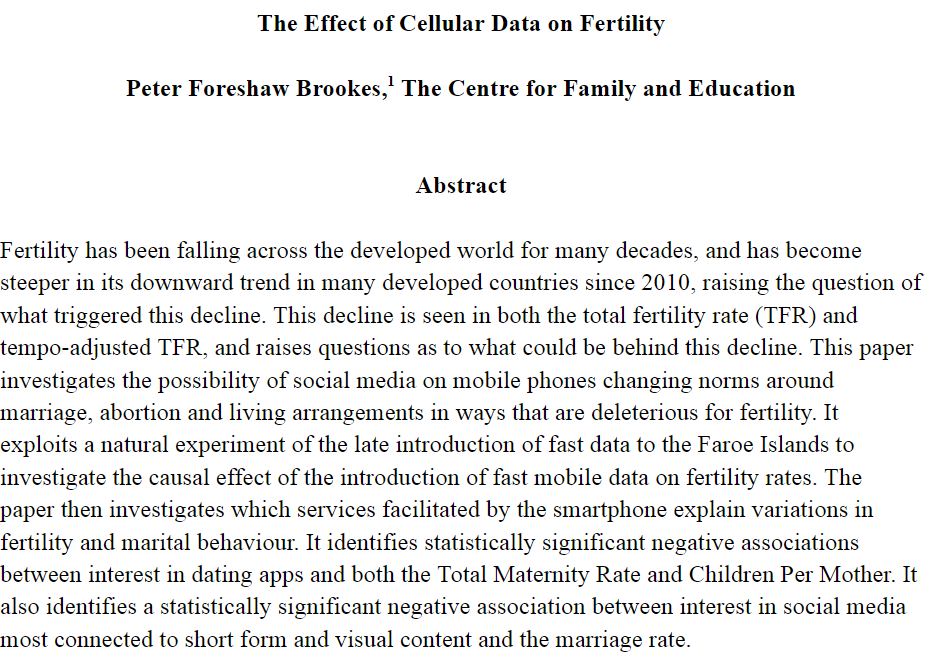
Two working papers in the past month ascribed fertility decline to the smartphone, but they couldn't tell us which aspect of smartphones do it. In this paper, I find that interest in mobile dating apps, unlike social media, leads to an immediate fall in fertility outcomes.
Two working papers in the past month ascribed fertility decline to the smartphone, but they couldn't tell us which aspect of smartphones do it. In this paper, I find that interest in mobile dating apps, unlike social media, leads to an immediate fall in fertility outcomes.
On the @MegynKellyShow, @theisabelb discusses her personal experience and IFS research about the fulfillment, meaning, and purpose people under 35 experience from getting married and having children. (1/6)🧵
A big problem with Costin Alamariu's ( @bronzeagemantis ) thesis is that the sex-obsessed lifestyle he espouses is actually anti-natal, argues @lymanstoneky in response to Alamariu's recent post, "Fertility Cult."
(1 of 2)
Read more here: https://t.co/nlADna3xa3
This piece has more holes than a sieve. It’s riddled with inaccuracies & lazy clichés about birthrates & fertility.
Articles like this perpetuate misunderstandings & lead to more women ending up childless, and regretting it.
Here are the facts: 🧵 1/
https://t.co/IrivJf9drR
@cash_regime@FamStudies At no point in the article is the claim made that disposable wages amount to the totality of the opportunity cost. But it does make the—correct—claim that raising disposable wages, ceteris paribus, increases the opportunity cost. And yet the income effects overruled this!
When Iceland increased the “opportunity cost” of fertility by increasing returns to work, fertility rose. Peter Foreshaw Brookes of @Centre4FE reports on his new study
Read more here: https://t.co/NFNnS7MFie
‘I do?’ a new report by @csjthinktank reveals UK marriage rate has collapsed. Why does this matter? Because most people want to get married; marriage protects against loneliness & abuse; married relationships much less likely to break down; married people have more children 💍 👶🏻
'These figures don't so much show a decline in marriage... It's a real collapse!'
@Miriam_Cates speaks with Luke Taylor of the Centre for Social Justice discusses new figures revealing only 2% of men are married by the time they reach 25.
"What is driving the collapse of marriage among young people? It is notable that marriage rates peaked in the 1970s following the post WWII housing boom, after more than 6 million homes had been added to Britain’s housing stock."
Me✍️in @telegraph https://t.co/5aeb1AFjK5
The first plenary session on Day 3 of the World Governments Summit featured Paul Morland in a discussion titled “The Great Demographic Shift: The Government’s Role.”
"At 8 billion as we are today on the globe, we live better and longer. We eat better food and drink safer water. We’re more educated. Better house and clothes than we had when we were 4 billion."
@MorlandDemog
'People are not properly informed.'
Peter Brookes highlights the misconceptions around IVF as figures reveal less than one in five women understand how low the success rates are.
📺 Freeview 236, Sky 512, Virgin 604
Become a Friend of GB News: https://t.co/RxzT9yFXwS
@AlexNowrasteh@cremieuxrecueil It seems an open question if the benefits paid weren't contingent on work, and therefore didn't directly increase the opportunity cost. Meanwhile, the Alaska dividend seemed to increase the fertility of single women (SCM paper out last year). Looking forward to investigating more
Research after research finds that finances have a significant effect on family formation and family size, we must get rid of this blatant myth that effects are only ever transitory
Excellent to see this new essay collection out from Bright Blue at a time when new thinking about how the State best serves families is both urgent and important https://t.co/AcA0YC0RLa