Millions of discounted shares can hit the open market the day a private placement hold period ends.
https://t.co/i8RxTlO0Jy Plus shows you that free-trading date ahead of time, with a live countdown inside the company’s channel.
It also tracks SEDI insider filings, so you can follow which insiders are buying and selling their own stock.
Track the cheap paper. First month free, then $20/month. Cancel anytime.
EarthLabs Reports Results for the Third Quarter of 2026
Read the Full PR: https://t.co/vqA4G5xtgu
◼️ Advertising and sponsorships revenue of $2,842,221 as compared to $2,189,792 for the three months ended September 30, 2025, an increase of 29.8%;
◼️ Subscription revenue of $351,944 as compared to $313,641 for the three months ended September 30, 2025, an increase of 12.2%;
◼️ Net investment gains of $5,427,513 from our investment portfolio as compared to $23,138,120 for the three months ended September 30, 2025, a decrease of 76.5%;
◼️ Net income and comprehensive income of $4,693,031 (basic earnings per share of $0.03) as compared to $20,288,958 (basic earnings per share of $0.15) for the three months ended September 30, 2025.
"The third quarter was our best of the year so far," said Denis Laviolette, Executive Chairman and CEO of EarthLabs. "Advertising and sponsorships revenue grew 30%, subscriptions grew 12%, and our portfolio delivered gains for the seventh straight quarter, while total expenses came in below last year. Through nine months, advertising and sponsorships revenue is up more than 50% and has nearly matched what we generated in all of 2025. We ended September with nearly $85 million in cash, amounts due from brokers and investments. We know markets are tough right now, but pullbacks are when capital and an audience are worth the most. We have both, and we intend to keep putting them to work in our media platforms and in the best opportunities we see across mining."
TSXV: SPOT | OTCQX: SPOFF
73.65 m of 0.95% copper with 1.05 g/t gold.
$CAM.V Cascadia Minerals cut it in hole CD-26-064 at its Carmacks project in the Yukon, starting 322.21 m downhole.
With silver and molybdenum counted, the company puts it at 2.03% CuEq.
The hole is the highest up-dip test so far in the Zone 2000S extension.
According to Cascadia, this year’s drilling has more than doubled the zone’s strike length, with Zone 2000S running at least another 400 m toward Zone 147.
Assays for 15 of the 39 holes drilled in 2026 are still pending.
https://t.co/i8RxTlO0Jy Plus ranks the interval in the top 5% of Cascadia’s drilling.
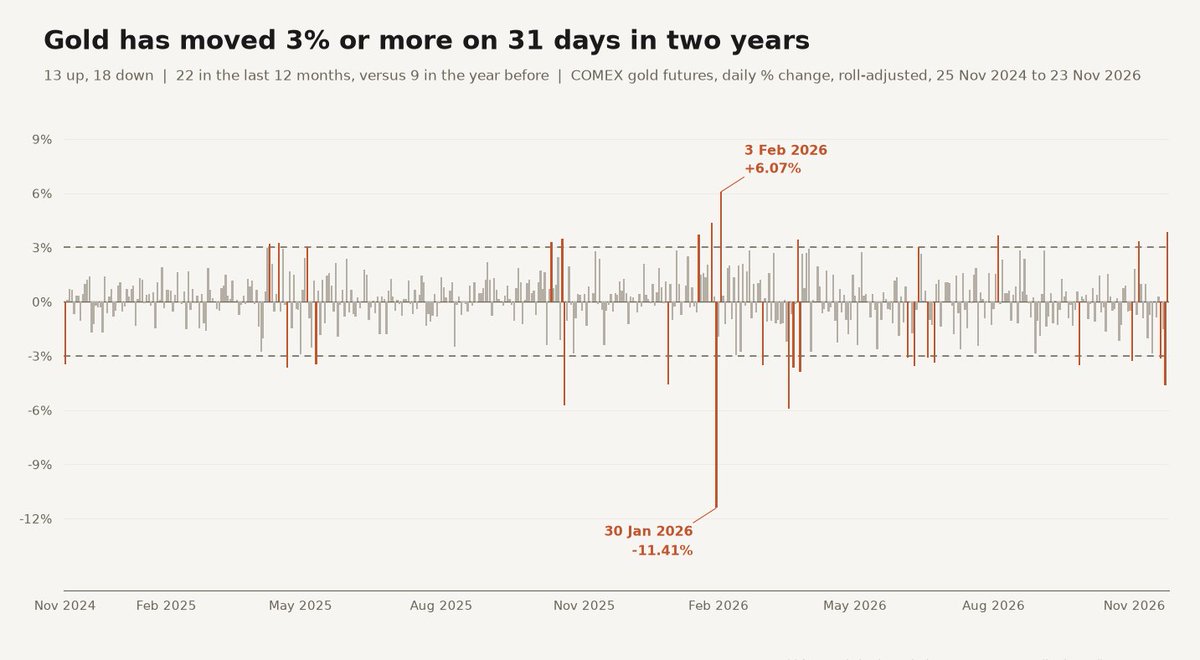
Gold has moved 3% or more in a single day 31 times in the last two years.
Four of them have come this month, and three in the last five sessions: down 3.2% Wednesday, down 4.6% Friday and up 3.9% Monday.
In this week's Chairman's Briefing:
-Scottie Resources $SCOT.V delivers another spectacular round of high-grade gold at Blueberry📈
-US copper booked for China as tariff bet unwinds🌍
-Marimaca $MARI.TO intersects 102m of 1% copper at Pampa Medina🤔
Read & subscribe: https://t.co/uH8QpZjF2T
In Partnership With: @monteromining & @buffalopotash
Lab Report - powered by https://t.co/eqFpIa32h7
Here is the show for November 23, 2026.
https://t.co/Lsk28siimj
Hello, everybody, and thank you for joining me today. It's Allan Barry Laboucan with the Lab Report, powered by https://t.co/eqFpIa32h7. The mailbag of how things can change from day to day is full today, so we're going to start with that. Then I've got my deep dives. I've got some good companies on the roster for that: Banyan Gold, Graycliff Exploration, Canadian Gold Resources, Maple Gold Mines, and Sitka Gold. Canadian Gold Resources and Maple Gold Mines are new names to the Lab Report, I believe.
Before I get started, I do want to mention something. We've got a pleasant surprise coming up on Friday, I think. Tentatively, don't hold us to it, but we're probably going to be doing Friday live streams. I'm stoked about that. Usually Fridays are a slow news day, so I can summarize the week of deep dives, and I want some live-stream interviews and Q&A happening. You can start sending emails our way if you have questions. I hope you will join us, because we're using a really cool platform where your questions will pop up on the screen.
Okay. So, how things can change in a day. The mailbag is crammed full today. One of those is NVIDIA reinstates Jensen Huang. The second coming. The resurrection has happened. And boy, the stock's up. It's up 32% as I'm doing the show, or $40 per share. I guess they cleaned up the image, if you will. All of a sudden he's not such a bad guy, too big to fire. Jensen's coming back. He's going to run his baby. I saw this morning that NASDAQ was up pretty aggressively. What a difference a day makes. I got kind of lucky, because I played some out-of-the-money calls that I thought he would get reinstated, so I'm kind of a happy camper today. Game on with NVIDIA.
I just noticed Anthropic is down a percent today. So maybe the backbone, or the foundation of AI, is more important than the AI engines today. We'll see how that plays out. Everything was kind of soft on Friday, because AI was ending, according to many people. Cash in your tickets. Today it's game on again.
And more on the mailbag that I am really excited about, secondly, is the gold market, up a hundred and fifty bucks today as I'm doing the show. Silver up two and a half, or six percent. Copper up. Oil down. Just on Friday, or all of last week, the soft bulls I call them were throwing in the towel. It's going down to three thousand. Look out below. Even the Wall Street "experts" were ratcheting down their projections, and gold came storming back today.
Earlier I was talking with one of my buddies about how he's been noticing almost a perfect correlation between oil and gold. This weekend it sounded like Trump is putting the war off until January at the earliest. I think what he's doing is trying to look for an exit ramp to get the hell out of there. Oil got smacked today, down three percent, and gold's up four point three, four percent, so outperforming the downward move in oil. A lot of people were getting shaky last week. But the reasons to be bullish on gold have only gotten better. We ran up to record highs, and we came off a significant dip. The death spiral of debt, the cost of servicing it, and the broken fiat currency system continue to get worse, and the central bankers continue to buy. A lot of commentators are price sensitive. Price is what you pay, value is what you get, and the value proposition has only gotten better as the price is coming down. This is not a reason to throw in the towel. I see you out there. We saw you panicking.
These Wall Street teams get pulled around by the nose on price, ratcheting estimates up and down with the tape. I think that is becoming the new golden indicator. That's the reality of bull markets, folks. They have significant pullbacks inside of long-term bull markets. When the Wall Street guys are dramatically ratcheting up their estimates, it's probably time to start thinning out. When they are max bearish, it's time to be getting more bullish. We're seeing the ramifications of that from Friday to Monday. Does that mean we're out of the woods? Of course not. You never know when these turning points happen.
All right. So that's my mailbag on how things can change very quickly in the metals prices, in the tech world, in the AI world. So let's get into the deep dives.
The first one today is Banyan Gold. Banyan Gold intersected 1.67 g/t gold over 32.2 metres in the Airstrip-Powerline gap at AurMac, Yukon. This gap area has me very excited, because in the previous studies that was sort of looked at as having no value. It does certainly look like the southern and the northern, and the gap in between, are connected, but they didn't do the drilling until recently to connect them. Now that they're being connected, not only do I think that this could push the resource over 10 million ounces, I think it could also have a very positive effect on the economics. I have been feeling for a long time that Banyan's days are numbered. There just aren't very many eight- to ten-million-ounce resource projects out there that could be open-pit mined and have roads and power all around them. That's the kind of thing majors not only want, but need, because they're mining out their reserves every day and that cupboard is pretty bare. So when one comes into that cupboard like Banyan Gold, this is why I think its days are numbered.
The official resource at AurMac, so you have the scale, is an Indicated Mineral Resource of 3.639 million ounces of gold, 167.3 million tonnes at 0.68 g/t, and an Inferred Mineral Resource of 4.985 million ounces, 267.2 million tonnes at 0.58 g/t. The Airstrip deposit hosts a notably higher-grade Inferred Mineral Resource of 405,000 ounces, 15.1 million tonnes at 0.84 g/t, which these results are focused on extending.
Tara Christie, President and CEO, talks about hole AX-26-910. She says it gives us a clear follow-up target in the Airstrip-Powerline gap. The hole intersected 1.67 g/t gold over 32.2 metres, including 31.3 g/t gold over 1.5 metres, in the Cal 2 horizon. I would interject there that open pits are being operated at a half a gram these days. So in an open-pit environment, this is very high grade, and it's over a nice thick intersection. The release describes Cal 2 as a lower sulphide-replacement horizon in calcareous metasedimentary rocks. We interpret this intercept, and an earlier intercept of 15.87 g/t gold over 2.2 metres in AS-25-817, roughly 500 metres away, to occur in the same horizon. Wow. Follow-up drilling will test the widths and how continuous the higher-grade mineralization extends between those intercepts and down-dip. The same hole also cut a separate high-grade quartz vein in the footwall, 1.1 metres at 18.60 g/t gold, which they plan to test in 2027.
This project is very special in the Yukon. Usually projects up there are very remote, they don't have road access. You basically got to build a town, run it on diesel. In this case, they got roads going right beside the project, and a power line right on it. That's why it's called the Powerline zone. That gives them a much longer exploration period. They're going to be drilling right into the December holiday and then cranking it back up in January. Most Yukon projects have already packed it in for the year. And some of the areas they want to drill, actually the gap itself, is more beneficial to be drilled when the ground is frozen.
These results were after the cutoff date for Banyan's Preliminary Economic Assessment and were not incorporated into the mineral resource model used for that study. Resources and PEAs are a snapshot in time. Since that PEA cutoff, Banyan has completed over 225 drillholes totaling over 69,000 metres, with the 70,000-metre program ongoing into December.
Green flags all over the place. They give you the plan map, the cross section, and a long section, and this is a pit-constrained resource, so they're not messing around with that resource. They show you the core. I can't find a yellow flag in the way that they're reporting anywhere. They give you all the data that's needed right at your fingertips.
The company has a very good audience, almost 500,000 shares of average daily trading. That's an absolute green flag. That tells me Tara is doing a great job at telling the story. They traded 1.2 million shares today. Their market cap is 618 million Canadian dollars. They're up 8.8 percent, or ten cents a share. They came off like practically every company in the mining sector, but now they're recovering nicely.
Where do I put them on the Lassonde Curve? I think that they're running up nicely up the left side of the Lassonde Curve, while they're also doing work that puts them in the development-discount window. So they're withstanding this kind of sell-off and still moving up the left side, because they do have a lot of drilling left to do. Not all companies in the development-discount window are created equal. Sometimes that window, that death valley, can last 10 to 15 years. When I'm looking for companies in that window, I want to see a management that has a game plan to get through it as rapidly as possible and move up the right side of the Lassonde Curve. Having said all that, I don't think that Banyan is going to get the chance to mine this, or even start building a mine. I think that they're a high-probability candidate to get taken over. And I think that that takeover would be at well over a billion Canadian dollars, most likely closer to two billion, is my guess. It's a guess. Don't quote me on that, please, unless you say it's a guess, and there's big ifs in there. My spidey senses are telling me that there's majors out there that are getting ready to jump on this one, because if they don't, they'll get beaten by somebody else. Do your homework on Banyan Gold.
The next company is Graycliff Exploration, who updates the market on progress at its Shakespeare Gold Project. This is a 100% owned project, less than 100 kilometres west of Sudbury, Ontario. They've completed 1,580 metres of drilling in 2026, logged and split the core, and sampled all potentially mineralized intervals from eleven holes drilled so far this year. Very good. Small program, but very good work. We've received the assays from the first five holes, released on November 5, 2026. Four of those five holes were noted to contain visible gold. Additional detail on these holes can be found in Graycliff's updated presentation on the website. Yellow flag for that, because they should be putting that data in the news release, in my opinion. The samples from the remaining six holes are either at ActLabs for analysis or on the way to the lab. Receipt of the first five holes took longer than anticipated. I get tired of hearing this. Everybody knows the labs are slow.
Senior management met last week in Toronto to review the detailed results and cross sections of all 75 holes drilled to date, totaling 14,550 metres. Another yellow flag, because you mentioned the cross sections and they're not in the news release. It is worth noting that visible gold was identified in 40% of those holes. If you've got visible gold in that many holes, put together a map with the drill traces and plot where it is. I will go look at that presentation. 95% of the readers of this news release will not.
Their Chairman and CEO is James Macintosh, and he has a very brief quote: "Our drilling has been and will continue to be focused on identifying and increasing the confidence in the detailed location and grade of the mineralized gold zone in the area proximal to and below the historic Miller Shaft." Now, wouldn't that be a wonderful picture to put to the story?
They trade 157,000 shares a day, which is pretty good until you put it into the context of a 17-cent stock. I give them a passing grade on the way they write news releases, although I don't see Graycliff management on a lot of interviews. Today they traded 66,000 shares, less than half of their average daily volume. They are up 26%. But they only have a 3.23 million dollar Canadian valuation. So their cost of capital is going to be high, and they're going to need more capital to do bigger programs than 1,500 metres. They'll probably say they don't want to do a big private placement because it's too dilutive. Well, in my opinion, that's delusional. They got to raise money, bite the bullet, and do a serious job about communicating that.
Where do I put them on the Lassonde Curve 2.0? I think they're being treated like they're not drilled into anything and they're just purely a concept, way over to the left of my chart. They're being treated almost like a glorified shell. You got to get out there and tell your story like a pit bull on a bone. You got to be relentless in this stuff, folks. Do your homework on Graycliff Exploration.
All right, Canadian Gold Resources, a new name. I don't think I've ever talked about Canadian Gold Resources on the Lab Report, powered by https://t.co/eqFpIa32h7. They were pleased to announce assay results from the 2025/2026 diamond drill program at the Lac Arsenault Gold Project, on the Gaspé Peninsula in Québec. Are you telling me that they're just getting 2025 drill results out? We're almost at the end of 2026. They're really on the slow boat. The drilling program intersected several high-grade gold-bearing intervals, including 6.01 g/t gold over 1.35 metres, including 11.75 g/t gold over 0.60 metres. Okay, that's a nice number, but kind of thin. A previously reported intercept of 19.50 g/t gold over 1.00 metre, from March 3, 2026, in drill hole LAC-25-BM-001, is also included for context. Selected gold assay results. Okay, so these are selective. And 15.00 g/t over 0.40 metres, within a broader interval of 1.97 g/t over 5.30 metres, in LAC-25-BM-010.
Management commentary, Ron Goguen, Interim Chairman and Interim President and CEO of Canadian Gold. Red flag there, folks. I don't like this interim stuff. Bite the bullet, find somebody else to take it over, or become the CEO. He says they are pleased with the results of their first diamond drilling program at the Baker and Mersereau targets at Lac Arsenault, and that the results provide a clear direction for the next phase of exploration, with the ultimate objective of defining a significant gold deposit. The Gaspé Project encompasses a substantial land position. In addition to Lac Arsenault, the Robidoux property is an advanced exploration target supported by historical high-grade gold intercepts and the recovery of a high-grade gold bulk sample. They have also identified additional exploration targets associated with the Grand Pabos Fault structural corridor. Cool. Structure, structure, structure.
I don't really care about surface channel sampling. That's not the truth machine, and I'm not saying this company has high-graded samples, but I don't pay attention to splashy high-grade surface numbers as a general thing.
The exploration model was based on significant IP chargeability anomalies identified with a geophysical survey completed in 2020, encompassing Baker and Mersereau. Green flag. They included the IP. Green card also for nice cross sections. Some nice zones, with very patchy drilling in between. I would guess these zones continue quite nicely. They're parallel, and they just haven't drilled beyond the edges of this upper and lower domain. Green card, green card, green card.
When I see a hundred and thirty thousand shares trading on a three-cent, three-and-a-half-cent stock, they're dropping the ball. Today they've traded two and a bit times their average daily volume, 284,000 shares, flat on the day, and a measly 2.08 million Canadian valuation. They are being valued not much better than a shell with nothing, so their cost of capital is going to be high. And the fact that they have an interim CEO and chairman kind of tells me that they don't have a champion yet. Without a champion, you're going to have low volume, low market cap, and a high cost of capital.
Where do I put them on the Lassonde Curve? I'd have to make my left side go way back here. They are absolutely being valued like a pure concept with moose pasture in the middle of nowhere, when that's not the reality. They have drilled into something, but the story's just not resonating. And I put that most of the time on the management. Do your homework on Canadian Gold Resources.
The next company for a deep dive is Maple Gold Mines. This is also a new name to the Lab Report, I believe. Maple Gold is pleased to announce that it has initiated a Preliminary Economic Assessment on their 100% owned Douay/Joutel Gold Project, located along the Casa Berardi-Douay Gold Trend in Québec, Canada, my favorite jurisdiction in Canada. The PEA is targeted for completion in the first half of 2027. The company has appointed global engineering firm DRA Global Limited as lead consultant, with support from Norda Stelo for environmental baseline studies, tailings, water management, and waste rock characterization; SGS Canada, I still call it Lakefield, for metallurgical test work; and SLR Consulting in Canada for mineral resource estimation. The PEA is expected to evaluate an integrated development scenario combining the open-pit and underground deposit at Douay with the higher-grade underground deposit at Joutel.
President and CEO Kiran Patankar says: "Initiating the PEA is a major step forward for Maple Gold. This inaugural study is expected to provide a disciplined framework for evaluating Douay/Joutel's economic potential and an initial set of project metrics, including scale, capital intensity, operating costs, mine life, economic sensitivities and opportunities for future optimization. It will incorporate all 2026 drilling and evaluate Douay and Joutel together as a single integrated project. We look forward to sharing the results with shareholders in the first half of 2027." Putting economic numbers on it, very good.
But I really like when management understands where they are on the Lassonde Curve. Doing a PEA puts them in the development-discount window. You cannot fight the Lassonde Curve. I'm just learning about this company, so I can't tell you if they've got a game plan to move aggressively through that window. They certainly have an interesting resource. But you got to tell that story in the news release. I can see that's happening to a degree, because the company only trades 54,000 shares on a daily basis. That's nothing. It's not resonating. Yes, it has a very nice valuation, 140 million, but doing a better job engaging investors could help the valuation. Today they've traded 48,000 shares, a little under the average daily volume. They had a nice reaction, the stock's up four percent, or seven cents a share, to a dollar eighty-nine. They started the year at about a dollar forty-ish, were as high as $3.90, and they're currently trading at $1.89. Almost the complete round trip year over year, not quite.
I'm giving this one lots of green flags, and a yellow flag on the engagement of telling their story. It certainly looks like an interesting project. Where do I put them on the Lassonde Curve? I don't, because I haven't done enough homework on them yet. And so I'm going to leave my deep dive at that. Do your homework on Maple Gold Mines.
The last company today is Sitka Gold. Sitka Gold announces a strategic investment of $72.7 million from AngloGold Ashanti. Why do I have a lot of enthusiasm in my voice about this, folks? A couple of years ago, I started talking about a trend that I thought would develop: majors would have to start going down the food chain to explorers and developers with important projects, to see if it could move the needle for them. AngloGold Ashanti is throwing money at Sitka to see if that can be a project that can move the needle for an AngloGold Ashanti-size company. I love it. I think we've got to see more of this, because the explorers and developers have chronically been underfunded. You can see it in a company like Barrick. They're at about half of their peak production, because they've been dropping the ball on investing in exploration and development. That's the bottom line. If you don't believe me on that trend, go to my Substack at https://t.co/DBuXwdvfqP. I never delete anything.
And AngloGold Ashanti — I still call them Anglo, actually. They're still Anglo to me. One of the world's largest gold producers, with a goal of advancing the company's 100% owned, road-accessible RC Gold Project in the Yukon, Canada. AngloGold Ashanti, through its wholly owned subsidiary, AngloGold Canada, will invest a minimum of $72,765,083 to acquire a 15% stake in Sitka. I love this because it gives Sitka a boost in the money they have to bring their project forward, and it also gives them somewhat of a stamp of approval. And not only does Anglo want to become a large shareholder, they are also putting together a joint technical committee that will give Sitka access to some real smart geologists within the majors. I love that stuff. Congratulations to the team at Sitka.
Cor Coe, the CEO, commented: "We are very pleased to welcome AngloGold Ashanti as a strategic investor in Sitka. This substantial investment by one of the world's largest gold producers is a major validator for both the RC Gold Project and the Company. With our 60,000-metre drill program now complete and a strengthened treasury, we look forward to working alongside AngloGold Ashanti's industry-leading technical teams and drawing on their mine-building experience as we continue to develop this wide-open gold system." Great stuff. Congratulations to Sitka and to AngloGold Ashanti. That gives me more confidence in both companies. If you don't support the explorers and the developers, you are going to struggle to keep replacing what you mine.
Sitka has a good audience. 343,000 shares, average daily volume. I see one of their managers, although it's not Cor Coe, regularly doing interviews and presentations at in-person conferences. He does a very good job of it, engaging. A real rock guy. They traded today, very well received, 1.94 million shares. That's almost six times the average daily volume. They have a 364 million dollar valuation. A lot of green flags.
Where do I place them on the Lassonde Curve? That's challenging. I don't have enough confidence in my homework on them to place them, like whether I think that they're being valued more in the development-discount window at a discount, or do they still have the chance to go up the left side of the Lassonde Curve. I'm imagining with seventy-two million that next year is going to be a lot about drill, drill, baby, drill. Let me do some more homework on that. I just don't want to say things unless I'm comfortable, and I'm not. So I won't. Do your homework on Sitka Gold.
All right. That's my show for today. I'll remind you, this Friday will be our first live broadcast. Don't hold me to it, in case there's any technical difficulties.
@BanyanGold@GraycliffExplor@cdngoldresource@MapleGoldMines@SitkaGoldCorp@ceodotca
I’m only an idea generator. I don’t make buying or selling recommendations. You need to speak with your financial advisors and do your homework before making any investment decisions. The best place to do that homework is on https://t.co/eqFpIa32h7 and I recommend you consider the Pro Membership. I use both daily and they are crucial for me to do my homework.
All the best,
Allan Barry Laboucan
Intervals are downhole lengths. True widths have not yet been determined.
Follow Canadian Copper through https://t.co/9Mv8araTW5 Plus Drill Holes. First month free, then $20/month. Cancel anytime. https://t.co/mvYJM0LE20
54.55 metres of 0.80% copper.
At $CCI Canadian Copper's Murray Brook project in the Bathurst Mining Camp of New Brunswick, MB26-06 returned that interval starting at 29.45 m downhole.
Inside it, 33.15 m of 1.14% copper.
Inside that, 4.00 m of 2.00% copper.
https://t.co/i8RxTlOyz6 Plus flags the interval length and the metal value in the top 5%.
MB26-06 has the highest metal value of the 12 Murray Brook intervals reported today.
What happens when gold is above $4,000 but many juniors are still valued per ounce like it’s $1,500 to $2,000?
Michael Gentile thinks the market still doesn’t believe $4,000 gold is sustainable. He sees “a big value arbitrage catch-up trade” in the resource space. He expects increasing M&A to lift those valuations.
Three resource-stage companies in his 35-company portfolio have been acquired in the last 12 months.
Gold Terra Resource: Allan Barry Laboucan Highlights High-Grade Gold & Continuity 🟡
In the November 5 Lab Report, powered by @CEODotCA, resource-sector investor Allan Barry Laboucan shares his perspective on Gold Terra’s latest drilling results.
He highlights:
• 6.61 g/t #gold over 7.35 m, including 31.6 g/t over 1.1 m;
• High-grade mineralization along the Campbell Shear in Zone 103N;
• Potential to extend mineralization above and below known zones;
• The importance of grade and continuity in evaluating a high-grade underground gold system.
👉 https://t.co/t30crE99bI
$YGT.NE $YGTFF @allanbreports #Mining #GoldMining
280 g/t silver.
At $CD.V Cantex Mine Development’s North Rackla project in the Yukon, hole YKDD26-365 returned 1.0 m of 280.0 g/t silver from 99 m downhole, at the North Gold target.
The same metre carried 23.80% zinc and 3.59% lead.
Higher up the hole, it cut 1.0 m of 2.42 g/t gold from 91 m.
https://t.co/i8RxTlOyz6 Plus ranks that silver grade in the top 5% of Cantex’s drilling.
In this week's Chairman's Briefing:
-NexGold Mining $NEXG.V hits 48.62 g/t gold over 5m and 34.30 g/t over 7m at Goldboro📈
-Copper price craters as AI, tariff trades unwind, wiping $186 billion off top producers in a month🌍
-BP Silver $BPAG.V discovers high-grade Jalsuri Northeast zone with 2,620 g/t silver over 1m🤔
Read & subscribe: https://t.co/uH8QpZjF2T
In Partnership With: @StamperNamibia
Pro tip for all the Gold & Silver first timers.
The second you sell, everything will rally back.
But if you hold, be ready for more pain.
Just how it works.
Lab Report - powered by https://t.co/eqFpIa32h7
Here is the show for November 19, 2026.
https://t.co/KeLCMHOdQp
Hello, everybody, and thank you for joining me today. I've got four companies to do deep dives on their news today, including Amex Gold Mining, Sun Peak Metals, Scottie Resources, and a new name for the Lab Report, Ivanhoe Electric.
Before I get started on that, I wanted to talk about some of the market-type things that are happening today. There's been a lot going on in the artificial intelligence world. I'll never call it super intelligence, by the way. NVIDIA is going through their stuff — I talked about that yesterday. I'm also a power user of AI, and I'm also invested in it. Today Anthropic is going public. When I started recording this on the 19th of November, at 11:23 Eastern Standard Time, it had not opened yet. The initial pricing was at US$83 a share, and speculation was that it would open somewhere over a hundred dollars. I was hearing US$108, and I said that if they hit that 108 number, that gives them a two-trillion-dollar valuation. I'm not so excited about the initial price as I am about what this all means, because it directly connects to mining. While everybody's chasing these big companies like an Anthropic or an NVIDIA, they're going to need a lot of copper. I think we're seeing the ramifications of high-grading and not enough discoveries in Chile, the most important source of copper production, and that's a problem for everybody. That's why I confidently say that I expect to see US$10 per pound and higher in the not too distant future, like in the next couple of years, maybe even sooner. It's needed to incentivize putting the developers into production, and what I call the Rodney Dangerfields of the industry, which is the explorers, need to be treated like rock stars with serious financing. Unstoppable force, going to need a lot of copper. That's my story, and I'm sticking to it.
So let's go on to my deep dives. The first one today is Amex Gold Mining. Amex advances ramp development, commences power line construction and completes the mechanical garage and ventilation installations at the Perron Gold Project, their 100%-owned project near Normétal, Québec. It's literally right beside the town. The release puts the project approximately 6.5 kilometres from Normétal, and construction of the approximately 6.5-kilometre, 25-kV power line connecting Perron to the existing electrical grid is underway. That gives it tremendous infrastructure advantages. They talk about 200 metres of underground ramp development completed, marking continued progress toward the fully funded 40,000-tonne bulk sample program.
They're going at this in three phases. The first phase is the 40,000-tonne bulk sample. And that sample, when your estimated grade is about a half an ounce per ton, that's going to generate a lot of gold, and that gold will help fund, and pretty much cover, the Phase 1 mining. Then the success with Phase 1 mining will fund Phase 2 mining. What I really like is that each phase looks after the next phase. The bulk sample is already funded. In that kind of a staged process, they're not going to need to raise much money, if any. They can do it organically. And I love the way they're going about it, because the 25-kV power line is designed with capacity to support both the bulk sample and future Phase 1 mining. They're not just digging a ramp for the bulk sample. They're doing it at the size and quality needed for Phase 1. So they're kind of killing two birds with one stone. I've jokingly called it like setting down the extension cords to the transformer. That's making light of it, but it's reality — they're right beside a town that was built for mining, with a power source only about 6.5 kilometres away. The mechanical garage structure has been installed, and the majority of the bulk sample site facilities have now been erected and are nearing completion. They're 200 metres into the ramp. I believe that they get to about 800 metres of ramp, and then they start the underground construction of where they're going to take the sample from, getting closer to the high-grade rock at the Champagne Zone.
I started following this company when they were a tiny little explorer that made a discovery hole back in 2018. That portal, plus the permanent ventilation system that will be used in Phase 1 as well as the bulk sample, is the culmination of about seven and a half years of exploration. I got a warm spot in my heart because of it. Victor Cantore, President and CEO, talks about: "Our team continues to make excellent progress at Perron, advancing the underground ramp while simultaneously progressing several major infrastructure projects. Importantly, we are not simply building infrastructure for the bulk sample program but investing in facilities that will also support our future Phase 1 mining operation." To me, the proof is in the pudding. By doing this foundational work now, they are hitting the ground running on Phase 1. They won't have to build a ramp, the underground workings, the permanent ventilation or the power tie-in later, because they're doing it now. That sets them up for success down the road.
I think some people have issues wrapping their heads around it because they all want to put things into a box. But this really has no analogs. Amex is doing it because they can, because the ore body is there, it's right beside a mining town, power is right next door, and they got a management team that's been able to fund all of this from the exploration days to now. You look at the valuation, C$445 million. At that valuation, they're not trading at very many multiples of what the future free cash flow will be, if by maybe as soon as 2028 that free cash flow starts hitting the bottom line. And so therein lies an opportunity. The company only trades 124,000 shares per day, which I would give a yellow card for. I'm a numbers guy, and the ultimate test is the average daily volume. Having such a spectacular story and only trading 124,000 shares is why they get a yellow card. I still think there's a certain amount of people thinking it's too good to be true. I don't think it is, and I think as they get that ramp in, they're going to show you it's not. Although today it's traded 548,000 shares.
Where do I put them on the Lassonde Curve? They are being priced, I think, like one-third into my sweet spot in the development discount window of the Lassonde Curve, before they start moving up the right side. But while they're doing that development work, they're also doing a lot of drilling. Not only do they have the Champagne Zone, they got several other zones within about a one-kilometre radius, and a very large land package that extends out of Québec into Ontario and up towards the Casa Berardi mine. The cream of the crop — companies like an Alamos, companies like an Agnico Eagle — increase their production, replace their production, and keep very good controls of their cost and their free cash flow. And I'm hopeful, as a shareholder of Amex, that they go on that trajectory. But time will tell. Do your homework on Amex.
That Amex is such a special company. I can't stop myself from blathering on about it. If I was only forced to own one gold company, that would be it. I just think that the company is doing the steps to become a five- to ten-billion-dollar company in the next two to three years, yet they're only trading at about a C$450 million valuation. And it's not speculative. When they get to Phase 1 mining, they're going to be making $200 million in free cash flow. Put a normal multiple on that, about 10x, and 10 times 200 is two billion. So I think it's a five- to ten-bagger. Five-bagger just if gold stays where it is today. If it goes up, six or seven thousand dollar an ounce gold, this company's going to be making $500 million per year free cash flow. That's free cash flow, buddy. Not cash cost, not all these bullshit accounting games. There's a long, long distance between revenue and free cash flow, and a lot of accounting bullshit in between. When you get to that free cash flow number, that is the ultimate test. No bullshit in free cash flow. That's what's in the bank.
The next company for today's deep dives is Sun Peak Metals, who mobilizes a third drill rig to Safra and provides an exploration update in Saudi Arabia. I am very interested in Saudi Arabia because in the last couple of years the government has opened its arms wide to foreign companies, but most of them are playing it slowly. Well, we'll wait to get drilling. Sun Peak is a first mover in drilling into something. I think Saudi Arabia could be an important source of metals in the future. Why have they been able to move so quickly? The management has a lot of experience in this geological environment, especially in the Arabian-Nubian Shield. And boy are they hitting the ground running, because they're hitting volcanogenic massive sulphides, with some very high grades in the copper and gold end of things.
The November 19 release is an exploration update, not a new assay drop. Sun Peak has added a third diamond drill rig to its ongoing 3,000-metre program at the 93 square kilometre Safra VMS project, is now drilling its 21st hole at Safra this year, and is on track to move directly into its maiden drill program at Al Miyah in December. The current program is testing extensions at Safra Main as well as targets at Safra North and Safra East. The first assays are expected by late December. The company has thirteen exploration licences totalling 1,072 km² across Saudi Arabia. Greg Davis, President and CEO, talks about: "With a third rig now turning at Safra, we remain on track to complete the current program and move directly into our maiden drill program at Al Miyah in December. We expect to be drilling multiple targets across our Saudi portfolio in the first quarter of 2027."
This company is firing on all cylinders. Green cards everywhere for this company on the work. I don't know Greg Davis from Adam, but what I do is what I've seen them doing, and that's a lot more important than marquee people on your board doing part-time work. These guys are doing it the right way: aggressively, first mover, experience in the geology, three drill rigs on the property. Considering all that, the company still only has a C$47 million valuation, and they only trade on average about 48,000 shares per day. So this is the first yellow-to-red card that they're going to get. Even today, only traded 33,000 shares while I'm recording this at around 12 o'clock Eastern Standard Time. They're down 2%, or $0.005, to 24.5 cents. What they could do better, and move off that yellow-to-red card, could also help the valuation and their cost of capital. I think this company is pretty well financed for their near-term plans over the next year or so. But yeah, I really like this story actually.
Where they fit on the Lassonde Curve: they're purely moving from concept to discovery. But I think they're being priced more like they're pure concept, and haven't even really entered into my green sweet spot on the left side of the Lassonde Curve. That's an opportunity, a great time to be doing your homework, because I think they got something serious there. Maybe they get a discount because they're in Saudi Arabia. But it's changing very rapidly, and Sun Peak is a leader in that first-mover status of getting the truth machine on the ground. Do your homework on Sun Peak Metals.
Scottie Resources intercepts 25.5 g/t gold over 14.00 metres and 120.0 g/t gold over 1.50 metres at the Blueberry Contact Zone. This has got me interested. My gosh, 25.5 grams over 14 metres. That's a monster of a hit for an underground high-grade system. The road-accessible Scottie Gold Mine Project, which includes the 100%-owned historic mine and adjacent Blueberry Contact Zone, is located 35 kilometres north of Stewart, British Columbia. This latest batch has significant high-grade intercepts across the Blueberry, Fifi and Lemoffe vein systems, reinforcing grade and continuity of the established mineralization. I'm going to throw a big green flag for this, because everybody in the mining business says grade is king. I think they're wrong. Grade plus continuity is king. If you have a little bit of high grade over there and some more over there and some way down there, that's not going to make a mine. What you need is continuity. So when they talk about grade and continuity, I love that. Another green flag. This supports the potential conversion of Inferred to Indicated resource. I think they can not only start production using a direct-shipping-ore model, but then keep growing and finding more.
Hole SR26-560 returned 25.5 g/t gold over 14.00 metres, including 17.6 g/t gold over 8.00 metres at Blueberry 3 (including 29.5 g/t gold over 4.50 metres) and 72.1 g/t gold over 3.00 metres at Blueberry 4, located about 20 metres beyond the existing PEA stope outline. That's a big grade and a big intersection. Love it. Hole SR26-522 intersected 120.0 g/t gold over 1.50 metres, approximately 20 metres below the modelled Blueberry 5 vein. The system is just juiced up with a lot of high grade. These days anything over four or five grams is high grade, and this is a big grade and a big intersection. The 2026 drilling program has concluded, with 61,578 metres drilled across 227 holes, and assay results for the majority of holes still outstanding. Results will inform the company's updated Mineral Resource Estimate and Feasibility Study, both targeted for the first half of 2027. Dr. Thomas Mumford, President and CEO, talks about: "The results we're seeing from the Blueberry Contact Zone continue to impress, and this latest round of drilling is no exception." That is an understatement. I am somewhat almost overwhelmed by the high grade that they're following. Green card for that. Underpromise, over-deliver. This is more than compelling, folks. Green flag for having a plan view. My mentor in geology always told me, Allan, look where the metals are in the individual drill hole, and then how those holes line up relative to each other. It's kind of like connecting the dots. I love this project. I'm becoming more and more in love with it all the time, every time they drill a hole.
Now they do get a red card for the average daily volume. 36,000 shares is a failing-grade red card. I think they're dropping the ball on broadening their horizon, because this is a fantastic story. They only have a market cap of C$166 million, which is very modest for what they have. Today they got great news: 25,000 shares of trading halfway into the trading day. That's pretty dismal. Nice to see that it's up 3.2%, or six cents a share, to $1.95. And also we see gold start to turn around, which I think we're near the bottom now, maybe within the bottom 10% of the correction. They got a ton of catalysts and an exciting story, and they need to up their game on telling that story, because I certainly believe it has a project of merit that warrants a higher valuation.
Where do I put them on the Lassonde Curve? They're kind of in this feasibility transition to the development kind of area. That's a good place to do your homework on, because not all companies in the development discount window are the same. What you want to look for is companies that can fast track through that window and then move up the right side of the Lassonde Curve. Why do I think they can be one of those special situations? They got road access. They're near the town of Stewart, B.C., in a mining-friendly jurisdiction in the Golden Triangle of British Columbia. And they're using the direct-shipping-ore model. Instead of the big expense of building a recovery plant, they're going to ship their high-grade material, because they can — not all can do that — to a facility that can extract the gold from it. Easier to permit, less costly to bring into production: those are the signs that they can move through the development discount window and start moving up the right side of the Lassonde Curve. Do your homework on Scottie Resources.
The final deep dive for today is from Ivanhoe Electric, who discovers breccia- and carbonate-hosted copper-gold-silver mineralization at its Gleeson project in southeastern Arizona. First of all, Arizona is the Nevada of copper production in the United States. What Nevada does for gold production, Arizona does for copper production. These carbonate-hosted systems are in the same family as a porphyry. They come off of the porphyry, and they can also lead you to it. There's one of those carbonate replacement systems being developed right now by South32 in Arizona, I might add.
Before I get into the bullets, a mid-show update on Anthropic, because I looked up at CNBC while I was getting started here. Officially, Anthropic opened at US$111.50, and news reports said that opening price implied a fully diluted valuation of nearly US$2 trillion. It had softened up a little bit from the open, but was still up about 20% from the US$83 issue price on my screen. Wow. Lots of attention. Okay, let's get on to Ivanhoe.
The Gleeson Project is located on private land, 28 miles north of the famous and historic Bisbee Mining District. Private lands are really important because that helps you with permitting. Intercepts include 123.60 metres grading 0.91% copper, 0.44 g/t gold and 5.27 g/t silver from 601.70 metres in hole CGD26-TR-003, including 71.03 metres at 1.38% copper, 0.52 g/t gold and 6.73 g/t silver from 640.32 metres. Drilling is occurring on a small portion of Ivanhoe Electric's land package, consisting of approximately 20,000 acres of mineral rights and over 2,000 acres of private surface rights — the release later puts that at over 19,606 acres of mineral rights and 2,033 acres of private surface rights. Two drill rigs are active, with further assays to be received in coming weeks. So they're tagging into something, and they're rolling up their sleeves and getting after it.
This news comes from Executive Chairman Robert Friedland and President and CEO Taylor Melvin, reporting the discovery in the first drill holes on private land at the Gleeson Copper-Gold Project, in the historical Courtland-Gleeson Mining District. Mines in the Bisbee Mining District produced from 1880 to 2013, exploiting similar breccia, carbonate and intrusive-hosted deposits. Results from the first eleven completed drill holes have discovered two separate, significant mineralized domains at Gleeson below low-angle faulting. Copper-gold-silver breccia has been logged spanning an area of approximately 500 by 500 metres, from 600 metres depth, pinching out in the east to over 380 metres downhole thickness in the south-west, and remains open in multiple directions.
Senior Vice President of Exploration Alex Neufeld talked about: "The initial drill holes at Gleeson are the most impressive I have seen in my 20-year career at an early-stage exploration project." That's a big statement. I can't disagree with that. I don't know about the most — maybe because I've been at this exploration thing for 30-some years — but he's been at it 20 years and likes what he sees. He says at this early stage it may be analogous to the mineralization that underpinned more than a century of historic mining at Bisbee. So basically, what's he saying? This could be Bisbee 2.0. Green card right there. 71.03 metres at 1.38% copper — now you're getting into some real juicy underground-mining kind of numbers.
They talk about the Gleeson project having suddenly become the company's highest priority exploration project. Says a lot to me. "These initial drill results are some of the best copper-gold-silver intercepts drilled in the western United States in the last ten years." If you want to test them on that, just plug that into your AI. These results provide a glimpse into what they think could become a major new copper-gold-silver district less than 30 miles north of historic Bisbee. Miners at Bisbee extracted over 200 million tonnes of ore over a 133-year period. The release later puts that at over 207 million tonnes of ore. They say Ivanhoe Electric controls a district-scale land package, with Gleeson being the focus of what they believe is the best copper-gold-silver exploration project in the United States. Well, the old truth machine will answer that question. District scale, to a retail investor, means they've got a large enough land package and they think they can find multiple deposits. Below 1,000 metres depth, intrusive and carbonate-replacement hosted copper-gold-silver-zinc mineralization has been discovered, logged over 800 metres of north-to-south extent, 600 metres east-to-west, and a strong vector to the west. Complete assays are in for the first seven holes, with partial results for two and assays pending for the remaining four. The drilling plan includes expanding the program to complete a total of 16,000 metres by the end of 2026. Drilling began in November 2025.
I love seeing Robert Friedland in exploration. There is nobody better than Robert Friedland when it comes to telling these exploration stories. As you can expect from an amazing exploration communicator in Robert Friedland, they get absolutely green flags everywhere, because they included everything that every company should. If a company wants a template on how to communicate what they're doing, watch Mr. Robert Friedland. They got a $1.34 billion valuation. I don't know enough about the project to really comment on how I see that as far as a valuation. They only trade a modest 58,000 shares, but I think that's in Toronto. I'm doing my homework in real time on https://t.co/eqFpIa32h7. I later saw about 35,000 shares of average daily trading, which is pretty modest for a Robert Friedland deal. Yeah, they do trade on the NYSE American, same symbol, IE, as in Toronto. I would imagine usually the volume is about 10 times higher in the United States. Got to talk to the technical people at https://t.co/eqFpIa32h7 — we're only seeing Toronto with the same symbol. My guess is they trade about 10 times that in the States. Where do I put them on the Lassonde Curve? I'm not going to put them anywhere on the Lassonde Curve, because I don't know enough about the project. They're just getting into drilling it, and they're hitting some good numbers. I won't place them anywhere on the Pierre Lassonde curve as of yet. Need to do more homework. Do your homework on Ivanhoe Electric.
All righty, folks. That's the show for today, November the 19th.
@AmexGoldMining@SunPeakMetals@ScottieCorp@ivanhoeelectric@ceodotca
I’m only an idea generator. I don’t make buying or selling recommendations. You need to speak with your financial advisors and do your homework before making any investment decisions. The best place to do that homework is on https://t.co/eqFpIa32h7 and I recommend you consider the Pro Membership. I use both daily and they are crucial for me to do my homework.
All the best,
Allan Barry Laboucan