Here’s a brand we do CRO for…
2 weeks in, we’re at 4.69% for the day.
There is not a “magic” formula that boosts your conversions, it’s proven structures & good copy that speaks to your audience.
Message me “CRO” if you are interested in optimizing your Shopify store.
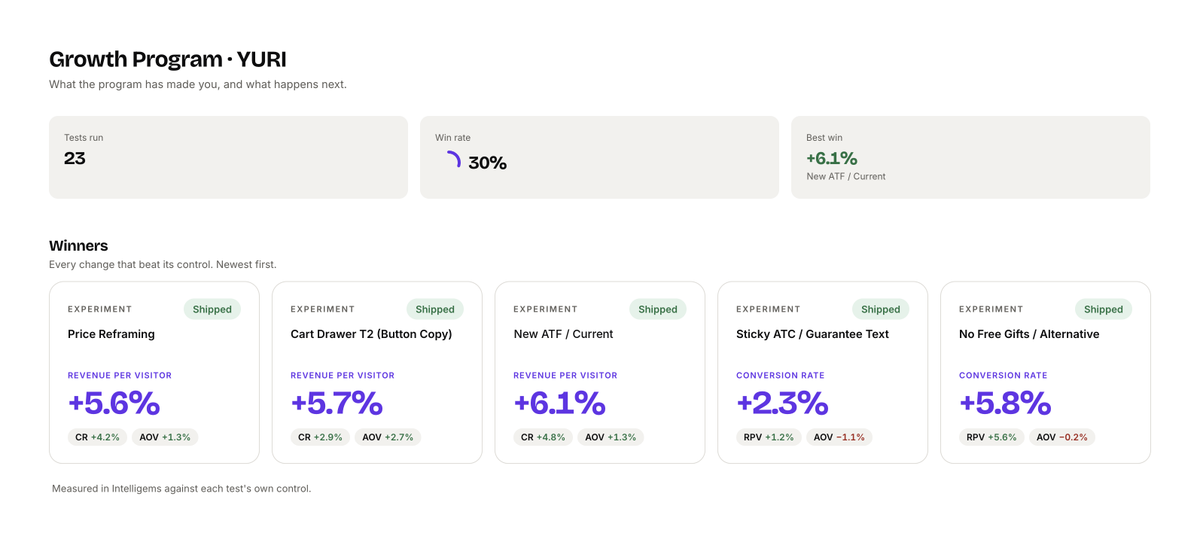
We’ve run 23 A/B tests for YURI. 16 of them lost.
YURI sells a collagen mask, and we’ve been running their testing program for 1 month.
23 tests. 7 winners. A 30% win rate.
Every one of those 16 losers was an idea someone was sure about. Including me.
What the 7 winners taught me:
1) The winners were small. Reframing the price: +5.6% revenue per visitor. Changing the button copy in the cart drawer: +5.7%. Nothing that makes a nice before and after.
2) Conversion rate can lie. Our sticky Add to cart test lifted conversion by 2.3%. But average order value dropped 1.1%, so the real gain was half of what it looked like. We judge every test on revenue per visitor now.
3) Some of the best ideas are removals. Removing the free gift won, +5.8% conversion.
4) A losing test isn’t wasted. It’s a change you didn’t push to 100% of your traffic on a hunch.
Most stores redesign on opinion and never find out which half of the changes hurt them.
Testing is slower. It’s also the only way I know to be sure.
Every client has his own CRM, with everything about the tests. Shopify, Intelligems & Google Page Speed connected. Also more features like tasks, scheduled tests, live data & revenue added every month. For YURI, we added more than half a million on subscriptions, roughly around $630,000.
i’ve been using Manus AI to build ENTIRE google ads funnels for ecom brands and the results have been ABSURD.....
a proper funnel build used to take me 2-3 weeks
now it’s 2-3 days
- advertorials
- listicles
- comparison pages
- quiz funnels
you name it - manus oneshots it
so I’ve decided to document the entire workflow I’m running with it...
here’s what’s included inside the guide:
- the competitor intelligence prompt
(pulls live data on the top 10 brands' landing pages, angles, and credibility signals, then runs a gap analysis. you find the angle nobody is running, so it doesn't fatigue like the saturated angles do.)
- keyword mapping by funnel stage:
(builds a full map by intent tier, 20 keywords per stage, each mapped to the landing page that actually converts it. "magnesium glycinate" and "why can't i sleep" are different intents. they don't belong on the same page.)
- funnel type selection
(picks the right format per stage - advertorial, comparison page, listicle, quiz, vsl, pdp - and hands you a testing roadmap. a cold supplement buyer needs a totally different pre-sell than a gadget enthusiast.)
- advertorial copywriting
(one prompt pulls real audience language off reddit, amazon, and forums. the next writes a 900-word advertorial that reads like a journalist wrote it, not a marketer. highest-leverage copy you can put in front of cold traffic.)
- the campaign architecture document
(outputs the full blueprint a media buyer runs from. naming convention, ad group structure, match types, bid sequence, negatives, 30-day launch plan. the part most agencies keep in their head, so nothing is ever replicable.)
- the branding audit
(scores the brand 1-5 on domain, photography, social proof, founder presence, and credibility before you spend a dollar on cold traffic. the best campaigns won't save a page that doesn't look legit.)
all backed by experience of scaling my pet brand to 7-figures with google ads
like + comment "MANUS" and i’ll DM you the link
(must be following + RT for priority access)