Introducing Ceres, a marketplace for commodity trade finance.
Each vault is structured by a named curator, funded by lenders and repaid by the trade it finances.
Priced by the trade, not the postcode.
Banks turn down 41% of trade finance requests from smaller businesses, according to the Asian Development Bank.
Those businesses still need financing, and lenders have capital to deploy. Ceres is the marketplace between them.
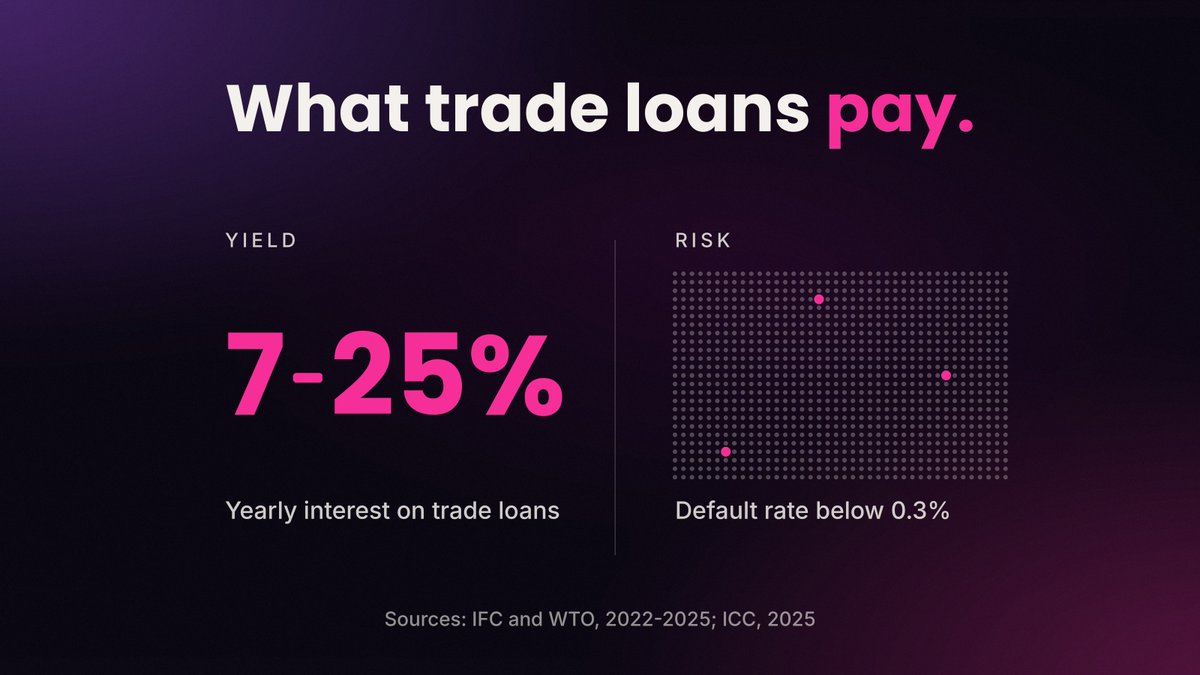
Trade loans in emerging markets charge 7 to 25% a year. Worldwide, fewer than 3 in 1,000 trade finance loans default.
So far, banks have kept most of that interest. On Ceres, you don't need to be a bank to earn yield by financing commodity trades.
Trade loans can cost as much as 13 to 25% a year across the world. Some traders get no loan at all.
Even with a sound cargo and a reliable buyer, the rate is the bank's call, based on the borrower's country, size, and sector.
On Ceres, the price follows the trade.
Every vault page on Ceres lists its terms in the same order, regardless of the curator. You can compare any two vaults line by line.
• Enforced by the contract: currency, access, close cadence, notice to exit, redemption, early exit, seniority, and minimum deposit.
• Stated by the curator: target return, security, documents, its name, and the publication date.
Every term is on the page before anyone deposits.
Every vault on Ceres has a named curator. It does the work a bank's credit team does today.
1. Sourcing. Finds the trade and decides whether it belongs in a vault.
2. Underwriting. Takes the credit decision and sets the terms.
3. Documentation. Lists the contracts, the security, and the documents on the vault page.
4. Monitoring. Values the vault at each close and reports to lenders.
That is why terms differ from vault to vault.
Every vault on Ceres has four parties, and each has a specific role.
• The borrower brings a documented trade that repays the vault.
• The curator underwrites the trade, structures the vault, and publishes the terms.
• The lenders deposit into the vault on the published terms.
• Ceres runs the marketplace and keeps one record of every vault. It never lends, sets the rate, or holds funds.
The same commodity trade can be financed in two ways.
One goes through a bank, a credit committee, and a yearly review. The other runs on one page of terms 🧵
Behind that number are real trades that never got funded.
On the other side, trade finance stays on bank balance sheets, a market most lenders can't reach today.
Businesses can't get financing on fair terms, and lenders can't reach the deals.
Ceres is built to change both. Businesses get access to a global rate, priced by the trade wherever they are based. Lenders get access to markets that were closed to them.